27 October, 2014

Ronald Reagan: A Time for Choosing


As a Millennial American, I was too young to pay attention to political and social events during the Reagan Administration.  As an adult I have come to appreciate Ronald Reagan for his ability to establish a vision for the country and to articulate principles to help the national achieve that vision.  Today marks the 50th anniversary of a campaign speech Reagan issued on behalf of Barry Goldwater during his ill-fated candidacy for president.  I want to point out a few items:
  • Note now much of Reagan's speech is spent on substance (almost all of it).  His is not an emotional message, but one based on facts that illuminate and articulate the benefits of limited government.
  • It is amazing how relevant his message is to today (indeed, many of the cited problems are much worse).  We continue to have the same conversations about the same issues 50 years later, and the arguments against the status quo are as applicable today.  This is a testament to the difficulty of reversing the tide of leviathan government.  Government rarely shrinks; instead, it continues its unending march to tax, spend, and coerce more in the pursuit of power.
  • Note to Conservative and Libertarian candidates running for office - take this speech apart point by point and you have a fantastic platform upon which to base a campaign today.  We could also learn something from the delivery - highlighting facts and the failure of government action does not make you uncaring or cold; we highlight those facts and lack of effectiveness because we care and believe society deserves better.  And that message can be delivered with warmth and a smile, with the promise of a brighter future. 


Ronald Reagan’s ‘A Time For Choosing’ Is 50 Years Old Today: Does It Hold Up?

By Brent Moody
OCTOBER 27, 2014

October 27, 1964. The Saint Louis Cardinals had just beaten the New York Yankees in seven games to win the World Series. “I Want to Hold Your Hand” by The Beatles was the number-one song of the year. In politics, Arizona Republican Barry Goldwater was one week away from an electoral thumping at the hands of Lyndon B. Johnson in the presidential election.

President Johnson’s campaign had likely scored the knockout blow with his campaign’s famous, perhaps infamous, Daisy television ad. A young girl is seen plucking petals from a daisy just prior to a nuclear mushroom cloud exploding, implying that Goldwater was reckless and dangerous. Later in life, Goldwater opined that this ad started the barrage of personal attack ads that became standard operating procedure in political campaigns.

The Goldwater campaign and the Republicans needed something. That something came in the form of Ronald Reagan’s landmark televised address, which would become known as “A Time for Choosing.” As we mark the 50th anniversary of the address, it is appropriate to reflect on its content and significance.

The overarching significance of the speech is that it set the stage for Reagan’s later political success and outlined his core political philosophy of limited government. Even beyond the generalities of the proper relationship between the citizen and the state, it is amazing how the actual details of the issues Reagan discussed are still relevant today.

Consider the finances of the federal government. Reagan noted that the federal government had not balanced a budget in 28 of the past 34 years and maintained deficit spending of $17 million per day. This predicament should sound very familiar to the contemporary observer. Our current 2014 projected federal deficit spending is $1.33 billion per day. Adjusted for inflation, our debt rises ten times faster per day, every day, than in 1964.

From 2008 to 2012, the U.S. federal government posted yearly deficits in excess of $1 trillion. Never in our history have we been so fiscally unbalanced. Even at the height of World War II, our highest yearly deficit did not reach the $1 trillion threshold in 2014 dollars. Reagan also discussed our national debt: after all, deficits are simply a pathway to debt. In 1964, our cumulative national debt stood at $316 billion . At the end of 2014, we will be carrying nearly $18 trillion in debt. Adjusted for inflation, our per-person debt is nearly four and a half times what it was in 1964.

Our debt is not a function of too little money flowing into the federal coffers. Federal receipts are at an all-time high. When adjusted for inflation, per-person receipts are more than double what they were in 1964. Washington’s ability to rake in more and more money is not shared by the American family, which has seen its real income fall every year since 2007. It is no wonder that Gallup recently found that Americans believe the federal government wastes 51 cents of every dollar it spends.

Beyond the pragmatic matter of fiscal mismanagement, Reagan used the address to highlight larger issues in the political discourse of the day, which are still a matter of great importance now. Key concepts such as the balance of freedom versus security and limitations to state authority over the citizens are woven throughout the speech.
Reagan cited the founders when he noted that a government can’t control things without controlling people and that controlling people requires force and coercion.

Sen. William Fulbright, best known now by the eponymous Fulbright program of education grants, made his way into Reagan’s remarks. Reagan cited the senator’s lament at Stanford University that the Constitution is outmoded, antiquated, and unnecessarily restrictive of centralized executive power. These fundamental concepts of the meaning and application of the Constitution in today’s modern world are still with us. Are you in the original meaning camp? Do you read the language of the document and believe its framers meant what they said? Or, do you believe, like Fulbright did, that the Constitution has outlived its usefulness? These questions are beyond the scope of this dissertation. However, consider that many constitutional questions, such as the Affordable Care Act, may be very narrowly decided, say 5-4 by the Supreme Court. In essence, one person, one person out of 320 million, functionally decides what the government can compel of a citizen.

Reagan clearly was worried about this relationship, this critical interaction between the citizen and the state. He noted that the founding fathers sought to minimize the power of the centralized government. Reagan cited the founders when he noted that a government can’t control things without controlling people, and that controlling people requires force and coercion. He discussed the nature of regulation and bureaucracy as a source of this coercion.

1964 was the height of the Cold War, and the Cuban missile crisis was fresh in the public’s mind, so it is not surprising that Reagan dealt with foreign affairs in the address. His main argument was against the notion of fighting the Soviet threat to a draw. Detente with the Soviets was not Reagan’s end goal. Since 1964, countries formerly under the control of the Soviets, such as Poland and East Germany, have emerged from the Russian shadow. But here we are 50 years later and the Russian Bear is again showing its teeth. There is trouble in Ukraine and a passenger jet has been shot out of the sky.

Despite the deteriorating state of American and Russian relations, one of the 2012 presidential candidates saw fit to mock the other who expressed concerns about the Russian threat. Reagan famously referred to the Soviets as an “Evil Empire.” Despite some criticism and backlash against the Evil Empire speech at the time, Reagan once again proved to be right.

If you are like me, one of the 220 million Americas not yet alive in 1964, I recommend you watch Reagan deliver the address. It is readily available online and equally, or perhaps more, relevant today than when he gave it. Fifty years later, our world in many respects is remarkably the same. Our challenges have not changed, only amplified. History tends to repeat itself. The Cardinals nearly made it to the World Series and Paul McCartney is still making music.

Reagan closed powerfully, succinctly, and with clarity. “You and I have a rendezvous with destiny. We’ll preserve for our children this, the last best hope of man on earth, or we’ll sentence them to take the last step into a thousand years of darkness.” Would you disagree with this poignant observation today? Are we currently fulfilling that promise to our children, or are we paving for them the road to darkness and despair?

24 October, 2014

Barack Obama, bewildered bystander


Barack Obama, bewildered bystander


By Charles Krauthammer 
Opinion writer October 23 at 7:50 PM

The president is upset. Very upset. Frustrated and angry. Seething about the government’s handling of Ebola, said the front-page headline in the New York Times last Saturday.

There’s only one problem with this pose, so obligingly transcribed for him by the Times. It’s his government. He’s president. Has been for six years. Yet Barack Obama reflexively insists on playing the shocked outsider when something goes wrong within his own administration.
Charles Krauthammer writes a weekly political column that runs on Fridays. View Archive
RSS

The IRS? “It’s inexcusable, and Americans are right to be angry about it, and I am angry about it,” he thundered in May 2013 when the story broke of the agency targeting conservative groups. “I will not tolerate this kind of behavior in any agency, but especially in the IRS.”

Except that within nine months, Obama had grown far more tolerant, retroactively declaring this to be a phony scandal without “a smidgen of corruption.”

Obamacare rollout? “Nobody is more frustrated by that than I am,” saidan aggrieved Obama about the botching of the central element of his signature legislative achievement. “Nobody is madder than me.”

Veterans Affairs scandal? Presidential chief of staff Denis McDonough explained: “Secretary [Eric] Shinseki said yesterday . . . that he’s mad as hell and the president is madder than hell.” A nice touch — taking anger to the next level.

The president himself declared: “I will not stand for it.” But since the administration itself said the problem was long-standing, indeed predating Obama, this means he had stood for it for 5½ years.

The one scandal where you could credit the president with genuine anger and obliviousness involves the recent breaches of White House Secret Service protection. The Washington Post described the first lady and president as “angry and upset,” and no doubt they were. But the first Secret Service scandal — the hookers of Cartagena — evinced this from the president: “If it turns out that some of the allegations that have been made in the press are confirmed, then of course I’ll be angry.” An innovation in ostentatious distancing: future conditional indignation.

These shows of calculated outrage — and thus distance — are becoming not just unconvincing but unamusing. In our system, the president is both head of state and head of government. Obama seems to enjoy the monarchial parts, but when it comes to the actual business of running government, he shows little interest and even less aptitude.

His principal job, after all, is to administer the government and to get the right people to do it. (That’s why we typically send governors rather than senators to the White House.) That’s called management. Obama had never managed anything before running for the biggest management job on earth. It shows.

What makes the problem even more acute is that Obama represents not just the party of government but a grandiose conception of government as the prime mover of social and economic life. The very theme of his presidency is that government can and should be trusted to do great things. And therefore society should be prepared to hand over large chunks of its operations — from health care (one-sixth of the economy) to carbon regulation down to free contraception — to the central administrative state.

But this presupposes a Leviathan not just benign but competent. When it then turns out that vast, faceless bureaucracies tend to be incapable, inadequate, hopelessly inefficient and often corrupt, Obama resorts to expressions of angry surprise.

President Barack Obama says he's cautiously more optimistic about the Ebola situation in the U.S., and that the virus has given the government the opportunity to try out the public health system. (AP)

He must. He’s not simply protecting his own political fortunes. He’s trying to protect faith in the entitlement state by portraying its repeated failures as shocking anomalies.

Unfortunately, the pretense has the opposite effect. It produces not reassurance but anxiety. Obama’s determined detachment conveys the feeling that nobody’s home. No one leading. Not even from behind.

A poll conducted two weeks ago showed that 64 percent of likely voters (in competitive races) think that “things in the U.S. feel like they are out of control.” This is one degree of anxiety beyond thinking the country is on the wrong track. That’s been negative for years, and it’s a reflection of failed policies that in principle can be changed. Regaining control, on the other hand, is a far dicier proposition.

With events in the saddle and a sense of disorder growing — the summer border crisis, Ferguson, the rise of the Islamic State, Ebola — the nation expects from the White House not miracles but competence. At a minimum, mere presence. An observer presidency with its bewildered-bystander pose only adds to the unease.

22 October, 2014

Why welfare, mimimum wage make it harder for poor Americans to succeed

Why welfare, mimimum wage make it harder for poor Americans to succeed


By John Stossel
Published October 08, 2014

Fifty years ago, President Lyndon Johnson declared “War on Poverty.” It sounded great to me.

I was taught at Princeton, “We’re a rich country. All we have to do is tax the rich, and then use that money to create programs that will lift the poor out of poverty.” Government created job-training programs for the strong and expanded social security for the weak.

It seemed to work. The poverty rate dropped from 17 percent to 12 percent in the programs’ first decade. Unfortunately, few people noticed that during the half-decadebefore the “War,” the rate dropped from 22 percent to 17 percent. Without big government, Americans were already lifting themselves out of poverty!

Johnson’s War brought further progress, but progress then stopped. It stopped because government is not good at making a distinction between needy and lazy. It taught moms not to marry the father of their kids because that would reduce their welfare benefits. Welfare invited people to be dependent. Some people started to say, “Entry-level jobs are for suckers.” Many could live almost as well without the hassle of work.

Despite spending an astonishing $22 trillion dollars, despite 92 different government welfare programs, poverty stopped declining. Government’s answer? Spend more!

Rep. Paul Ryan, R., Wis., chairman of the House Budget Committee, points out that government measures “success” by the growth of programs: “based on inputs, how much money are we spending, how many programs are we creating, how many people are we putting on these programs -- not on outcomes -- how many people are we getting out of poverty? … Many of these programs end up disincentivizing work -- telling people it pays not to go to work because you’ll lose more in benefits than you gain in earning wages.”

That doesn’t mean the poor are lazy. It means they respond to incentives. They are rational about choosing behaviors that, at least in the short term, pay off.

It’s not only welfare that makes it harder for the poor to climb the ladder of success. Well-intended laws, such as a minimum wage, hurt, too.

But most people don’t understand that. Even Republicans, according to opinion polls, support a higher minimum wage. A minimum sounds compassionate. It’s hard to live on $7.25 an hour.
But setting a minimum is anything but compassionate because that eliminates starter jobs. The minimum wage is why kids don’t work as apprentices anymore, nor clean your windshield at gas stations. They never get hired because employers reason, “If I must pay $9, I’m not taking a chance on a beginner.”

To most economists, the claim that the minimum wage kills starter jobs is not controversial. But it is among the general public. And so politicians pander.

On my Fox Business Network show this week, Rep. Jim McDermott, D., Wash. says that people like Paul Ryan and I “just want to cut the size of government. And trust the private sector to do everything.”

Well … yes. The private sector does just about everything better.

McDermott says, “This whole business about somehow raising the minimum wage causes a loss of jobs -- if that’s true, why don’t we just drop the minimum wage altogether and let people work for a dollar a day or $1 an hour?”

OK, let’s do it! It’s not as if wages are set by the minimum wage.

That is a great conceit of the central planners: thinking that only government prevents employers from paying workers nearly nothing. But the reason Americans don’t work for $1 an hour is competition, not government minimums.

Competition is what forces companies to pay workers more. It doesn’t much matter that the law says they can pay as low as $7.25. Only 4 percent of American workers now make that little. 95 percent make more.

The free market will sort this out, if politicians would just let it. Left free, the market will provide the greatest benefit to workers, employers and consumers, while allowing charity as well.

It would all happen faster if politicians stopped imagining that they are the cause of everything.

21 October, 2014

Predatory Journalism

Predatory Journalism
Thomas Sowell | Oct 21, 2014


The New York Times is again on the warpath against what it calls "predatory lending."

Just what is predatory lending? It is lending that charges a higher interest rate than people like those at the New York Times approve of. According to such thinking -- or lack of thinking -- the answer is to have the government set an interest rate ceiling at a level that will be acceptable to third parties like the New York Times.

People who believe in government-set price controls -- whether on interest rates charged for loans, rents charged for housing or wages paid under minimum wage laws -- seem to think that this is the end of the story. Yet there is a vast literature on the economic repercussions of price controls.

Whole books have been written just on the repercussions of rent control laws in countries around the world.

These repercussions include the housing shortages that almost invariably follow, the deterioration of existing housing and the shift of economic resources -- both construction materials and construction labor -- from building ordinary housing for the general public to building luxury housing that only the affluent and the rich can afford, because that kind of housing is usually exempted from rent control.

There is at least an equally vast literature on the repercussions of minimum wage laws. Unemployment rates over 20 percent for younger, less skilled and less experienced workers have been common, even in normal times -- with much higher unemployment rates than that during recessions.

Against this background of negative repercussions from various forms of price control, in countries around the world, why would anybody imagine that price controls on interest rates would not have repercussions that need to be considered?

Yet there is remarkably little concern on the political left as to the actual consequences of the laws and policies they advocate. Once they have taken a stance on the side of the angels against the forces of evil, that is the end of the story, as far as they are concerned.

Low-income people often get short-terms loans when they run out of money to meet some exigency of the moment. The interest rates charged on such unsecured loans to people with low credit scores are usually higher than on loans to people whose higher incomes and better credit histories make them less of a risk.

Crusaders against such loans often make the interest rate charged seem even higher by quoting these interest rates in annual terms, even when the loan is actually repayable in a matter of weeks. It is like saying that a $100 a night hotel room costs $36,500 a year, when virtually nobody rents a hotel room for a year.

Because those who make unsecured short-term loans are usually poor and often ill-educated, the political left can cast the high interest rates as unconscionably taking advantage of vulnerable people. But similar economic principles apply to more upscale short-term lending to well-educated people who have valuable possessions to use as collateral.

A small-time businessman who suddenly finds that he does not have enough cash on hand, or readily available from a bank, to pay his employees this week, knows that if he doesn't pay them this week he may not have any employees next week -- and can face lawsuits the week after that.

There is an upscale lending market available to such people, where he can use his expensive personal possessions as collateral to get the money he needs immediately.

He can borrow more money than the poor can borrow, and at not as high an interest rate. But his interest rate can still be 200 percent if figured on an annual basis -- even though he may be able to pay off the loan next month when his customers pay him what they owe him, so he is paying only a small fraction of that hypothetical 200 percent, just as the poor are paying only a small fraction of the hypothetical 300 percent or 400 percent that they are charged.

Editorial demagoguery against "predatory" lending might well be called predatory journalism -- taking advantage of other people's ignorance of economics to score ideological points, and promote still more expansion of government powers that limit the options of poor people especially, who have few options already.

15 October, 2014

CA Soda Taxes

I struggle to understand the rationale behind this type of "nudge" taxation - if people want to drink sugary drinks, they should be able to.  The government does not have a legitimate interest in dictating what people can and cannot drink, and taxing consumption is a form of dictation (with the added benefit of government revenue!).  People can weigh the costs of consumption against the benefits they receive from drinking the product.  

That being said, at least these are ballot measures - voters will get to decide if they wish to tax or ban certain items.  This is the appropriate path to implementing the concept, even if the concept is a bad one...

Election 2014: San Francisco, Berkeley Consider Soda Taxes
FILED UNDER: Policy, Measure D, News, Prop. E, Soda Tax


(Scott Olson/Getty Images)

When it comes to the 2014 election, the Bay Area is ground zero on a fight being watched across the country. Both Berkeley and San Francisco voters are considering soda taxes.

They’re not the first cities to try to slap a tax on sugary beverages. In California alone Richmond and El Monte tried similar measures in 2012 — and failed. New York City tried to ban large servings — and failed.

If either one of the current measures passes it will be first in the country. The two proposals are similar, yet key differences might make one or the other more likely to be passed.

San Francisco’s Proposition E

Let’s start with San Francisco.

Last summer, the Board of Supervisors put Prop. E on the ballot — a 2 cents an ounce tax on sugar-sweetened beverages. And just as it has in multiple places across the country that have tried taxes, warning labels or bans on extra-large drinks, the American Beverage Association swooped in and opened its wallet.

San Francisco is currently flooded with TV and radio ads paid for by the Beverage Association. It’s poured in $7 million and counting, on track to be the most corporate money ever in any San Francisco campaign.

So why are cities so intent on taxing sugary drinks? They say it’s a health issue. Dr. Robert Lustig specializes in pediatric endocrinology at UC San Francisco where he treats a lot of children with diabetes.To Lustig, sugar is the enemy of good health. “Sugar goes to your liver and makes your liver fat which causes all the chronic metabolic diseases we know about: type 2 diabetes, heart disease, hypertension, lipid problems.”

Sugar-sweetened beverages are concentrated doses of sugar. For example, a can of Coke has nine teaspoons’ worth. That extra sugar is helping drive up the rate of type 2 diabetes, among other illnesses, Lustig says.

The idea of a sugary-beverage tax is to make those drinks, not just sodas but other beverages such as energy and sports drinks, more expensive. Then consumption will go down, says Prop. E co-author San Francisco Supervisor Scott Wiener. That’s what happened in Mexico after its soda tax took effect on January 1.

Soda Tax Affect on Consumption

“Mexico with a smaller soda tax experienced a quick 10 percent drop in consumption,” Wiener said. Since San Francisco’s tax is bigger than Mexico’s, the consumption could decline as much as 31 percent, according to an analysis from the city and county’s office of economic analysis. Wiener said that effect would be “huge.”

A huge drop in consumption could lead to a huge drop in revenue for beverage companies. The American Beverage Association’s spokesman in the Bay Area is Roger Salazar. “We think taxing people for the food and beverage choices they make is just bad policy in and of itself,” Salazar said.

He argues that a tax leads to job loss. The Beverage Association paid for an economic analysis, which forecast the tax would cost 1,000 jobs in San Francisco. Salazar says people running corner grocery stores, for example, work on tight margins and any extra expense can cost jobs.

But San Francisco’s tax is estimated to bring in $35 to 54 million a year. Supervisor Wiener says that money is specifically earmarked for nutrition and physical activity programs, mainly in schools and parks. “It will actually create jobs in those areas,” he said. Wiener says the city’s own economic analysis found only limited job loss.

But because Prop. E’s funds are earmarked funds, a two-thirds supermajority of San Francisco voters needs to approve it. That’s different from the soda tax measure across the bay in Berkeley.

Berkeley’s Measure D

Berkeley’s Measure D would mandate a penny-an-ounce tax. Unlike San Francisco, the proceeds, estimated at a million dollars per year, are not earmarked. That means Measure D needs only a simple majority to pass — 50 percent plus one vote.

That approach failed in the California cities of Richmond and El Monte in 2012. Many people didn’t trust the money would be spent on health programs. Berkeley’s Measure D does create a panel of health experts to advise the City Council on health programs worth funding. But this promise doesn’t satisfy self-described liberal Jill Hershman. The longtime Berkeley resident says she is voting against Measure D. “Even though the city council has promised that they intend on spending the money on school and health programs,” Hershman said, “in the end, they don’t really have to, and there’s no guarantee that this measure will fund anything that helps kids.”

Still, every major candidate running for office in Berkeley — and a long list of health and community groups — support the measure.

In an effort to get its message out, the beverage association is spending big in Berkeley, too, close to $1.5 million so far. Spokesman Salazar makes a similar argument that critics made in Richmond two years ago: that this tax hits low-income people the hardest. “There are ways in which we can promote healthy lifestyle choices,” he says, “but taxing people, especially in a way that impacts the lowest income of our residents is not the way to go about it.”

Supervisor Wiener counters that it is diabetes and other health problems that are regressive. “We know the soda industry targets low income people, targets communities of color with its marketing,” he said, “and the diabetes explosion that is fueled by these drinks is worse in communities of color than it is in the broader community.”

Come election day, whatever voters decide will resound nationally. A yes vote would signal that voters think of sugar-sweetened beverages in a similar way as other health-harming products like cigarettes and alcohol. But if the liberal, health-conscious voters of Berkeley and San Francisco say no, it’s likely to make people across the country wonder, “If it can’t pass there, can it pass anywhere?”

14 October, 2014

The Mythical ‘Pay Equity’ Crisis


The Mythical ‘Pay Equity’ Crisis

Democrats won’t tell you, but equal pay for women is already the law.


By GERALD SKONING
Oct. 13, 2014 7:13 p.m. ET

As the 2014 midterm campaigns come down the home stretch, Democrats are pounding on the issue of “equal pay for women.” In his speech at Northwestern University on Oct. 2, for example, Mr. Obama said that we must “make sure a woman is paid equal to a man.” Democrats are “for equal pay for equal work,” Hillary Clinton said at a recent rally in Iowa, “and our opponents are not.” North Carolina Sen. Kay Hagan’s campaign has blasted Thom Tillis, her GOP opponent, for opposing “federal equal pay legislation.”

As a campaign issue, demands for pay equity are beside the point. Equal pay for women has been the law of the land for more than a half-century.

Democrats say we need another new federal statute to protect women because the existing panoply of federal and state laws prohibiting pay discrimination on the basis of gender are insufficient. Specifically, they have continued to press for passage of the Paycheck Fairness Act, which according to its congressional sponsors would “provide more effective remedies to victims of discrimination in the payment of wages on the basis of sex.” In reality, this bill would expand litigation opportunities for class-action lawyers seeking millions of dollars from companies without ever having to prove that the companies intentionally discriminated against women.

The Paycheck Fairness Act instead is meant to address the fact that “on average, full-time working women earn just 77 cents for every dollar a man earns,” as the Obama White House explains on its website. This is not a claim that any woman earns less than any man for the same work. Pay “disparities” between men and women generally reflect other factors such as interrupting a career to raise children, the types of jobs men and women on average choose, the type of education they have (sociology vs. engineering), etc.

Since 1963 it has been unlawful under the federal Equal Pay Act for an employer to pay a female employee less than a male employee for equal work. Sex discrimination in wages is also prohibited by Title VII of the Civil Rights Act of 1964. For employees of federal contractors and subcontractors, Executive Order 11,246 prohibits gender-based pay discrimination.

Finally, 46 states have antidiscrimination statutes mandating equal pay for equal work. While the enforcement schemes of these laws vary from state to state, the remedies those statutes provide are comparable to those available under federal laws.

Today, the Equal Pay Act and Title VII provide a woman who prevails on her wage discrimination claim a virtual smorgasbord of effective remedies. They include, but aren’t limited to, back pay, attorneys’ fees, injunctive relief, prejudgment interest, $300,000 in punitive and compensatory damages, an additional $10,000 in penalties, and a prison sentence of up to six months for an employer who willfully violates the law.

A government contractor or subcontractor—as some 270,000 American companies are—may face serious penalties for gender-based wage discrimination, including termination or suspension of any existing contract, and take remedial action including elimination of illegal pay practices, seniority relief, and monetary and equitable relief to identified class members.

Campaign rhetoric and simplistic election-year sound-bites can and do mislead voters into thinking that gender-based wage discrimination is a national crisis and that women have no recourse whatsoever in the face of invidious pay discrimination by their heartless employers. Nothing could be further from the truth. Several layers of tough federal and state laws protect women from pay discrimination.

Moreover, powerful federal and state agencies like the Equal Employment Opportunity Commission, the Labor Department and its Office of Federal Contract Compliance Programs, and 46 state agencies are charged with overall enforcement of the respective federal and state laws and their prohibitions of sex-based wage discrimination. In short, serious enforcement muscle is available to women who are discriminated against on payday.

So our lawmakers should ask themselves, do we really need another federal statute protecting women’s rights to equal pay? The laws already exist in spades. Those laws contain tough sanctions, generous remedies for violations, and establish powerful government enforcement agencies to pursue offenders.

Vigorous enforcement of the arsenal of tough federal and state laws prohibiting sex discrimination in wages will ensure continued progress toward the important national goal of true equal opportunity, as well as pay equity, for all. The Democrats’ populist campaign mantra about “pay equity” is empty rhetoric.

Mr. Skoning is a labor and employment lawyer in Chicago.

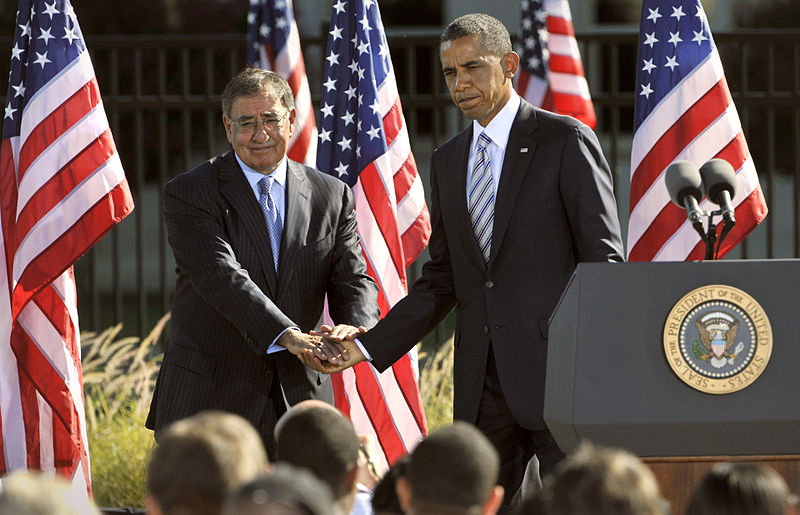
Panetta’s “Disloyalty” to the President Is How It’s Supposed to Work


Panetta’s “Disloyalty” to the President Is How It’s Supposed to Work

OCTOBER 14, 2014 By Robert Tracinski

The new memoir from former CIA Director and Secretary of Defense Leon Panetta has been aptly described as a vindication of just about everything the president’s critics on the right have been saying about his policy in Iraq and Syria.

So naturally Panetta is now a marked man. Washington Post columnist Dana Milbank, for example, is shocked—shocked!—at Panetta’s “stunning disloyalty,” and he even extends his surprise to the milder criticisms of Obama offered by former Secretary of Defense Robert Gates and former Secretary of State Hillary Clinton. (Mia Farrow went further, castingPanetta as Judas to Obama’s Jesus.)

There is an obvious hypocrisy here. Everyone loves leaks and tell-alls and criticisms from embittered former insiders—when these things are directed at a politician they don’t like. When they’re directed at your guy, they’re vicious and opportunistic and “stunning loyalty.” And of course it is a measure of the media’s sycophancy toward this president that anything less than hagiography is considered an attack.

Yet Milbank stumbles toward the real explanation of this “disloyalty,” pointing out that “Panetta, Gates, and Clinton didn’t owe their careers to Obama. Clinton was a rival, Gates was a Bush holdover, and Panetta is a Democratic eminence grise. Loyalty didn’t trump book sales—or Clinton’s need to distance herself from Obama before a presidential run.” So these people can turn against the president and throw him under the bus for a change, because they’re not dependent on him, and they have their own independent reputations and ambitions to worry about.

Rather than being some kind of problem, that is precisely the way things are supposed to work. What Milbank is missing is the whole point of the “advice and consent” provisions of the Constitution, which requires the president to seek the approval of the Senate for his appointments to prominent executive positions, particularly the kind of cabinet-level offices held by Panetta, Gates, and Clinton.

This was something America’s Founding Fathers borrowed from the English system of government, where it originated as a way to limit the power of the king. Over many centuries of struggle between Crown and Parliament, the Parliament realized that, for all his power, the king is only one man. He cannot run every aspect of the government directly, so he needs to act through his ministers and advisors. If Parliament can exercise some degree of control over whom he appoints to these posts, they can effectively limit what the king is capable of doing. Eventually, the British system ends up with a member of Parliament elected as the monarch’s Prime Minister, who runs the government on his own, with the monarch as a mere figurehead.

America’s Founders didn’t want to completely take away the power of the chief executive, but they did want to keep it limited. Hence the “advice and consent” provisions. Ideologically, the need for congressional approval serves as a reminder that these officials do not serve the president. They serve the people of the United States. As a practical matter, if a president wants to get his appointees approved by Congress, he has a much better chance if he chooses known and established political figures, they type who had reputations and careers before the president came along and who will continue to have their own interests and agenda after he is gone. Which, of course, gives those appointees some independence from the president.

Each one of these appointees knows that he doesn’t just answer to the president. He will also have to justify his actions in his future career, particularly after the president is out of office and has gone home. So he’s only going to be willing to go so far to accommodate the agenda of the president.

Does the president want to collect tax revenue? Then he has to collect it through a Secretary of the Treasury approved by Congress. Does he want to go to war—or stay out of one? Then he has to do so with a Secretary of Defense approved by Congress. Does the president want to loosen up on illegal immigration, or crack down? He has to do it (alas) through the Secretary of Homeland Security, approved by Congress. And he has to do it knowing that any one of these people might later have an incentive to rat him out for being corrupt, indecisive, overly political, or for any other fault.

If we’re seeing an unusual number of such indictments from former officials, it might just be that Obama has an unusual number of faults—which seems more than plausible, given the results of his administration.

To blame it on lack of “loyalty” misses the point. Our system is designed to discourage the kind of sycophants and yes-men who will be endlessly loyal to the president. Think about what the executive branch look like if it were populated only by people who owed their careers to Obama. This is exactly what Obama has been fitfully trying to do, going around the cabinet secretaries by appointing “czars” who answer only to the president and are creatures of his will. They will be loyal, all right. And that’s the problem.

Ours is not supposed to be a system of personal loyalty to the president. It never has been, and to expect it is an affront to the whole American political system.

06 October, 2014

DERELICTION OF DUTY ON A GRAND SCALE

I don't totally agree with Ben that the Fed should have stepped in to save any specific institution.  That sort of intervention in selecting winners and losers violates the larger principle Ben is making:  Smaller government is preferable to a powerful national government.  Federal Government activity is force - no options, no outs (except for the powerful and influential) with widespread impact on all who live in the United States.

DERELICTION OF DUTY ON A GRAND SCALE

By Ben Stein – 10.2.14


Two days ago, I came upon the front page of the New York Times for Tuesday. Now, theNYT. That’s a big paper. Prestige paper. I hate it, but it’s the big dog in the newspaper world.

And what is the lead story on page one? Armed intruder scaled a fence in front of the White House — and believe me, I worked at that White House a lot. I know that fence and it’s damned high. Then he ran across the North Lawn, supposedly one of the most heavily patrolled stretches of earth on the planet. Then he walked into the front door of the White House, which was unlocked with no guard at it. Then he ran down the main hall, and into the East Room, the most august room in the White House — and he was carrying a long knife. Finally he was tackled by a White House policeman after he was in an even more intimate room, the Green Room, used for very high powered receptions.

Again, he was carrying a knife. Mr. Obama was not there, but that’s not the story. The story is about high-level government incompetence.

It follows the amazing story of a private security guard getting onto an elevator with the President without anyone knowing he (1) had a gun; and (2) had a major criminal record.

So, that’s the first story.

The second story is about how the U.S. executive branch was warned over and over again about the power and the violence and aggressiveness of ISIS. But completely ignored the warnings because Mr. Obama was dealing with other problems like the furor over Benghazi. That was where the government basically just turned its back and allowed the U.S. Ambassador to be murdered in Libya. And when Mrs. Clinton was questioned about it, she basically said, “Well, what does it matter? He’s dead now.”

So, that’s the second story. Then the third story, the one that’s genuinely sickening, is about the roots of the crash of ’08, from which we are now finally recovering.

The story is that in 2008, the top people in charge of whether or not to let Lehman fail and thus bring on a crash were Henry Paulson, at one time, head of a huge investment bank named Goldman Sachs, in 2008, Treasury Secretary. Other players were Timothy Geithner, who, with no training in economics at all, was head of the New York Federal Reserve Bank. The key player, though, was Ben Bernanke, a Princeton professor of econ who had just recently been made head of the Federal Reserve. He had been testifying before Congress for a year that the financial system was strong and sound and a crash in real estate leading to a crash on Wall Street or Main Street was impossible.

All three men were interviewed for a recent postmortem on why the crash happened and why they allowed Lehman, at that time one of the five biggest IB’s in the world, to fail.


All three of them said that they would have liked to rescue Lehman, but they had no authority. Anyway, they said, Lehman was insolvent, so neither the Federal Reserve nor the U.S. Treasury could lend on the assets of Lehman.

Now, dear friends, I have been in the worlds of finance and government and government regulation of finance for decades. I have testified before a dozen Congressional Committees and in many federal and state trials.

I have seen a lot of fools and knaves and liars. But I have never seen such a combination of them all at once time as I saw in yesterday’s Times.

First of all, the Fed is the king of the financial jungle. It doesn’t need any rules to bail out a bank any more than a cheetah needs rules to eat a zebra. It’s the King Kong in the jungle. It can do whatever it pleases.

All Mr. Bernanke had to do was make a mild statement: “We here at the Fed would view with sorrow the failure of a bank as large as Lehman and we will make every effort to keep it afloat.”

By itself, without anything more, that would have kept Lehman intact. Lenders would have made loans to it, and it would have stayed in business and there would have been no crash and no recession. Just a whisper from Ben Bernanke would have saved millions of jobs and kept millions of Americans in their homes.

Again, the Fed doesn’t need rules. The Fed is the rules. They could have loaned on any collateral they saw fit to lend on. The ball was in their court and they just let it bounce by.

The same goes for Treasury Secretary Paulson. All he had to say was that the Treasury was going to work with the Fed to save Lehman because its survival was vital to the nation. End of story. No failure. No crash, no recession. Why didn’t he do it? Maybe bad blood between him and the head of Lehman. Maybe just plain ignorance, but it was dereliction of duty on a grand scale.

Same goes for Tim Geithner. He could have used his authority as head of the NY Fed to say he would lend against Lehman’s stressed assets — and the bank would have been saved. All three men said the cost of rescuing Lehman, about $7 billion, was too much. The losses to the nation when Lehman failed were in the trillions.

These men didn’t do even their most minimal duty. The nation and the world suffered terribly.

Now, it turned out that Lehman was in fact solvent. The selloff in it was a classic run on the bank and the feds could have stopped it by reassuring words. In the final analysis, the assets of Lehman turned out to be valuable indeed and the people who bought them at distressed prices during the bursting in 2008 made billions.

Now, why am I telling you this story?

Because government makes a lot of mistakes. An incredibly lot of mistakes. The people who run government, even at the very highest levels, are not great geniuses. And even when they are great geniuses, they make mistakes.

When you and I make serious mistakes we lose our spouse or our home or our jobs or our 401K, which is plenty bad.

But the people who run government are in control of gigantic, unstoppable machines. Their actions have the force of law. They are just humans — but with the whole power of the state behind them.

This is a good reason to be very careful who we have at the levers of power in government — and to try to keep the role of government as small as possible. Power will be abused. So let’s make sure it is out of the hands of a few willful people — as in the people who started the recession or missed ISIS. Government is a dangerous instrumentality. Sometimes needed, but always dangerous. Let’s bear it in mind. Because you call powerful idiots “the government” doesn’t mean they’re not idiots.

02 October, 2014

Mob Rule Economics

Mob Rule Economics
Thomas Sowell
9/13/2014 12:01:00 AM - Thomas Sowell


While we talk about democracy and equal rights, we seem increasingly to let both private and government decisions be determined by mob rule. There is nothing democratic about mob rule. It means that some people's votes are to be overruled by other people's disruptions, harassments and threats.

The latest examples are the mobs in the streets in cities across the country, demanding that employers pay a minimum wage of $15 an hour, or else that the government makes them do so by law. Some of the more gullible observers think the issue is whether what some people are making now is "a living wage." This misconstrues the whole point of hiring someone to do work. Those who are being hired are paid for the value of the work they do.

If their work is really worth more than what their employer is paying them, all they have to do is quit and go work for some other employer, who will pay them what their work is really worth. If they can't find any other employer who will pay them more, then what makes them think their work is worth more?

As for a "living wage," the employer is not hiring people in order to acquire dependents and become their meal ticket. He is hiring them for what they produce.

Are some people not able to produce much? Absolutely! I know because I was once one of those people.

After leaving home as a teenager, I discovered that what I could earn would only enable me to rent a furnished room about 6 by 9 feet. Instead of a closet, it had a nail on the back of the door -- which was completely adequate for my wardrobe at the time.

It became painfully clear that there was no great demand for a high school dropout with no skills and no experience.

My choices were to get angry at my employer or to acquire some skills and experience -- and try to pick up some more education, while I was at it. Even to a teenage dropout, that choice was a no-brainer.

There was no one around to confuse the issue by telling me that I was somehow "entitled" to what other people had produced, whether at the expense of the taxpayers or the employer.

There was a minimum wage law, even back in those days. But it had been passed ten years earlier, and inflation had raised both prices and wages to the point where it was the same as if there were no minimum wage law.

Thank heaven! The unemployment rate among black teenagers back then was a fraction of what it would become in later years, after "compassionate" politicians repeatedly raised the minimum wage rate to keep up with inflation.

In 1948, the year I left home, the unemployment rate among black 16-year-olds and 17-year-olds was 9.4 percent, slightly lower than that for white kids the same ages, which was 10.2 percent.

Over the decades since then, we have gotten used to unemployment rates among black teenagers being over 30 percent, 40 percent or in some years even 50 percent. Such is the price of political "compassion."

Whatever the good intentions behind minimum wage laws, what matters are the actual consequences. Many people have ideological, financial or political incentives to obfuscate the consequences.

Labor unions are the biggest force behind attempts to raise the minimum wage, not only in the United States but in other countries around the world. That may seem strange, since most union members already earn more than the minimum wage. But the unions know what they are doing, even if too many gullible observers do not.

Low-skill workers with correspondingly low wages compete in the labor market with higher skilled union members with correspondingly higher wages. Many kinds of work can be done by various mixtures of low-skilled workers and high-skilled workers.

Minimum wage rates that are higher than what most low-skilled and inexperienced workers are worth simply price those workers out of the job markets, leaving more work for union members. All the unions have to do is camouflage what is happening by using rhetoric about "a living wage," or "social justice" or whatever else will impress the gullible.

Life was tough when all I could get were low-paying jobs. But it would have been a lot tougher if I couldn't get any job at all. And a tough life made me go get some skills and knowledge.

30 August, 2014

What Leadership looks like:

In case our President needs an example, here it is from British Prime Minister David Cameron...


Highlights from the transcript:

"My first priority as PM is to make sure we do everything possible to keep our people safe. Today I want to set out the scale and nature of the threat we face, and the comprehensive we are taking to combat it."

"It was clear evidence that this was not some foreign conflict thousands of miles from home we can afford to ignore ... ISIS is a threat to our security here in the UK"

"The terrorist threat was not created by the Iraq war 10 years ago. It existed even before the horrific attacks on 9/11, themselves some time before the Iraq war. This threat cannot be solved simply by dealing with the perceived grievances over Western foreign policy. Nor can it be dealt with by addressing poverty, dictatorship or instability in the region, as important as these things are. The root cause of this threat to our security is quite clear. It is a poisonous ideology of Islamist extremism that is condemned by all faiths and by all faith leaders. It believes in using the most brutal forms of terrorism to force people to accept a warped world view and to live in an almost medieval state. A state in which its own citizens would suffer unimaginable brutality, including barbaric beheadings of those who refuse to convert to their warped version of Islam; the enslavement and raping of women; and the widespread slaughter of Muslims by fellow Muslims. And, of course, the exporting of terrorism abroad.

So this is about a battle between Islam on the one hand and extremists who want to abuse Islam on the other. It is absolutely vital that we make this distinction between religion and political ideology."

"We cannot appease this ideology. We have to confront it at home and abroad."

He then goes on to outline the guiding principles of Britain's response, namely being touch, intelligent, and comprehensive in response to the terrorist threat. They will be immediately seizing passports of suspected terror suspects, and will announce additional security measures over the next few days.

His closing:
"Britain is an open, tolerant and free nation. We are a country that backs people in every community, who want to work hard, make a contribution and build a life for themselves and their families. But we cannot stand by and allow our openness to be confused with a tolerance of extremism, or one that encourages different cultures to live separate lives and allows people to behave in ways that run completely counter to our values. Adhering to British values is not an option or a choice; it is a duty for those who live in these islands. And in the end it is only by standing up for these values that will defeat the extremism, protect our way of life and keep all our people safe. Thank you."

Or, as one Twitter post put it...
Obama: It's "unrealistic" to defeat ISIS,and we don't have a strategy anyway.
Cameron: It won't be quick, but we will defeat them.
#Contrast

06 August, 2014

Bordering on Madness

Thomas Sowell
In a recent confrontation between protesters against the illegal flood of unaccompanied children into the United States and counter-protests by some Hispanic group, one man from the latter group said angrily, "We are as good as you are!"
One of the things that make the history of clashes over race or ethnicity such a history of tragedies around the world is that -- regardless of whatever particular issue sets off these clashes -- many people see the ultimate stakes as their worth as human beings. On that, there is no room for compromise, but only polarization. That is why playing "the race card" is such an irresponsible and dangerous political game.
The real issue when it comes to immigration is not simply what particular immigration policy America should have, but whether America can have any immigration policy at all.
A country that does not control its own borders does not have any immigration policy. There may be laws on the books, but such laws are just meaningless words if people from other countries can cross the borders whenever they choose.
One of the reasons why many Americans are reluctant to keep out illegal immigrants -- or even to call them "illegal immigrants," instead of using the mealy-mouthed word "undocumented" -- is that most Hispanics they encounter seem to be decent, hard-working people.
This column has pointed out, more than once, that I have never seen Mexicans standing on a street corner begging, though I have seen both whites and blacks doing so.
But such impressions are no basis for deciding serious issues about immigration and citizenship. When we do not control our own borders, we have no way of knowing how many of those coming across those borders are criminals or even terrorists.
We have no way of knowing how many of those children are carrying what diseases that will spread to our children. And we already know, from studies of American children, that those who are raised without fathers in the home have a high probability of becoming huge, expensive problems for taxpayers in the years ahead, and a mortal danger to others.
A hundred years ago, when there was a huge influx of immigrants from Europe, there were extensive government studies of what those immigrants did in the United States. There were data on how many, from what countries, ended up in jail, diseased or on the dole. There were data on how well their children did in school.
As with most things, some immigrant groups did very well and others did not do nearly as well. But today, even to ask such questions is to be considered mean-spirited.
Such information as we have today shows that immigrants from some countries have far more education than immigrants from some other countries, and do not end up being supported by the taxpayers nearly as often as immigrants from other countries. But such information is seldom mentioned in discussions of immigrants, as if they were abstract people in an abstract world.
Questions about immigration and citizenship are questions about irreversible decisions that can permanently change the composition of the American population and the very culture of the country -- perhaps in the direction of the cultures of the countries from which illegal immigrants have fled.
During the era of epidemics that swept across Europe in centuries past, people fleeing from those epidemics often spread the diseases to the places to which they fled. Counterproductive and dangerous cultures can be spread to America the same way.
Willful ignorance is not the way to make immigration decisions or any other decisions. Yet the Obama administration is keeping secret even where they are dumping illegal immigrants by the thousands, in communities far from the border states.
Looking before we leap is not racism -- except in the sense that anything the Obama administration doesn't like is subject to being called racist.
Americans who gather to protest the high-handed way this administration has sneaked illegal immigrants into their communities can expect the race card to be played against them. The time is long overdue to stop being intimidated by such cheap -- and dangerous -- political tactics.

21 July, 2014

The Immigration No-brainer


The immigration no-brainer


By Charles Krauthammer 
July 10

As is his wont, President Obama is treating the border crisis — more than 50,000 unaccompanied children crossing illegally — as a public relations problem. Where to photo op and where not. He still hasn’t enunciated a policy. He may not even have one.

Will these immigrants be allowed to stay? Seven times was Obama’s homeland security secretary asked this on “Meet the Press.” Seven times he danced around the question.
Charles Krauthammer writes a weekly political column that runs on Fridays. View Archive

Presidential press secretary Josh Earnest was ostensibly more forthcoming: “It’s unlikely that most of those kids will qualify for humanitarian relief. . . .They will be sent back.” This was characterized in the media as a harder line. Not at all. Yes, those kids who go through the process will likely have no grounds to stay. But most will never go through the process.

These kids are being flown or bused to family members around the country and told to then show up for deportation hearings. Why show up? Why not just stay where they’ll get superior schooling, superior health care, superior everything? As a result, only 3 percent are being repatriated, to cite an internal Border Patrol memo.

Repatriate them? How stone-hearted, you say. After what they’ve been through? To those dismal conditions back home?

By that standard, with a sea of endemic suffering on every continent, we should have no immigration laws. Deny entry to no needy person.

But we do. We must. We choose. And immediate deportation is exactly what happens to illegal immigrants, children or otherwise, from Mexico and Canada. By what moral logic should there be a Central American exception?

There is no logic. Just a quirk of the law — a 2008 law intended to deter sex trafficking. It mandates that Central American kids receive temporary relocation, extensive assistance and elaborate immigration/deportation proceedings, which many simply evade.

This leniency was designed for a small number of sex-trafficked youth. It was never intended for today’s mass migration aimed at establishing a family foothold in America under an administration correctly perceived as at best ambivalent about illegal immigration.

Stopping this wave is not complicated. A serious president would go to Congress tomorrow proposing a change in the law, simply mandating that Central American kids get the same treatment as Mexican kids, i.e., be subject to immediate repatriation.

Then do so under the most humane conditions. Buses with every amenity. Kids accompanied by nurses and social workers and interpreters and everything they need on board. But going home.

One thing is certain. When the first convoys begin rolling from town to town across Central America, the influx will stop.

President Obama took questions after making a statement on the border crisis on Wednesday in Dallas. Obama explained his reason for not using his executive power to push immigration reform, citing House Speaker John Boehner's recent lawsuit against him. (AP)

When he began taking heat for his laxness and indecisiveness, Obama said he would seek statutory authority for eliminating the Central American loophole. Yet when he presented his $3.7 billion emergency package on Tuesday, it included no such proposal.

Without that, tens of thousands of kids will stay. Tens of thousands more will come.

Why do they come? The administration pretends it’s because of violence and poverty.

Nonsense. When has there not been violence and poverty in Central America? Yet this wave of children has doubled in size in the past two yearsand is projected to double again by October. The new variable is Obama’s unilateral (and lawless) June 2012 order essentially legalizing hundreds of thousands of illegal immigrants who came here as children.

Message received in Central America. True, this executive order doesn’t apply to those who came after June 15, 2007. But the fact remains that children coming across now are overwhelmingly likely to stay.

Alternatively, Obama blames the crisis on Republicans for failing to pass comprehensive immigration reform.

More nonsense. It’s a total non sequitur. Comprehensive reform would not have prevented the current influx. Indeed, any reform that amnesties 11 million illegal immigrants simply reinforces the message that if you come here illegally, eventually you will be allowed to stay.

It happens that I support immigration reform. I support amnesty. I have since 2006. But only after we secure the border.

Which begins with completing the fencing along the Mexican frontier. Using 2009 Government Accountability Office estimates, that would have cost up to $6.6 billion. Obama will now spend more than half that sum to accommodate a mass migration that would have been prevented by just such a barrier.

But a fence is for the long term. For the immediate crisis, the answer is equally, blindingly clear: Eliminate the Central American exception and enforce the law.

It must happen. The nightmare will continue until it does. The only question is: How long until Obama is forced to do the obvious?

07 July, 2014

President Obama Doesn’t Understand Representative Government


President Obama Doesn’t Understand Representative Government

JULY 3, 2014 By Robert Tracinski


Once again, President Obama has announced that he’s going to bypass Congress in order to impose his own agenda through executive orders, this time on immigration.

Does this guy even understand how representative government works?

Here’s how it works: the representatives govern. In other words, Congress makes the laws. But Obama seems to think that when push comes to shove, the president is the only representative the people need. Thus, he declared that “America cannot wait” for Congress, as if he speaks for America, rather than the people actually elected by the people to represent them in something called—you guessed it—the House of Representatives.

Oh, but he says he was forced into it. “I don’t prefer taking administrative action. I’ve made that clear multiple times…. I only take executive action when we have a serious problem, a serious issue, and Congress chooses to do nothing.” No, when Congress chooses to do nothing, the president’s job is also to do nothing. It’s not a matter of his preference, because he has no law authorizing him to act.

According to legend, President Obama once taught constitutional law. But the part he taught was civil rights law, and it often seems that is the only part of the Constitution he has ever bothered to study. Clearly, he missed the part in Article I where it says that “All legislative powers…shall be vested in a Congress of the United States,” including the creation of “a uniform Rule of Naturalization” for immigrants.

The essence of the president’s role in our system is not: I have to adhere to the laws passed by Congress, but only if they do what I want. His role is: I have to adhere to the laws passed by Congress.

To the nitpickers: yes, there are emergency situations in which the president might act without proper procedures, such as a Thomas Jefferson’s negotiation of the Louisiana Purchase, where he leapt on a diplomatic opportunity before Congress could respond. But Jefferson believed that he should offer up his action to Congress for approval afterward, on penalty of impeachment if they thought he had abused his power. (The purchase was, of course, met with widespread acclaim.)

In Obama’s case, taking action on immigration after five years in which he has fitfully pursued the issue with Congress does not qualify as an emergency.

President Obama has been a little vague on what exactly he’s planning to do. He merely said that he has asked his advisors to present him with options later this year. That gives this the feel of a policy that is intended, not to achieve any particular result, but to appease a constituency and buy a little silence from critics, in this case, from advocates of liberalized immigration who are frustrated at how little Obama has done for their cause.

They shouldn’t be appeased, because Obama is doing something for his cause: he’s setting it back by a decade. As John Boehner points out, a huge part of the reason it’s so hard to get an immigration deal in Congress is that Republicans have no faith that Obama will stick to it. They think he will simply pocket any concessions that they make to him, while refusing to follow through on any concessions he promises to them. The president has just confirmed this fear.

America’s immigration policy certainly needs fixing. The difference in wealth and security between the United States and its nearest neighbors to the South creates huge incentives for immigration, yet restrictive laws and inadequate quotas make it impossible for most of these people to immigrate legally. But poor enforcement means that most people who come illegally won’t be sent back. So illegal immigration is the existing system. It’s the result our system is designed to produce.

Far from fixing this system, everything Obama has done has made it worse, and what he is preparing to do is likely to make it even worse still.

His last big unilateral executive action was a program that granted legal status to illegal immigrants who came to America as children. The result: a peculiar and disturbing wave of unaccompanied children coming over the border.

So his latest solution, the only thing that has specifically been announced from his new wave of executive actions? To suspending deportations and basically all enforcement of immigration laws within the center of the country—so he can send more people and resrouces to increase enforcement at the border.

All presidents have made unsatisfying compromises between opposing principles. But President Obama distinguishes himself in his tendency to choose the cruelest compromises, the ones most likely to result in a horrific human cost and dissolve into chaos.

In this case, it sounds like the premise of some dystopian science fiction story. Call it the Running Man immigration policy: you’re trying to get from dusty, hopeless slums into a gated community of wealth and opportunity, and the way the system is set up, you have get past a terrifying gauntlet of border guards, and then you’re home free. For a lot of people on both sides—and for the people who live on a border that has been turned into a war zone—this story is not going to end nicely.

But what really fits the dystopian mold is the way this system is being created: not as a deliberate policy chosen by the people, but by the edict of a president who regards the country’s legislature as an annoying and dispensable encumbrance.

Planned Parenthood Editorial - Let's Play 'Spot the Fallacies'

Let's Play "Spot the Fallacies" in red.  What disingenuous commentary... 


Guest: Hobby Lobby ruling puts bosses’ values ahead of a woman’s health

In a very disappointing ruling, the court gave bosses of some closely held profit-making corporations the right to deny their employees legally mandated coverage, writes guest columnist Chris Charbonneau.
Special to The Times
LAST week, the U.S. Supreme Court issued a verdict in Burwell v. Hobby Lobby Stores Inc. that placed women’s health-care needs as secondary to the personal beliefs of their bosses.
In a very disappointing ruling, the court gave bosses of some closely held profit-making corporations the right to deny their employees legally mandated coverage for birth control because of the boss’ personal objections — even if those objections are not supported by science or medicine. Wouldn't it be interesting to hear him describe the "personal objections"?  I think 'science and medicine' supports Hobby Lobby's contention that 4 of the 20 mandated contraceptions actually terminate the germination of a fertilized egg.
As chief executive officer of Planned Parenthood of the Great Northwest, I am the boss of 450 people across three states. The health insurance plan that I buy for my employees costs the same whether birth control is included or not.  Two key reasons for this price parity 1) the price parity is required by law and 2) it's so cheap as to not really make a difference - ~$9 a month at Target/WalMart.  If it's that cheap, why not just allow women to purchase birth control on their own?
For me, choosing to make that plan cover fewer of the services my staff and their families might need, only to satisfy my own beliefs, would be unconscionable. Just as I don’t tell my staff what to do with their paychecks, I don’t tell them how they must use their insurance. It’s none of my business, and it’s surely none of the Supreme Court’s business.  Perhaps he missed the point - they can purchase whatever contraception they want with their paycheck.  Their jobs don't provide food or shelter directly, why should it to provide abortive birth control? 
It’s unbelievable that in 2014 we’re still fighting about whether women should have access to birth control.  Access?  Who is denying access?  See Target and Walmart availability, and Planned Parenthood will provide birth control for free.  No one is denying access. Some would go even further than the Supreme Court, working to repeal the entire birth-control mandate, a critical piece of the Affordable Care Act that is already benefiting 675,000 women in Washington state and nearly 30 million nationwide.  Yes, many people are benefiting from the hard work of others. The number of people receiving free stuff is irrelevant to the ethical/religious issue at hand. 
Birth control is basic preventive health care for women, and 99 percent of sexually active women have used birth control at some point in their lives — nearly 60 percent of whom have used contraception for health reasons. The widespread and universal acceptance of birth control in the United States is widely hailed as one of the most important health advances of the 20th century.  The term "preventive health care" is laughable.  Preventing a baby is hardly "health care", unless you view the baby as an unwanted 'disease' or affliction.  Secondly, the fact birth control is so widely available and accepted undercuts the "access" argument made earlier.  Also, Chris continues to conflate abortive birth control with preventative birth control.  He is struggling with that distinction...  
Thanks to the Affordable Care Act, women are granted access to this important preventive care through their insurance plans at no additional out-of-pocket cost. In its first year, the birth-control benefit has saved women across the country more than $483 million, according to a report by the U.S. Department of Health and Human Services. This number will only continue to rise.  That's just a transfer!  The money saved by the women is being paid for by the taxpayer.  It isn't as if it now appeared out of thin air.
Now, as a result of a verdict that was issued by five male justices (and opposed by all three female justices), that coverage is jeopardized for all women who work at closely held corporations. The court’s decision affects for-profit companies employing thousands of women and more than half of the workforce in this country.
To the majority of Americans, birth control simply isn’t a controversial issue. What is deeply unpopular, however, is the idea of giving bosses a right to discriminate and deny their employees access to birth control.  (Ahem, again with the access)
Local women’s health leader Kristin Rowe-Finkbeiner, co-founder of MomsRising.org, put it succinctly: “America is just waking up to the fact that women are 50 percent of the labor force for the first time in history, and we need to update our outdated workplace policies to match our modern labor force and to build a vibrant economy. It’s time to move forward, not backwards for the good of our economy and our families.”  Nice quote - what's your point related to abortive contraception?
At Planned Parenthood of the Great Northwest, we agree, which is why we’re not giving up. Every day we work to ensure that all women have access to the full range of reproductive health care, including birth control — no matter where they work, live or how much money they make. We believe cost shouldn’t get in the way of important medical care.  And the important medical care here would be?  Again, being pregnant is totally preventable without drugs and is not an affliction or disease.  Also, let's refocus on abortive birth control at issue here, which is a form of "medical care" made unnecessary with alternative options.
Planned Parenthood will continue to fight for women’s access to affordable birth control, and we look forward to working with local leaders like U.S. Sen. Patty Murray, D-Wash., and U.S. Rep. Suzan DelBene, D-Medina, to fight back and make sure women have the same rights and protections as everyone else.  Rights refer to the ability to do something without government interference (gun owndership, speech, religious expression).  When did a right become something provided to you at someone else's cost?
The solution is clear: Responsible members of Congress must join together to pass legislation that stands with women and our right to affordable health care.
Chris Charbonneau is CEO of Planned Parenthood of the Great Northwest.