27 March, 2014

6 Ridiculous Arguments Offered During Yesterday’s Hobby Lobby Hearing


Yesterday morning, the Supreme Court heard oral arguments in the case of Sebelius v. Hobby Lobby Stores, Inc. The case centers around the question of whether companies run by people of faith should be forced to violate their religious beliefs — specifically, whether Hobby Lobby and its owners should be required to provide coverage for several different types of abortifacients or face stiff penalties.
The Obama administration has argued that the government has a greater interest in requiring contraceptive coverage than it does in protecting religious liberty. A full transcript of yesterday’s arguments can be found here.
During the hearing, the Obama administration’s top appellate attorney, Donald Verrilli, and two of the Supreme Court’s most liberal justices made numerous specious arguments in favor of Obamacare’s contraceptive and abortifacient mandate. Here are the six most ridiculous arguments.

1) A Government Surtax On Religious Exercise Is Totally Acceptable

During her questioning of Hobby Lobby’s lead attorney, Justice Sonia Sotomayor appeared to endorse the concept of a religion surtax. Sotomayor’s rationale was that rather than providing health coverage that included abortifacient coverage, companies could refuse outright to provide any health insurance at all, thereby getting around the mandate.
But isn’t there another choice nobody talks about, which is paying the tax, which is a lot less than a penalty and a lot less than — than the cost of health insurance at all? These employers could choose not to give health insurance and pay not that high a penalty ­­– not that high a tax.
Given that the American Revolution started in large part due to a tax on stamps, it seems odd that the Founders would have agreed that citizens should be forced to pay a tax for the privilege of not doing things that might lead to the eternal damnation of their souls. At any rate, Chief Justice John Roberts interjected, and noted that Hobby Lobby’s owners believed they had a religious duty to provide health coverage to their employees. As a result, they would be forced to violate their beliefs no matter what: providing abortifacient coverage would be a violation, as would a failure to provide any health insurance coverage at all.

2) The Mandate Isn’t Really A Mandate

Sotomayor’s endorsement of a religion surtax led directly to the next point, which was made by Justice Elena Kagan. According to Kagan, Obamacare does not say “you must do something that violates your religion”:
It’s giving you a choice. You can do this thing or if this thing violates your religion you can do another thing.
The “other thing,” in her opinion, was to just pay a stiff tax to retain your right to not violate your religious principles.
Justice Nebuchadnezzar could not be reached for comment, but he would surely agree with Kagan’s reasoning. Shadrach, Meshach, and Abednego, after all, weren’t forced to bow down and worship the golden idol constructed by Nebuchadnezzar. He gave them a choice. They could do this thing which violated their religion or they could do another thing. Thankfully, the Supreme Creator intervened on behalf of the three men and issued an injunction that stayed the mandatory furnace penalty.

3) This Is Just A Sneaky Way To Undo The Civil Rights Act

Arguing on behalf of the Obama administration, Solicitor General Donald Verrilli argued that if Hobby Lobby could avoid compliance with the law under the Religious Freedom Restoration Act (RFRA), then there would be no way to prevent a KKK-run company from saying that employing minorities violated its religious beliefs:
[W]ith respect to this issue of whether there are exemptions that defeat a compelling interest, that I submit would be a very dangerous principle for this Court to adopt in the form that my friends on the other side have offered it, because not only would you then be in a position where it would be very hard to see how Title VII [Civil Rights Act employment anti-discrimination] enforcement could be justified by compelling interest in response to a RFRA objection, ADA enforcement, FMLA, all kinds of things.
Justice Ruth Bader Ginsburg was unimpressed by this argument.
“Title VII was passed before 1993, so it wouldn’t apply, she retorted. “RFRA wouldn’t apply to Title VII.”
Nor was Justice Antonin Scalia impressed.
“Except that they passed RFRA after that. That made a lot of sense.  But the question is they passed RFRA after that.”

4) Corporations Can Have A Racial Identity, Just Not A Religious One

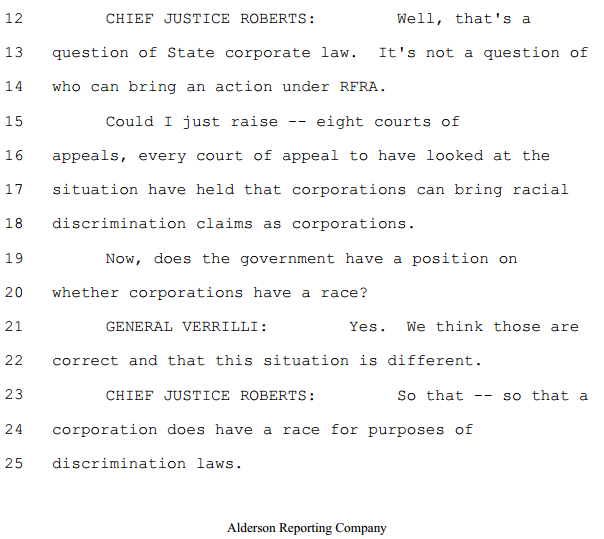
Corporations are people, my friend, just as long as they’re not religious people. That’s the essence of one argument offered by Verrilli. A major issue in the case is whether a for-profit company or corporation even has standing to sue under RFRA, or whether that right is granted only to individuals or non-profits. The Obama administration has argued that for-profit companies do not have standing. That argument led Roberts to ask the following:
Corporations Are People
“So the person — the corporation can bring as a person a claim of racial discrimination[?]” Roberts asked.
“That’s correct, but not exercise of religion,” Verrilli replied.

5) Don’t Start A Business If You Want The Government To Respect Your Religious Rights

In response to arguments that the mandate wasn’t really a big deal since the company could just pay a stiff tax to avoid it, Hobby Lobby’s attorney noted that it wasn’t that simple, and that there would be significant negative consequences to the company if it dropped health coverage altogether. The Obama administration’s attorney was unmoved:
[O]nce you make a choice to go into the commercial sphere, which you certainly do when you incorporate as a for­-profit corporation, you are making a choice to live by the rules that govern you and your competitors in the commercial sphere.
Basically, if you can’t handle those additional costs incurred as a result of the government taxing you for adhering to certain religious beliefs, oh well.

6) Abortifacients Aren’t Really Abortifacients

The most bizarre argument offered by Verrilli was that Hobby Lobby shouldn’t really care about being forced to pay for abortifacients since some people don’t think life begins at conception. If you just arbitrarily decided when life begins — for example, by declaring that it begins at implantation rather than conception — then you can also declare that an abortion can’t happen up until that point.
Roberts teed up Verrilli’s argument when he said, “One of the religious beliefs is that they have to pay for these four methods of contraception that they believe provide abortions. I thought that’s what we had before us.”
Verrilli disagreed:
It is their sincere belief and we don’t question that.  But I will say, and I do think this is important and I say it with all  respect, that that is how they that is the judgment that they make.  It is not the judgment that Federal law  or State law reflects.  Federal law and State law which does ­­ which do preclude funding for abortions don’t consider these particular forms of contraception to be abortion.
In short, since there’s no law stating that life begins at conception, it’s kind of ridiculous for anyone to believe and act as though life begins at conception.

24 March, 2014

Should Unborn Babies Be Used To Heat Hospitals?


Should Unborn Babies Be Used To Heat Hospitals?Should Unborn Babies Be Used To Heat Hospitals?


The Telegraph (UK) reports today:


Aborted babies incinerated to heat UK hospitals
The remains of more than 15,000 babies were incinerated as ‘clinical waste’ by hospitals in Britain with some used in ‘waste to energy’ plants 


The bodies of thousands of aborted and miscarried babies were incinerated as clinical waste, with some even used to heat hospitals, an investigation has found.
Ten NHS trusts have admitted burning foetal remains alongside other rubbish while two others used the bodies in ‘waste-to-energy’ plants which generate power for heat.
People are reacting to this story with the natural revulsion one feels for such callous treatment of humans, whether it’s evoking memories of crematoriums at concentration camps or promises made to mothers who miscarry about the treatment of their children who died.
But why are we in any way surprised? Once supposedly enlightened societies have decided that unborn children can be dismembered in the womb for any reason — in some particularly barbaric lands, this is permitted no matter how many months old the baby is — why should their bodies be treated with any respect whatsoever once they are removed from where they were gestating?
Of course people who think it’s wrong to kill innocent human beings via abortion are going to be sickened by this story. We’re sickened by most things about abortion and how it makes people view human life as disposable.
But do prominent pro-choice politicians and leaders share our revulsion? Do they think it’s in any way wrong to use unborn children for heating fuel? And, if so, could they explain why? I’d be interested in their answer.
Could a reporter please ask President Barack Obama, the country’s most prominent defender of abortion rights, whether he thinks that Obamacare should ban the use of humans for fuel and, if so, why? Could a reporter ask Rep. Nancy Pelosi why it’s totally OK to kill an unborn baby but not OK to use her body for fuel? How about Senate Majority Leader Harry Reid? Perhaps the media’s most beloved political candidate of the moment — I speak of Texas gubernatorial candidate and late-term abortion filibusterer Wendy Davis — can discuss whether Texas should save money by burning the victims of abortion for heating fuel.
What about pro-choice leaders such as Planned Parenthood head Cecile Richards? She loves to talk to the media every day. Have her weigh in.
Reporters and editors, you’ve struggled to cover American serial murderer abortionist Kermit Gosnell. Even Gosnell didn’t use his victims’ bodies for fuel, though he did keep trophies of them around. You’ve claimed you would do a better job of being on top of abortion news after your failures with the Gosnell coverage. And you never fail to ask pro-life politicians about whether babies should be killed if they’re produced via rape — and get days of coverage out of whatever their answer.
It’s not just that reporters and editors are tenacious with pro-life politicians compared to pro-choice politicians. It’s also that even when there’s a crazy serious hook, pro-choicers skate without questions, much less tough questions. Was any pro-choice politician grilled about Gosnell? None. Were any pro-choice activists grilled about fighting health standards for abortion clinics? No. When was the last time you saw a reporter ask a pro-choice politician why they think it should be legal to kill an unborn baby for the crime of being a little girl? (Abortion is the major means of gendercide in some countries.) Oh you have never heard that question? That’s interesting.
So let’s add queries about whether unborn children who are victims of abortion should be used for building heat to the list of questions we ask pro-choice politicians and activists. I’m really curious to read their answer and I’m sure millions of others are as well.

17 March, 2014

We overhauled U.S. health care — to insure 4.2 million people?

-
The Washington Times


The number bounced around for years — 46 million.

President Obama said it in August 2009: "I don't have to explain to you that nearly 46 million Americans don't have health insurance coverage today. In the wealthiest nation on Earth, 46 million of our fellow citizens have no coverage."
He said it dozens more times, including in June 2013: "We are not a nation that accepts nearly 46 million uninsured men, women and children."

The Obama administration pumped the number with official reports. The White House Council of Economic Advisers said, "Perhaps the most visible sign of the need for health care reform is the 46 million Americans currently without health insurance." The Census Bureau got in on the act, too, saying some 48 million Americans lacked health insurance.
It was official: Nearly 15 percent of America's 313 million citizens had no coverage and were, as Mr. Obama loved to say over and over to hype the fear, "one illness away from financial ruin."

So, he created Obamacare. The crux of the biscuit: The United States would completely change its entire health care system to make sure those 46 million got insured. Well, at least that's what every rational American thought. If there are 46 million uninsured, and the president and Congress are overhauling the system, it must be to solve the whole problem — not just part of it.

But last week came word that with just 15 days left for people to enroll for federal coverage, just 4.2 million had. The math is simple: That's just 9 percent of the supposedly 46 million uninsured.

"It will be a larger number than that by the end of March," Mr. Obama promised in an interview with WebMD. "At this point, enough people are signing up that the Affordable Care Act is going to work."

Still, the obvious question is: We changed the $2.7 trillion health care system to sign up 4.2 million people?

While the president has opted to press class warfare and income inequality in the weeks leading up to the Obamacare sign-up cutoff date of March 31, he has made an effort to enroll the people most needed to make the federal program work: the young.

He did an ask-me-anything on Reddit.com, popped up on "Between Two Ferns" with Zach Galifianakis, introduced a segment on the popular show "Cosmos," even invited 'N Sync singer Lance Bass to the White House to "discuss" health care.

But the young have not flocked to the Web page to sign up for insurance that, even with a hefty federal subsidy, will still cost them more than not paying anything. And anyone with teenagers or 20-somethings knows that they don't do anything unless they're absolutely forced to (Zach didn't actually tell them to go sign up, just the pushy president, again).

What's more, it turns out many of those signing up to the program already had insurance. "Few uninsured Americans are gaining coverage under Obamacare," CNN reported in early March. Just 27 percent of the enrollees were previously uninsured, according to a survey conducted in February by McKinsey & Co.

To top it all off, reports have emerged that many of the enrollees are more elderly and more unhealthy, which is likely to tax the system heavily just as it gets started.

What's surprising is how little the mainstream media cares. The White House now says it was hoping to enroll 8 million in the first year — but does anyone remember that being a big selling point as the president crisscrossed the country scaring Americans? And no one in the MSM blinked an eye when the nonpartisan Congressional Budget Office said that in 2023, Obamacare will still have left 31 million people without health insurance while adding more than $1.7 trillion in federal spending.

In a wonderfully timed plea, Mr. Obama is asking Americans to give him money so that he can push his signature policy.
"Chip in before it's too late. What we do right now determines how aggressive we can make our final push for health care this month." You can give $15 or $5,000. But your president is begging: "Make a donation — and let's finish what we started."
With just 4.2 million of the 46 million uninsured Americans enrolled, it seems Obamacare is already finished before it started.

13 March, 2014

Do You Like to Be Nudged?


I completely agree that "nudging" is just a nice way of saying "forcing".  Now, I take some issue with Gonzalez's portrayal of the global warming debate quote.  Not all views need to receive equal time (e.g. the earth is not flat), but saying an argument is "settled" is not an argument, especially when legitimate and factual points can be made on both sides.    

Do You Like to Be Nudged?


Do you want society’s so-called best and brightest “nudging” your decisions about what to consume – whether it’s for news, soft drinks or light bulbs?
If so, chances are you call yourself progressive. If you snort at the mere notion, however, you are almost certainly a conservative.
In fact, throw out all the other Rorschach tests. This is the one that separates one side from the other.
This difference is at the heart of a spat I find myself in with colleagues Darrell West and Beth Stone of the Brookings Institution. West and Stone contended in a paper in early February that our media organizations need to “nudge” Americans to consume “more thoughtful information.” I argued in a piece in The Federalist that their manuscript was a veiled attempt at putting the media revolution genie back in the bottle and returning us to the age when the likes of Walter Cronkite, NPR and The New York Times told us what was news. Not to be outdone, West and Stone returned the favor and scolded me this week for being anti-thoughtful.
Our little debate is actually a microcosm of a larger one. Progressives like a centralized state composed of luminaries making enlightened decisions for the rest of society. Conservatives fear that this state will treat the individual less like an adult and more like an infant — and, more importantly, tear his family and community apart.
In this wonk spat between West, Stone and me, the operative word is “thoughtful” — the quality I supposedly lack and a word they use no fewer than nine times in their response. To be thoughtful is indeed a fine quality, but I posit that the term here can be wielded to quash dissenting voices. Tin pot dictators don’t have laws that say “whatever Tin Pot doesn’t like is banned.” No, they ban actions, speech or even thought deemed “hateful,” “anti-social,” “against social conviviality,” and so on.
West and Stone are not totalitarians or even authoritarians. I am sure they view themselves as broad-minded, tolerant and urbane. They protest that “we are not ultra-liberals and we actually have voted for Republicans and Democrats” (though I would point out to Mr. West that a former professor at Brown University pulling the lever for Lincoln Chaffee doesn’t count).
They do, however, make clear that “thoughtful reporting” would be what Ezra Klein, Andrew Sullivan, Jill Abramson, Amy Goodman and Juan Gonzalez — journalists ranging from liberal to very liberal — think is thoughtful, as these are the names they cite. One doesn’t find Brit Hume, George Will, Rich Lowry or Paul Gigot among their arbiters of thoughtfulness.
Even if they had included Charles Krauthammer, the idea of nudging consumers only toward what an elite of either side deems appropriate is frightening. Consider West’s interview on Bloomberg radio this past weekend on what he considers thoughtful.
Interviewer Bill Frezza asked West how he thought the media should deal with issues of settled science. West answered that “good scientists never resolve anything permanently because there’s always new information that comes around,” which is right. But then Frezza asked, “So would you be in favor of equal time for both global warming alarmists and climate change deniers?”
West: “I would not in that situation, just because you’re talking about a situation where, you know, 98 percent of scientists believe that the world is getting warmer and that human activities are part of the reason it is getting warmer. It is a very small number of people—many of them don’t have good credentials—who are challenging that viewpoint. So I think it’s a mistake when journalists equate those two perspectives when in reality, you know, scientists overwhelmingly believe in global warming.”

Frezza: “Fascinating.”
Indeed. I think we all get the point.
After I wrote my piece in The Federalist, it emerged that the Federal Communications Commission was launching a study on whether news outlets were covering “critical information needs.” Among these were the “environment” and “economic opportunities.”
This study would be an instance where the government uses its full might to force media outlets to cover what it wants, and the FCC’s actions led to a huge outcry. West and Stone don’t come armed with the power to take TV licenses away, and would only “nudge” us toward the “right” consumption patterns.
But caution is in order. Nudging is a term popularized in the policy context by former Obama official Cass Sunstein, by which he meant using public policy to persuade people subconsciously to make certain choices and not others. In media consumption, people click much more often on items that are higher on a search engine’s queue.
West and Stone observe approvingly that Facebook already gives priority to what it considers high-quality content. Conservatives need to be watchful of this. Facebook, Google and Twitter — all so essential to our new-found, post-Cronkite media freedom — are basically monopolies.
West and Stone complain that I denigrated their paper. I didn’t. I respect their work and also that of Brookings. I believe society benefits from a collegial, Socratic dialogue in which we probe each other’s thinking in policy and moral matters, in order to stimulate critical thinking. But to do that, you need to present more than one point of view. And no nudging allowed.

War on Women

War on Women

By John Stossel - March 12, 2014
You've probably heard that Democratic Party leaders decided that a way to win votes this November is to shout loudly that Republicans wage "war on women." Politico calls this a "proven, persuasive argument."
Give me a break. The idea of a conservative "war on women" is as silly as propaganda I was taught in college: Aside from sex organs, genders are exactly equal, said my leftist professors, and any admission of differences between men and women is oppressive.
I was taught that the only reason boys and girls behave differently is because we're raised differently. If society and parents were to treat genders the same, behavior differences would vanish. I believed it.
Then I had kids, and spent more time with kids, and learned what a fool I'd been.
Back in my ABC News days, I did a TV show about the differences. A typical mom said, "We gave them each trucks.
She just wouldn't play with trucks. We wouldn't let him play with guns, so he pretended carrots were guns."
There were exceptions, of course. But it turns out that there's plenty of science documenting that men and women are just programmed differently.
Yet when I reported on that, feminist icon Gloria Steinem told me that gender differences shouldn't even be studied. She sneered, it's "anti-American, crazy thinking to do this kind of research."
At the time, fire departments had dropped strength tests to avoid being accused of sex discrimination. When I told Steinem that one of my interviewees complained that instead of being carried during a fire, now she would be dragged downstairs, with her head hitting each stair, Steinem retorted, "It's better to drag them out ... there's less smoke down there."
Such mindless egalitarianism appeals to politicians, so governments push more of it. President Barack Obama and his supporters brag that Obamacare forces health insurance companies to sell men and women health insurance for the exact same price. On my TV show this week, Democratic activist Jehmu Greene asks indignantly, "Do you want to live in a country where you charge women more than men?"
Well, yes, I do. Insurance should account for costs. Women go to doctors much more often. The Centers for Disease Control and Prevention say, even if you exclude pregnancy visits, women are 33 percent more likely to visit a doctor.
Insurance companies used to reflect that in prices. That isn't bigotry -- it's just math.
Insurance companies still charge men more for car and life insurance. A survey of car insurance companies found that the cheapest policy for a woman cost 39 percent less than for a man. A 60-year-old woman pays 20 percent less than a man for a 10-year life insurance policy. Seventy-year-old women pay half as much as men.
That's just math, too, because most women live longer than men and, despite the "woman-driver" stereotype, we men get into more car accidents.
I don't hear activists complaining about men  paying too much. The "victim" propaganda works only when women pay more.
The sexes are simply different. Yet government demands that colleges have gender-equal sports participation. It's fine if dance and art groups are mostly women, but if athletic teams are too male, lawsuits follow.
Obama even cynically repeats the misleading claim that women make 77 cents for every dollar men make, although his own Department of Labor says the difference evaporates once you control for experience and other choices.
Government once even claimed that Hooters discriminates against men because it hires big-breasted female waiters. The Equal Employment Opportunity Commission only dropped its complaint after Hooters ran a commercial showing a hairy male server wearing Hooters' skimpy uniform. Good for Hooters for mocking the bureaucrats; most companies just cringe and pay.
Liberal social engineers may dream of a society where genders are exactly equal, but that's nonsense. Men and women are different. We should celebrate that difference instead of claiming that women are victims. 

04 March, 2014

Inequality in San Francisco

Article: http://content.time.com/time/magazine/article/0,9171,2164220,00.html

How interesting that nearly all evidence of inequality is caused by the government b/c the free market is not allowed to work:

  • Not enough affordable housing, yet zoning restrictions and rent control continue to hinder new development while limiting housing flexibility and discouraging home ownership
  • Not enough good paying non-tech jobs, yet we criticize, demonize, and seek to raise taxes on local businesses (including taxes on private buses in the name of "fairness")
  • The entire article is about how stuff is too expensive, yet one of the solutions is to raise the minimum wage nearly 50%.  Do we not think that increasing the cost of low-skill labor will increase the cost of everyday items?  If we were able to make items more affordable by raising the minimum wage, then why not $50 an hour or $100?  Two reasons: first, raising the minimum wage reduces employment opportunitie, as companies hire fewer workers.  Second, increasing the minimum wage raises the cost of production, increasing the cost of items for all consumers.  There is no free lunch; at the end of the day people will (and should) be paid for the value of the work they produce.  The value of that work is determined by the supply and demand of the labor market (see previous comments regarding minimum wage).  
Favorite quote: "There's been this debate of people with more wealth saying, 'Well, if you don't have enough money, then you need to move to a cheaper city,'"..."That's not taking into account their roots, their community, their needs, or anything else."  Actually, it is taking "anything else" into consideration, namely the concept of individual liberty and the laws of supply and demand and the economic efficiencies that allow for growth to improve the quality of life for the vast majority of citizens.  And since when is ownership determined by "roots" or "needs"?  By that logic, the Native Americans own all this land and all of you must move.  Also not sure who speaks for "the community"... 

Admittedly, the cost of living is likely to rise as wealthier individuals move into an area with geographic limitations on expansion.  Some lower income citizens will be affected.  Now, even though the wealthier citizens did nothing wrong, illegal, or predatory, do we view it as the government's job to protect poorer citizens from experiencing any changes even through those government protections will require infringement on the freedom, economic growth, and well-being of all other citizens in San Francisco?

03 March, 2014

The 'Fairness' Fraud

Thomas Sowell | Feb 25, 2014

It seems as if, everywhere you turn these days, there are studies claiming to show that America has lost its upward mobility for people born in the lower socioeconomic levels. But there is a sharp difference between upward "mobility," defined as an opportunity to rise, and mobility defined as actually having risen.
That distinction is seldom even mentioned in most of the studies. It is as if everybody is chomping at the bit to get ahead, and the ones that don't rise have been stopped by "barriers" created by "society."
When statistics show that sons of high school dropouts don't become doctors or scientists nearly as often as the sons of Ph.D.s, that is taken as a sign that American society is not "fair."
If equal probabilities of achieving some goal is your definition of fairness, then we should all get together -- people of every race, color, creed, national origin, political ideology and sexual preference -- and stipulate that life has never been fair, anywhere or any time in all the millennia of recorded history.
Then we can begin at last to talk sense.
I know that I never had an equal chance to become a great ballet dancer like Rudolph Nureyev. The thought of becoming a ballet dancer never once crossed my mind in all the years when I was growing up in Harlem. I suspect that the same thought never crossed the minds of most of the guys growing up on New York's lower east side.
Does that mean that there were unfair barriers keeping us from following in the footsteps of Rudolph Nureyev?
A very distinguished scholar once mentioned at a social gathering that, as a young man, he was not thinking of going to college until someone else, who recognized his ability, urged him to do so.
Another very distinguished scholar told me that, although his parents were anti-Semitic, it was the fact that he went to a school with many Jewish children that got him interested in intellectual matters and led him into an academic career.
All groups, families and cultures are not even trying to do the same things, so the fact that they do not all end up equally represented everywhere can hardly be automatically attributed to "barriers" created by "society."
Barriers are external obstacles, as distinguished from internal values and aspirations -- unless you are going to play the kind of word games that redefine achievements as "privileges" and treat an absence of evidence of discrimination as only proof of how diabolically clever and covert the discrimination is.
The front page of a local newspaper in northern California featured the headline "The Promise Denied," lamenting the under-representation of women in computer engineering. The continuation of this long article on an inside page had the headline, "Who is to blame for this?"
In other words, the fact that reality does not match the preconceptions of the intelligentsia shows that there is something wrong with reality, for which somebody must be blamed. Apparently their preconceptions cannot be wrong.
Women, like so many other groups, seem not to be dedicated to fulfilling the prevailing fetish among the intelligentsia that every demographic group should be equally represented in all sorts of places.
Women have their own agendas, and if these agendas do not usually include computer engineering, what is to be done? Draft women into engineering schools to satisfy the preconceptions of our self-anointed saviors? Or will a propaganda campaign be sufficient to satisfy those who think that they should be making other people's choices for them?
That kind of thinking is how we got ObamaCare.
At least one of the recent celebrated statistical studies of social mobility leaves out Asian Americans. Immigrants from Asia are among a number of groups, including American-born Mormons, whose achievements totally undermine the notion that upward mobility can seldom be realized in America.
Those who preach this counterproductive message will probably never think that the envy, resentment and hopelessness they preach, and the welfare state they promote, are among the factors keeping people down.

Why Young Adults Won't Sign Up for Obamacare

By Napala Pratini, NerdWallet

http://abcnews.go.com/m/story?id=22690267

Anyone who looked at the law could have predicted these problems (and, I suspect if you look back to the 2008 portion of this blog, you will find several examples of conservative writers who did just that).  Why wasn't this obvious to the legislators who voted for it?  On wait, we needed to "pass the bill so you can find out what's in it"

The U.S. Department of Health and Human Services has released data showing that 55 percent of Americans who enrolled in plans under the Affordable Care Act (ACA) in the first three months were between the ages of 45 and 64. The report from January showed a whopping one-third of enrollees were aged 55 and older—people just shy of coverage under Medicare, and more likely to get sick or to have pre-existing health conditions. Only 24 percent of the 2.2 million who have signed up are between the ages of 18 and 34, well below the Obama administration's target of around 40 percent. A new study on the cost of insurance for young adults reveals why young adults may opt out of purchasing health insurance through the marketplace.

1. Most young adults are in the "healthy majority"
Adults aged 18 to 34 and without health problems are called "young invincibles" for a reason. According to a report by the Centers for Disease Control, less than a quarter of adults ages 18 to 29 said they visited an emergency room during a one-year period, and only 7 percent stayed overnight at the hospital. Just 4.2 percent of people in this age group report their heath to be fair or poor—meaning the remaining 95.8 percent claim that their health is good, very good or excellent. An additional 30 percent will not even see a doctor once in the year. This "healthy majority" who rarely access care have good reason to think twice before purchasing insurance.

2. Being healthy doesn't entitle you to a big break on insurance costs
Prior to the ACA, older and/or unhealthy adults could be charged more than five times what young, healthy adults were for health insurance premiums. The ACA limits this "age-rating" ratio to three—that is, older or unhealthy individuals can be charged only up to three times what the young and healthy pay. This is great news for those suffering from illness, because it means they will be able to get more affordable insurance that covers all of their health problems. Young invincibles, however, get the short end of the stick. One study estimates a median rate increase of 237 percent for young invincibles (without taking premium assistance into account).

3. Emergencies don't necessarily cost less with insurance
Many young invincibles wisely worry about going uninsured and risking massive bills following a trip to the emergency room. A recent study on insurance costs for young adults, however, predicts that being insured will cost upwards of $700 more for individuals who visit the ER. This is because most insurance plans require the policyholder to meet a deductible before benefits kick in. For this reason, the study estimates an uninsured young adult who visits the ER once in 2014 will pay $2,022 in annual out-of-pocket expenses. Meanwhile, an insured young adult will see a total 2014 bill of $2,791, including premiums and out-of-pocket expenses to cover the ER visit. This estimate takes into account the penalty that the uninsured will pay, as well as the cost of physician office visits throughout the year for both the insured and the uninsured.

4. For the healthy majority, being uninsured is 5 times cheaper than being insured
Assuming no major medical issues, foregoing insurance in 2014 will on average save young invincibles more than $1,000. Not only do the uninsured who visit the doctor spend less on these visits per year than their insured peers (an estimated $253 for the uninsured, as opposed to $517 for the insured), the penalty for being uninsured in 2014 is dwarfed by premium costs for the insured. While it is impossible to rule out the onset of certain conditions or an accident, young adults with the stomach for calculated risk are likely to opt for being uninsured—and therefore potentially saving thousands of dollars.