22 April, 2014

Krauthammer: The zealots win again

Charles Krauthammer
Charles Krauthammer
Opinion Writer

The zealots win again

The debate over campaign contributions is never-ending for a simple reason: Both sides of the argument have merit.
On the one hand, of course money is speech. For most citizens, contributing to politicians or causes is the most effective way to augment and amplify speech with which they agree. The most disdainful dismissers of this argument are editorialists and incumbent politicians who — surprise! — already enjoy access to vast audiences and don’t particularly like their monopoly being invaded by the unwashed masses or the self-made plutocrat.
On the other hand, of course money is corrupting. The nation’s jails are well stocked with mayors, legislators, judges and the occasional governor who have exchanged favors for cash. However, there are lesser — and legal — forms of influence-peddling short of the outright quid pro quo. Campaign contributions are carefully calibrated to approach that line without crossing it. But money distorts. There is no denying the unfairness of big contributors buying access unavailable to the everyday citizen.
Hence the endless law-writing to restrict political contributions, invariably followed by multiple fixes to correct the inevitable loopholes. The result is a baffling mass of legislation administered by one cadre of experts and dodged by another.
For a long time, a simple finesse offered a rather elegant solution: no limits on giving — but with full disclosure.
Open the floodgates, and let the monies, big and small, check and balance each other. And let transparency be the safeguard against corruption. As long as you know who is giving what to whom, you can look for, find and, if necessary, prosecute corrupt connections between donor and receiver.
This used to be my position. No longer. I had not foreseen how donor lists would be used not to ferret out corruption but to pursue and persecute citizens with contrary views. Which corrupts the very idea of full disclosure.
It is now an invitation to the creation of enemies lists. Containing, for example,Brendan Eich, forced to resign as Mozilla CEO when it was disclosed that six years earlier he’d given $1,000 to support a referendum banning gay marriage. He was hardly the first. Activists compiled blacklists of donors to Proposition 8 and went after them. Indeed, shortly after the referendum passed, both the artistic director of the California Musical Theatre in Sacramento and the president of the Los Angeles Film Festival were hounded out of office.
Referendums produce the purest example of transparency misused because corrupt favoritism is not an issue. There’s no one to corrupt. Supporting a referendum is a pure expression of one’s beliefs. Full disclosure in that context becomes a cudgel, an invitation to harassment.
Sometimes the state itself does the harassing. The IRS scandal left many members of political groups exposed to abuse, such as the unlawful release of confidential data. In another case, the Obama campaign Web site in 2012 published the names of eight big Romney donors, alleging them to have “less-than-reputable records.” A glow-in-the-dark target having been painted on his back, Idaho businessman Frank VanderSloot (reported the Wall Street Journal’s Kimberley Strassel) suddenly found himself subject to multiple audits, including two by the IRS.
In his lone dissent to the disclosure requirement in Citizens United, Justice Clarence Thomas argued that American citizens should not be subject “to death threats, ruined careers, damaged or defaced property, or pre-emptive and threatening warning letters as the price for engaging in core political speech, the primary object of First Amendment protection.” (Internal quote marks omitted.)
In fact, wariness of full disclosure goes back to 1958 when the Supreme Court ruled that the NAACP did not have to release its membership list to the state, understanding that such disclosure would surely subject its members to persecution. “This court has recognized the vital relationship between freedom to associate and privacy in one’s associations . . .particularly where a group espouses dissident beliefs.”
A different era, a different set of dissidents. But the naming of names, the listing of lists, goes on. The enforcers are at it again, this time armed with sortable Internet donor lists.
The ultimate victim here is full disclosure itself. If revealing your views opens you to the politics of personal destruction, then transparency, however valuable, must give way to the ultimate core political good, free expression.
Our collective loss. Coupling unlimited donations and full disclosure was a reasonable way to reconcile the irreconcilables of campaign finance. Like so much else in our politics, however, it has been ruined by zealots. What a pity
.

17 April, 2014

Statistical Frauds

Thomas Sowell

The "war on women" political slogan is in fact a war against common sense.
It is a statistical fraud when Barack Obama and other politicians say that women earn only 77 percent of what men earn -- and that this is because of discrimination.
It would certainly be discrimination if women were doing the same work as men, for the same number of hours, with the same amount of training and experience, as well as other things being the same. But study after study, over the past several decades, has shown repeatedly that those things are not the same.
Constantly repeating the "77 percent" statistic does not make them the same. It simply takes advantage of many people's ignorance -- something that Barack Obama has been very good at doing on many other issues.
What if you compare women and men who are the same on all the relevant characteristics?
First of all, you can seldom do that, because the statistics you would need are not always available for the whole range of occupations and the whole range of differences between women's patterns and men's patterns in the labor market.
Even where relevant statistics are available, careful judgment is required to pick samples of women and men who are truly comparable.
For example, some women are mothers and some men are fathers. But does the fact that they are both parents make them comparable in the labor market? Actually the biggest disparity in incomes is between fathers and mothers. Nor is there anything mysterious about this, when you stop and think about it.
How surprising is it that women with children do not earn as much as women who do not have children? If you don't think children take up a mother's time, you just haven't raised any children.
How surprising is it that men with children earn more than men without children, just the opposite of the situation with women? Is it surprising that a man who has more mouths to feed is more likely to work longer hours? Or take on harder or more dangerous jobs, in order to earn more money?
More than 90 percent of the people who are killed on the job are men. There is no point pretending that there are no differences between what women do and what men do in the workplace, or that these differences don't affect income.
During my research on male-female differences for my book "Economic Facts and Fallacies," I was amazed to learn that young male doctors earned much higher incomes than young female doctors. But it wasn't so amazing after I discovered that young male doctors worked over 500 hours more per year than young female doctors.
Even when women and men work at jobs that have the same title -- whether doctors, lawyers, economists or whatever -- people do not get paid for what their job title is, but for what they actually do.
Women lawyers who are pregnant, or who have young children, may have good reasons to prefer a 9 to 5 job in a government agency to working 60 hours a week in a high-powered law firm. But there is no point comparing male lawyers as a group with female lawyers as a group, if you don't look any deeper than job titles.
Unless, of course, you are not looking for the truth, but for political talking points to excite the gullible.
Even when you compare women and men with the "same" education, as measured by college or university degrees, the women usually specialize in a very different mix of subjects, with very different income-earning potential.
Although comparing women and men who are in fact comparable is not easy to do, when you look at women and men who are similar on multiple factors, the sex differential in pay shrinks drastically and gets close to the vanishing point. In some categories, women earn more than men with the same range of characteristics.
If the 77 percent statistic was for real, employers would be paying 30 percent more than they had to, every time they hired a man to do a job that a woman could do just as well. Would employers be such fools with their own money? If you think employers don't care about paying 30 percent more than they have to, just go ask your boss for a 30 percent raise!

15 April, 2014

How Convenient

Wow, this is really interesting.  It would not seem like now is the right time to change the way healthcare statistics are collected, if for no other reason than to gain a full understanding of the impact of recent changes.  

A more cynical person might attribute this to political motives.  I'll let you decide...

Census Survey Revisions Mask Health Law Effects
New York Times, April 15, 2014

By ROBERT PEAR

WASHINGTON — The Census Bureau, the authoritative source of health insurance data for more than three decades, is changing its annual survey so thoroughly that it will be difficult to measure the effects of President Obama’s health care law in the next report, due this fall, census officials said.

The changes are intended to improve the accuracy of the survey, being conducted this month in interviews with tens of thousands of households around the country. But the new questions are so different that the findings will not be comparable, the officials said.

An internal Census Bureau document said that the new questionnaire included a “total revision to health insurance questions” and, in a test last year, produced lower estimates of the uninsured. Thus, officials said, it will be difficult to say how much of any change is attributable to the Affordable Care Act and how much to the use of a new survey instrument.

“We are expecting much lower numbers just because of the questions and how they are asked,” said Brett J. O’Hara, chief of the health statistics branch at the Census Bureau.

With the new questions, “it is likely that the Census Bureau will decide that there is a break in series for the health insurance estimates,” says another agency document describing the changes. This “break in trend” will complicate efforts to trace the impact of the Affordable Care Act, it said.

A major goal of the law is to increase the number of people with health insurance. The White House reported that 7.5 million people signed up for private health plans on the new insurance exchanges and that enrollment inMedicaid increased by three million since October. But the administration has been unable to say how many of the people gaining coverage were previously uninsured or had policies canceled, so the net increase in coverage is unclear.

Health policy experts and politicians had been assuming that the Census Bureau would help answer those questions when it issued its report on income, poverty and health insurance, based on the Current Population Survey. The annual report shows the number of people with various kinds of health insurance and the number of uninsured for the nation and for each state.

Several recent private polls, including one by the Gallup organization, suggest that the number of uninsured is indeed declining, because of the Affordable Care Act and improvements in the economy.

Census officials and researchers have long expressed concerns about the old version of insurance questions in the Current Population Survey.

The questionnaire traditionally used by the Census Bureau provides an “inflated estimate of the uninsured” and is prone to “measurement errors,” said a working paper by statisticians and demographers at the agency.

In the test last year, the percentage of people without health insurance was 10.6 percent when interviewers used the new questionnaire, compared with 12.5 percent using the old version. Researchers said that they had found a similar pattern in the data for different age, race and ethnic groups.

In addition, “the percentage of people with private coverage was statistically higher” when the bureau tested the new questionnaire, the working paper said. For reasons that are not clear, people were less likely to respond when interviewers used the new questionnaire.

Another Census Bureau paper said “it is coincidental and unfortunate timing” that the survey was overhauled just before major provisions of the health care law took effect. “Ideally,” it said, “the redesign would have had at least a few years to gather base line and trend data.”

The old questionnaire asked consumers if they had various types of coverage at any time in the prior year. The new survey asks if they have insurance at the time of the interview — in February, March or April — then uses follow-up questions to find out when that coverage began and what months it was in effect. Using this technique, census officials believe they will be able to reconstruct the history of coverage month by month, over a period of about 15 months, for each person in a household.

However, Mr. O’Hara of the Census Bureau said the agency was not planning to release coverage data from early this year in its next report. Agency officials want to assess the reliability of the monthly data, being collected this year for the first time.

The White House is always looking for evidence to show the benefits of the health law, which is an issue in many of this year’s midterm elections. The Department of Health and Human Services and the White House Council of Economic Advisers requested several of the new questions, and the White House Office of Management and Budget approved the new questionnaire. But the decision to make fundamental changes in the survey was driven by technical experts at the Census Bureau, and members of Congress have not focused on it or suggested political motives. The new survey was conceived, in part, to reduce a kind of bias or confusion in the old survey. When asked about their insurance arrangements in the prior year, people tended to give answers about their coverage at the time of the interview — forgetting, for example, if they had Medicaid for a few months early in the prior year.

People are continually moving on and off Medicaid rolls. The number of people who say in surveys that they have Medicaid coverage is almost always lower than the enrollment figures reported by federal and state agencies that administer the program.

The new survey asks people if they have coverage through an exchange, if it has premiums and if the premiums are subsidized.

People generally know if they have health insurance, but not necessarily the type of coverage. A study by the Census Bureau said that the line between public and private coverage is blurry.

“The same exact coverage will be construed as private by some and public by others,” it said.

Census Bureau research in Massachusetts found that consumers “inevitably conflate Medicaid and the subsidized exchange.” And many people with subsidized private insurance, purchased on the exchange, said they were receiving coverage from the government or the state.

Such perceptions are understandable. “Exchange coverage is a hybrid, partly private and partly government,” said Joanne Pascale, a Census Bureau researcher who helped develop the new questionnaire.

The new survey also includes more detailed questions about whether people were offered insurance at work and whether they accepted it. If a worker is not in an employer’s plan, the government asks why.

Kathleen Thiede Call, a professor at the University of Minnesota School of Public Health, said, “The health insurance data reported in September of this year will not be directly comparable to what was reported last September.”

But Ms. Call, who was consulted by the Census Bureau, said: “I am excited about the redesign of the survey. For the first time, we will be able to look at monthly changes in coverage over a 14- or 15-month period, which was not possible with the old version of the survey.”

8 Infuriating Facts To Remember On Tax Day


Sean Davis
By 

Happy Tax Day, America! It’s not every day that you either get to write a big fat check to Uncle Sam or discover that you’d been loaning him money interest-free for the last year. But have no fear: at least your hard-earned money has been spent on vital projects essential to America’s well-being. Projects like studying shrimp running on treadmills (seriously, you paid for that), or Bridges to Nowhere. Super important stuff like that.
In honor of tax day, here are 8 facts that will make you even angrier than you already are about the state of the U.S. tax system.
1. It will take you 111 days this year just to pay off the government.
According to the Tax Foundation, a non-profit which compiles detailed tax statistics, it will take 111 days this year for American workers to collectively pay their tax bills. That means that every cent you earn throughout those first 111 days of the year gets collected and consumed by government. The Tax Foundation pegs Tax Freedom Day — the day on which the money you earn effectively belongs to you rather than America’s governmental bureaucracy — as April 21 this year. So as you sign your tax returns today, you can rest easy knowing that you’ll still need to work another 6 days before the American tax leviathan will be satisfied.

2. Those federal bureaucrats whose salaries you pay? A bunch of them are tax cheats.

According to an investigative report by Sen. Tom Coburn (R-Okla.), over 300,000 federal employees and retirees were delinquent on their own taxes to the tune of $3.5 billion:
While millions of Americans continue to send back portions of their hard earned wages to Washington, many federal employees are tax cheats. During the year of sweeping budget cuts, millions of federal employees faced layoffs, furloughs, and other cutbacks as a result of Congress’ failure to replace sequestration with responsible, targeted cuts. Most of these federal employees are responsible citizens who pay their taxes. Some, however, don’t feel they have to live by the rules like other Americans. In 2011, the IRS found nearly 312,000 federal employees and retirees were delinquent on their federal income taxes, owing a total of $3.5 billion in unpaid federal income taxes. This represented an 11.5 percent increase in the number of federal employees failing to pay their taxes, and a 2.9 percent increase in the total taxes owed the Treasury by these public servants.

3. You probably pay more in Medicare and Social Security taxes than you do in income taxes…

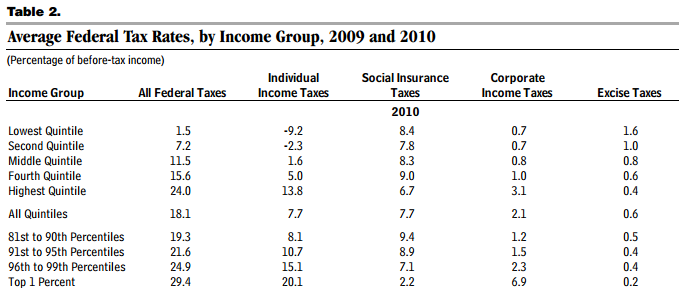
A lot of tax day commentary focuses on the income tax, but the vast majority of Americans — 80 percent or more — actually pay more in federal payroll taxes (the FICA line on your pay stub) than they do in federal income taxes. Those payroll taxes pay for Medicare and Social Security, the two largest federal entitlement programs.
A 2013 study from the Congressional Budget Office (CBO) found that each of the bottom four quintiles of income earners in America (the bottom 80 percent) pays a higher effective payroll tax rate than income tax rate. The middle quintile, for example, pays an average payroll tax rate of 8.3 percent and an average effective income tax rate of 1.6 percent. Only the top quintile pays a higher effective income tax rate than it does a payroll tax rate.
CBO Comparison

4. …And if you’re young, you’re probably never going to get that money back.

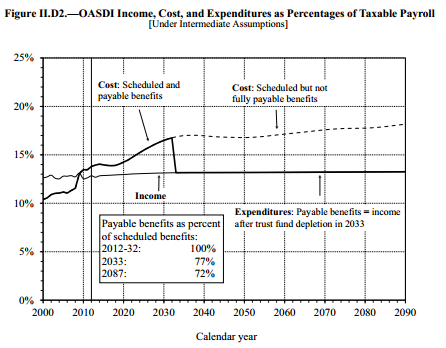
Rather than a program that takes your contributions and deposits them into a savings account with your name on it, Social Security is actually a massive transfer program, and in less than 20 years, the program will effectively be bankrupt. Workers today pay for retirees today, and payments to tomorrow’s retirees will come from tomorrow’s workers. But due to major demographic changes since Social Security was first created, there are far fewer workers per retiree now, and actuaries expect that trend to continue for the foreseeable future.
The major financial consequence of that change in demography is that we have promised future retirees far more than future workers will be able to pay. In fact, the Social Security trust fund started running operational deficits in 2009, meaning that the program was paying out more in benefits than it collected from workers in the form of payroll taxes.
OASDI Trust Fund Depletion
Without significant reforms to the system, the Social Security trust fund is expected torun dry in 2033, according to the program’s trustees (the trust fund balance increases when income exceeds benefits paid out, and decreases when benefits exceed income). When that happens, benefits will fall overnight by 23 percent. Millennials should keep that in mind next time politicians talk about raising their payroll taxes to pay for benefits they’ll never receive.

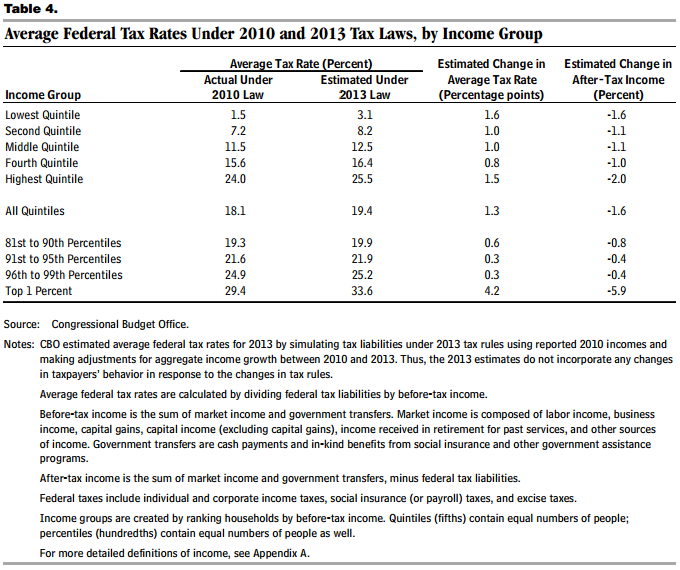
5. Pretty much everybody’s tax rates went up in 2013 thanks to Obamacare and the so-called fiscal cliff deal.

The so-called fiscal cliff deal that was signed into law in January of 2013 raised taxes for a lot of people — 77 percent of people, by some estimates. That’s because the deal allowed payroll tax rates to increase, goring anyone with earned income.
From the New York Times:
Jack Andrews and his wife no longer enjoy what they call date night, their once-a-month outing to the movies and a steak dinner at Logan’s Roadhouse in Augusta, Ga. In Harlem, Eddie Phillips’s life insurance payment will have to wait a few more weeks. And Jessica Price is buying cheaper food near her home in Orlando, Fla., even though she worries it may not be as healthy. Like millions of other Americans, they are feeling the bite from the sharp increase in payroll taxes that took effect at the beginning of January. There are growing signs that the broader economy is suffering, too.
CBO looked at the effects of the fiscal cliff bill, compared it to what the law was in 2010, and found that average tax rates would increase for every single income quintile.
CBO Table
But that’s not all! Obamacare also hiked taxes beginning in 2013. The president’s health law instituted a new 3.8 percent tax on net investment income, as well as a brand new 0.9 percent “Additional Medicare Tax.” And yes, that’s actually what they called it.

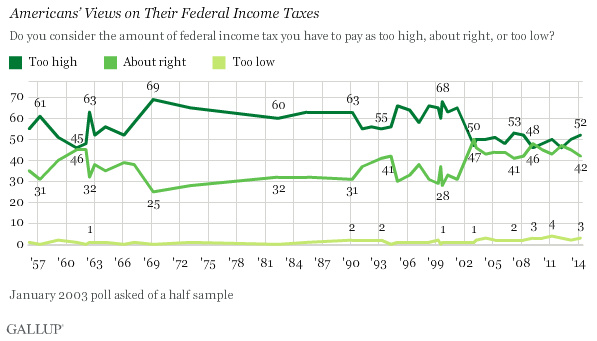
6. Most Americans believe their taxes are too high.

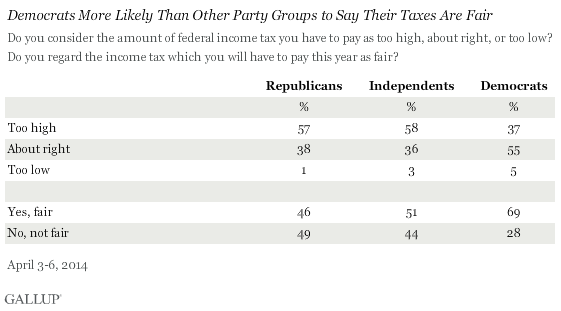
A new poll released yesterday by Gallup shows that most Americans believe they pay too much in taxes. According to Gallup, 52 percent of those surveyed said taxes were too high, while 42 percent said they were about right. For some reason, 3 percent of respondents said taxes were too low.
Gallup Tax Views

7. Even as they try to raise your taxes, only 5 percent of Democrats think their own taxes are too low.

The same Gallup poll broke down tax sentiment by party affiliation. Unsurprisingly, 57 percent of Republicans responded that their own taxes were too high. Fifty-eight percent of Independents agreed, while only 37 percent of Democrats said the amount they paid in taxes was too high. Shockingly, given the Democratic Party’s steadfast belief that tax rates should always be higher, only 5 percent of Democrats felt that their own taxes were too low.
Gallup Tax Poll

8. Corporations are people? Not so much. They get way better tax treatment than actual people.

While it’s true that corporate tax burdens are eventually borne by their investors and shareholders, it’s also true that corporations have access to a vast array of deductions and credits that are not available to individual taxpayers. Corporations can deduct nearly all expenses — things like rent, utilities and gas — from their income in order to reduce their tax liability. They can also deduct health insurance premiums, a benefit not available to families who may have to buy insurance on their own rather than having it provided by an employer. And when a corporation gets busted for tax fraud, it usually gets off the hook with a fine, since you can’t send a piece of paper to prison for its crimes. 

09 April, 2014

Kirsten Powers - Fair and Balanced

Below is today's article by Kirsten Powers.  Powers is a Liberal columnist with whom I often disagree, but I respect her willingness to break with her party.  This earns her great respect in my eyes - as her article demonstrates, Liberals are often not as tolerant of dissension as they would have us believe...

Kirsten Powers: Liberals' mob rule

Kickstarter's attempt to censor film about convicted abortion doctor is another example.

SHARE 2297 719 86COMMENTMORE
Last week brought a chilling reminder of how mercilessly some liberals will work to silence and marginalize people who hold views with which they disagree.
Even for those of us who support same-sex marriage, the virtual manhunt of Mozilla chief Brendan Eich was scary to watch. His heresy was a private donation in support of an anti-gay marriage initiative six years ago. Mob rule enforcing groupthink is as illiberal as it gets, and yet it was liberals demanding uniformity of thought — or else.
Another incident of muzzling those without the proper worldview received less attention. Kickstarter, the nation's biggest crowd-funding site,refused to accept a film about convicted abortion doctor Kermit Gosnell unless descriptions of his crimes were removed.
After producers Phelim McAleer and his wife, Ann McElhinney, complained publicly, embarrassed Kickstarter CEO Yancey Strickler claimed on Twitter that the allegation was false. Strickler released an e-mail accepting the Gosnell film, but failed to mention that it was accepted only after the filmmakers withdrew in frustration. The producers released e-mails from Kickstarter demanding that references to stabbing babies and "similar language" be removed. The "acceptance letter" came March 28, the day after the producers withdrew their proposal.
Kickstarter explained its reasoning for blocking the movie by writing, "We understand your convictions … however … our Community Guidelines outline that we encourage and enforce a culture of respect and consideration, and we ask that that language specifically be modified."
Somehow, making a movie recounting the crimes of a convicted abortion doctor is disrespectful and inconsiderate. Kickstarter would only speak off the record, but its explanations were dissembling and contradictory. That might be because Kickstarter's standards aren't exactly rigorously enforced. An album titled Incest is the Highest Form of Flattery was fine. The movie Die Sluts Die telling "the story of ... sex crazed friends ... murdered in unusual and creative ways," ditto.
What type of movie on late-term abortion do our meddling gatekeepers want? Kickstarter accepted After Tiller, a hagiography of the abortionists who took over when Wichita doctor George Tiller was murdered. The film presumably doesn't belabor the process of late-term abortion, where babies are often stabbed in the neck with scissors and the contents of their skulls suctioned out. One wouldn't want to violate Kickstarter's culture of respect and consideration. Or provide factual information.
Kickstarter, like too much of the news media, wants only one version of the late-term abortion story told. If Gosnell hadn't killed the babies outside the mothers' body and instead kept them inside as is standard procedure for the After Tiller docs, he would not have been charged with murder. He'd be the hero in a film Kickstarter would happily fund.
Kirsten Powers writes weekly for USA TODAY. 

08 April, 2014

"Campaign Finance Reform" = Incumbent Protection

A Halo for Selfishness

By Thomas Sowell - April 8, 2014
The recent Supreme Court decision over-ruling some Federal Election Commission restrictions on political campaign contributions has provoked angry reactions on the left. That is what often happens whenever the High Court rules that the First Amendment means what it says -- free speech for everybody.
When the Supreme Court declared in 2010 that both unions and corporations had a right to buy political ads, that was considered outrageous by the left. President Obama called the decision "devastating" and said it "will open the floodgates for special interests."
Those unfamiliar with political rhetoric may not know that "special interests" mean people who support your opponents. One's own organized supporters -- such as labor unions supporting President Obama -- are never called "special interests."
All politicians are against "special interests," by definition. They all want their own supporters to have the right to free speech, but not those individuals and groups so benighted as to support their opponents.
Even in an age of polarization and gridlock, the one area in which it is easy to get bipartisan support in Congress is in passing campaign finance laws, restricting how much money can be spent publicizing political candidates. What Congressional Democrats and Republicans have in common is that they are all incumbents, and they all want to keep their jobs.
Publicity is necessary to win elections, and incumbents get millions of dollars' worth of free publicity from the media. Incumbents can all pontificate in Congress and be covered by C-SPAN. They can get interviewed on network television, have their pictures in the newspapers, and send out mail to their constituents back home -- and none of this costs them a dime.
Congressional staffs, paid by the taxpayers, are supposed to help members of Congress with the burdens of their office, but a major part of their staff's work is to help get them re-elected.
That's not just during campaign years. Everything members of Congress do is done with an eye toward re-election.
Any outsider who wants to challenge an incumbent at the next Congressional election has to pay hard cash to buy ads and arrange other forms of publicity, in order just to get some comparable amount of name-recognition, so as to have any serious chance of winning an election against an incumbent.
Few people have the kind of money it takes for such a campaign, so they have to raise money -- in the millions of dollars -- to pay for what incumbents get free of charge.
Campaign finance laws that restrict who can contribute how much money, who can run political ads, etc., are all restrictions on political challengers who have to buy their own publicity.
If truth-in-packaging laws applied to Congress, a campaign finance law would have to be labeled an "Incumbents Protection Act."
The very high rate of incumbent re-elections, even while polls show the public disgusted with Congress in general, shows how well incumbents are protected.
The media are accessories to this scam. So long as the information and opinions that reach the public are selected by mainstream media people, whom polls show to be overwhelmingly on the left, the left's view of the world prevails.
Hence the great alarm in the media, and in equally one-sided academia, over the emergence of conservative talk radio programs and the Fox News Channel on television.
No longer can the three big broadcast television networks determine what the public will and will not see, nor two or three leading newspapers determine what is and is not news. Nobody wants to give up that kind of power.
When businesses that are demonized in the mainstream media, and in academia, can buy ads to present their side of the story, that is regarded in both the media and academia as distortion. At the very least, it can cost the left their self-awarded halo.
It is fascinating to see how some people -- in both politics and the media -- can depict their own narrow self-interest as a holy crusade for the greater good of society. The ability of the human mind to rationalize is one of the wonders of the world.

The '77 Cents on the Dollar' Myth About Women's Pay

The '77 Cents on the Dollar' Myth About Women's Pay

Once education, marital status and occupations are considered, the 'gender wage gap' 
all but disappears.


By
MARK J. PERRY And
ANDREW G. BIGGS
April 7, 2014 6:58 p.m. ET
April 8 is "Equal Pay Day," an annual event to raise awareness regarding the so-called gender wage gap. As President Obama said in the State of the Union address, women "still make 77 cents for every dollar a man earns," a claim echoed by the National Committee on Pay Equity, the American Association of University Women and other progressive groups.
The 23% gap implies that women work an extra 68 days to earn the same pay as a man. Mr. Obama advocates allowing women to sue for wage discrimination, with employers bearing the burden of proving they did not discriminate. But the numbers bandied about to make the claim of widespread discrimination are fundamentally misleading and economically illogical.
In its annual report, "Highlights of Women's Earnings in 2012," the Bureau of Labor Statistics states that "In 2012, women who were full-time wage and salary workers had median usual weekly earnings of $691. On average in 2012, women made about 81% of the median earnings of male full-time wage and salary workers ($854)." Give or take a few percentage points, the BLS appears to support the president's claim.
But every "full-time" worker, as the BLS notes, is not the same: Men were almost twice as likely as women to work more than 40 hours a week, and women almost twice as likely to work only 35 to 39 hours per week. Once that is taken into consideration, the pay gap begins to shrink. Women who worked a 40-hour week earned 88% of male earnings.
Then there is the issue of marriage and children. The BLS reports that single women who have never married earned 96% of men's earnings in 2012.
Education also matters. Even within groups with the same educational attainment, women often choose fields of study, such as sociology, liberal arts or psychology, that pay less in the labor market. Men are more likely to major in finance, accounting or engineering. And as the American Association of University Women reports, men are four times more likely to bargain over salaries once they enter the job market.The supposed pay gap appears when marriage and children enter the picture. Child care takes mothers out of the labor market, so when they return they have less work experience than similarly-aged males. Many working mothers seek jobs that provide greater flexibility, such as telecommuting or flexible hours. Not all jobs can be flexible, and all other things being equal, those which are will pay less than those that do not.
Risk is another factor. Nearly all the most dangerous occupations, such as loggers or iron workers, are majority male and 92% of work-related deaths in 2012 were to men. Dangerous jobs tend to pay higher salaries to attract workers. Also: Males are more likely to pursue occupations where compensation is risky from year to year, such as law and finance. Research shows that average pay in such jobs is higher to compensate for that risk.
While the BLS reports that full-time female workers earned 81% of full-time males, that is very different than saying that women earned 81% of what men earned for doing the same jobs, while working the same hours, with the same level of risk, with the same educational background and the same years of continuous, uninterrupted work experience, and assuming no gender differences in family roles like child care. In a more comprehensive study that controlled for most of these relevant variables simultaneously—such as that from economists June and Dave O'Neill for the American Enterprise Institute in 2012—nearly all of the 23% raw gender pay gap cited by Mr. Obama can be attributed to factors other than discrimination. The O'Neills conclude that, "labor market discrimination is unlikely to account for more than 5% but may not be present at all."
These gender-disparity claims are also economically illogical. If women were paid 77 cents on the dollar, a profit-oriented firm could dramatically cut labor costs by replacing male employees with females. Progressives assume that businesses nickel-and-dime suppliers, customers, consultants, anyone with whom they come into contact—yet ignore a great opportunity to reduce wages costs by 23%. They don't ignore the opportunity because it doesn't exist. Women are not in fact paid 77 cents on the dollar for doing the same work as men.
Administration officials are (very) occasionally challenged on their discrimination claims. The reply is that even if lower average female pay is a result of women's choices, those choices are themselves driven by discrimination. Yet the choice of college major is quite free, and many colleges recruit women into high-paying science or math majors. Likewise, many women prefer to stay home with their children. If doing so allows their husbands to maximize their own earnings, it's not clear that the families are worse off. It makes no sense to sue employers for choices made by women years or decades earlier.
The administration's claims regarding the gender pay gap are faulty, and its proposal to make it easier for women to sue employers for equal pay would create a disincentive for firms to hire women.
Mr. Perry is a scholar at the American Enterprise Institute and professor of economics and finance at the University of Michigan's Flint campus. Mr. Biggs is a resident scholar at AEI.

03 April, 2014

Should Everything That Is Bad Be Illegal?


Should Everything That Is Bad Be Illegal? March 28, 2014/ Francis Menton


Read (or re-read) the Declaration of Independence, and you will be reminded that the big complaint of the colonists was the arbitrariness of rule by a king who could just do to you whatever he wanted. We replaced that, with remarkable success, with what we call "the rule of law." In fact, maybe the rule of law has been too successful.


Faced with a situation where the laws are viewed as basically fair and well-applied, most people show a remarkable willingness to be law-abiding. Thus arises the fallacy that the world can be perfected if only we can enact enough laws prohibiting everything bad. And in this game, "bad" quickly morphs from something that most everyone would agree is wrong, to whatever got a bare majority in Congress or a state legislature on some particular day.


It may seem like most of the victimless crimes have been around forever, but look into it and you find out that this game only really got started well into the 20th century, and it only took off during your own lifetime. Gambling, for example, was pretty much open season in the United States in the 19th century, and restrictions started proliferating in the 1920s and 30s. Drugs were almost entirely legal at the federal level before the Marijuana Tax Act of 1937 tried to make marijuana illegal by back-door means. Only when that was struck down by the Supreme Court in the Timothy Leary case in 1969 did we then get the Controlled Substances Act of 1970 and the launch of the "War on Drugs." I was in college. Also launched in the momentous year of 1970 was the war against the victimless crime that I regard as the most ridiculous and most futile of all to try to wipe out, namely "money laundering." The law that started it was the so-called Bank Secrecy Act of 1970. (A better name for it would be the Bank Non-Secrecy Act -- It requires your bank to rat you out to the government on request and not tell you that they are doing it.) And then we have the explosion of increasingly preposterous "crimes" over the past few decades: Installing a toilet of more than 1.6 gallon flush (Energy Policy and Conservation Act of 1992)! Manufacturing a 100 watt incandescent light bulb (Energy Independence and Security Act of 2007)! OK, make that a 75 watt incandescent light bulb! I could go on (and on, and on).


Read the justification for any of this stuff, and you find out that freedom just isn't considered a value of any importance by many people. And actually, it's far worse than that, because restrictions on human freedom come with untold unintended consequences as people act to evade the restrictions. Yet it is very hard to get the unintended consequences heard as part of the debate.


Nowhere is this clearer than in the drug war. Most of the debate is between drugs = bad and therefore should be illegal, versus drugs = good and therefore should be legal. There actually is some to be said on the side of drugs = good, most notably medical uses of marijuana, and remarkably that is where most of the recent ground has been gained. But I would not stand up for the drugs = good position for most people and in most circumstances.


Looking over the arguments put forth by the drugs = bad crowd, it's hard to find much if any discussion of the value of human freedom or of the unintended negative consequences of the drug war. For example, Bill O'Reilly of Fox News has become a big advocate of continued illegality of drugs including marijuana. Here is a 2013 column he wrote on he subject. Excerpt:


If you have kids, you most likely prayed hard that they would avoid drugs and alcohol. Once a child becomes intoxicated, childhood is over. The young person will never be the same again. Thus, a sane society discourages substance abuse if only to protect children. A sane society does not put a happy face on inebriation.


O'Reilly puts what he calls the "freedom issue" among the "usual excuses" put forth by the legalizers. He completely equates "discouraging substance abuse" with necessary criminalization and putting millions of people in jail. Or here is a relatively balanced discussion of the drug war from a high ranking official of the New York Police Department. But at bottom he weighs freedom at zero and thinks that drugs turn the users into crazed maniacs who go on crime sprees. Is there any actual evidence for that?


Or for that matter, is there any actual evidence that criminalization decreases the number of drug users? A big recent study from the European Union concludes "Among the strongest and most consistent findings, eliminating punishments for possession for personal use is not associated with higher drug use."


And then there is the long list of negative consequences of the war. Here is a roundup. Examples:
$51 billion annually spent on the drug war. (I have seen higher numbers elsewhere.)
1.55 million arrests in the U.S. in 2012 on nonviolent drug charges.
658,000 arrests in the U.S. in 2012 for marijuana for possession only
$46.7 billion foregone tax revenue (OK, that one is kind of made up, but doesn't seem wildly out of line to me.)
70,000 deaths in Mexico since 2006.


And they don't even mention hard-to-quantify (but also hard to deny) things like increased crime and corruption of the police. It sure seems like a lot of the murders in places like Chicago and Detroit stem from drug turf wars, a consequence of prohibition.


And don't get me started on money laundering!