16 March, 2018

Stossel - Worry About Budget Deficits, Not Trade Deficits

Worry About Budget Deficits, Not Trade Deficits

Next year's $1 trillion federal government budget deficit will bankrupt us. Trade deficits are trivial.

Maybe Donald Trump is such a powerful communicator and pot-stirrer that other countries, embarrassed by their own trade barriers, will eliminate them. Then I will thank the president for the wonderful thing he did. Genuine free trade will be a recipe for wonderful economic growth.

But I fear the opposite: a trade war and stagnation—because much of what Trump and his followers say is economically absurd.

"(If) you don't have steel, you don't have a country!" announced the president.

Lots of things are essential to America—and international trade is the best way to make sure we have them. When a storm blocks roads in the Midwest, we get supplies from Canada, Mexico, even China. Why add roadblocks?

Steel is important, but "the choice isn't between producing 100 percent of our steel (and having a country) or producing no steel (and presumably losing our country)," writes Veronique De Rugy of the Mercatus Center.

Today, most steel we use is made in America. Imports come from friendly places like Canada and Europe. Just 3 percent come from China.

Still, insists the president, "Nearly two-thirds of American raw steel companies have gone out of business!"

There's been consolidation. But so what? For 30 years, American steel production has stayed about the same. Profits rose from $714 million in 2016 to $2.8 billion last year. And the industry added nearly 8,000 jobs.

Trump says, "Our factories were left to rot and to rust all over the place. Thriving communities turned into ghost towns. You guys know that, right?"

No. Few American communities became ghost towns. More boomed because of cheap imports.

It's sad when a steelworker loses work, but for every steelworker, 40 Americans work in industries that use steel. They, and we, benefit from lower prices.

Trump touts the handful of companies benefiting from his tariffs: "Century Aluminum in Kentucky—Century is a great company—will be investing over $100 million."

Great. But now we'll get a feeding frenzy of businesses competing to catch Trump's ear. Century Aluminum got his attention. Your company better pay lobbyists. Countries, too.

After speaking to Prime Minister Malcolm Turnbull of Australia, Trump tweeted: "We don't have to impose steel or aluminum tariffs on our ally, the great nation of Australia!"

Economies thrive when there are clear rules that everyone understands. Now we've got "The Art of the Deal," one company and country at a time.

I understand that Trump the developer liked to make special deals, but when presidents do that, it's crony capitalism—crapitalism. You get the deal if you know the right people. That's what kept most of Africa and South America poor.

But Trump thinks trade itself makes us poorer: "We lose ... on trade. Every year $800 billion."

Actually, last year's trade deficit with China was $375 billion. But even if it were $800 billion, who cares? All a trade deficit shows is that a country sells us more than we sell them. We get the better of that deal. They get excess dollar bills, but we get stuff.

05 December, 2017

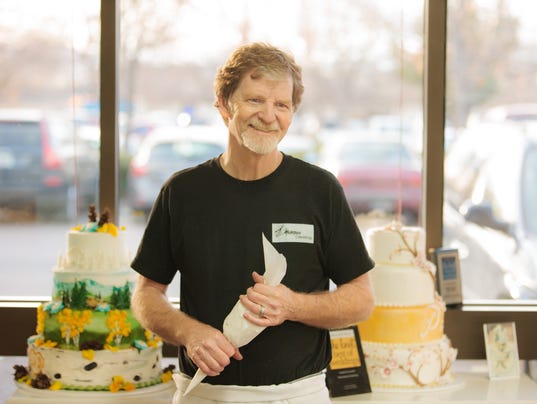
Cake Baker's POV

Do you find Jack's perspective compelling?  I do.  Not sure anyone (artist or otherwise) should be compelled to apply their skills against their will, even if this frustrates or insults others.

If a business owner is willing to sacrifice that business (and risk the reputational impact), they should be free to do so.

Here's why I can’t custom-design cakes for same-sex weddings


What I didn’t say was that I wouldn’t sell them a cake.

I’m happy to sell a cake to anyone, whatever his or her sexual identity. People should be free to make their own moral choices. I don’t have to agree with them.

But I am responsible for my own choices. And it was that responsibility that led me to decline when two gentlemen came into my shop and invited me to create a wedding cake for their same-sex ceremony.

Designing a wedding cake is a very different thing from, say, baking a brownie. When people commission such a cake, they’re requesting something that’s designed to express something about the event and about the couple.

What I design is not just a tower of flour and sugar, but a message tailored to a specific couple and a specific event — a message telling all who see it that this event is a wedding and that it is an occasion for celebration.

In this case, I couldn’t. What a cake celebrating this event would communicate was a message that contradicts my deepest religious convictions, and as an artist, that’s just not something I’m able to do, so I politely declined.

But this wasn’t just a business decision. More than anything else, it was a reflection of my commitment to my faith. My religious convictions on this are grounded in the biblical teaching that God designed marriage as the union of one man and one woman.

Obviously, not everyone shares those convictions. I don’t expect them to. Each of us makes our own choices; each of us decides how closely we will hold to, defend and live out those choices.

The two men who came into my shop that day were living out their beliefs. All I did was attempt to live out mine. I respect their right to choose and hoped they would respect mine.

They did not. And, considering all of the hate mail, obscene calls and death threats my family has received since I was sued, a lot of other people don’t see tolerance as a two-way street, either.

But the Constitution does. The First Amendment defends my right to create custom cake art that is consistent with my faith, while declining requests that ask me to celebrate events or messages that conflict with my faith. As a cake artist, I can live out my faith in my day-to-day life, and make that faith the basis for my creative decisions.

We live in a big, diverse nation. We don’t all have to agree on religion. We don’t have to agree on questions of sexual morality. We don’t even have to agree on the meaning of marriage.

What we should be able to agree on is our mutual freedom, as Americans, to live out the ideals that are most important to us.

Just as I shouldn’t be able to use the law to force others to design something that promotes my beliefs, others shouldn’t be able to force me to design a cake that celebrates theirs.

That, for me and those at Alliance Defending Freedom who are defending me, is what this case is about. I hope the U.S. Supreme Court affirms that basic freedom.

And if those who oppose me would grant me a certain measure of respect — not as someone they agree with, but as a fellow citizen free to stand by my own moral choices, well … that would be icing on the cake.

Jack Phillips is the owner of Masterpiece Cakeshop in Lakewood, Colo. Oral arguments for Masterpiece Cakeshop v. Colorado Civil Rights Commission will be heard Tuesday.

20 October, 2017

Taxes and 'Fair Share'


How exactly are the rich not paying their 'fair share' again?  

Any why is it inappropriate that tax reform reduces income taxes for the people who actually pay the tax?