Showing posts with label Climate Change. Show all posts

25 July, 2021

Global Warming - Inconvenient Facts

 Another Global Warming Fact Alarmists Want Buried

pxhere.com

The entire climate change movement has been shady from its beginnings. Data have been hidden, truth has been sacrificed to politics, and hypocrisy and personal interests among its “leaders” have produced a giant credibility deficit. The more we learn, the worse the alarmists look.

Take, for instance, a new report that shows greenhouse gas emissions are not an American or Western problem. They are primarily a Chinese problem. A study from Sun Yat-sen University in China found that more than half of the world’s urban greenhouse gas emissions are generated in only 25 big cities, and 23 of them are located in China.

In other words, if the entire developed world cut its greenhouse gas emissions as activists, politicians, journalists, and celebrities have demanded, nothing would change regarding the climate. (This assumes human carbon dioxide emissions are responsible for warming the planet, which is a load of speculation that’s yet to be proved.)

The paper’s findings remind us of the great plastic scare that’s “inspired” lawmakers to outlaw single-use plastic bags, plastic straws, plastic utensils, and other modern products, in a mass pretense of doing something when in reality they’re doing nothing but inconveniencing people.

The data show ​​90% of ocean plastic pours into the sea from “the top 10 rivers with the highest loads” of plastic debris, according to the Helmholtz Centre for Environmental Research in Germany. None are in the U.S., which contributes only about 1% percent of all plastic debris found at sea. Eight of them though are in Asia, while two are in Africa.

While it provides useful information, the Sun Yat-sen study isn’t a shocking revelation. We’ve known for at least a decade that while agitators campaigned to force developed economies to eliminate fossil fuel use, China and India have been busy building hundreds of coal plants in an effort to spread the First World prosperity that the climate alarmists have enjoyed their entire lives. Late last year, the Canadian Energy Centre, affiliated with the Alberta government, reported that as of 2020, 350 coal-fired power plants were under construction worldwide. Seven were in South Korea, another 13 in Japan. But China and India were building 184 and 52 plants, respectively. 

China, which has not lived up to its emissions pledges even as the U.S. has decreased its GHG emissions, “is also building and financing hundreds of other coal-fired power plants in countries such as Turkey, Vietnam, Indonesia, Philippines, Egypt, and Bangladesh.”

A few months after the Canadian report, Yale Environment 360 noted that “despite pledges to cut emissions,” China, responsible for 28% of GHG emissions though it makes up less than 19% of the world’s population, has been “on a coal spree.”

Yet the U.S., and the developed nations of the West, which have zero cities listed among the top 25 greenhouse gas emitters – New York City is 26th – and only eight in the top 50, are the focus of climate activists.

Environmental zealots, more than a few of them elected and appointed officials, are constantly bullying Washington over international emissions agreements that will hurt the U.S. economy; telling Americans they have to live more primitively because they wreck the planet a little every time they consume conventional energy; and that they must make sacrifices for the health of Gaia. The hectoring never ends, the exaggerations never stop, the lies flow freely.

That China is rarely a target of the fanatics tells us a lot: The climate scare is more about pulling down capitalism, weakening the U.S. and other developed nations, cranking out international transfers of wealth, and advancing socialism than it is about saving the world. It’s no coincidence that the countries that are constantly mugged by the alarmists are those whose economic systems are the furthest removed from socialism on the political spectrum. There’s no reason for them to denounce China because it’s already laboring under the system they want to inflict on the world.

It’s a not-so-little secret among the environmental extremists that’s dirtier than Beijing’s polluted skies.

— Written by the I&I Editorial Board

17 January, 2021

Falling CO2, Rising Temperatures

It's hard to know the direct relationship between CO2 and the timing of climate warming, but the author makes some interesting points here regarding the fact CO2 has fallen significantly worldwide due to COVID lockdowns, yet temperatures seem unaffected. If we want to 'follow the science', we must also incorporate evidence that leads us in new directions.

Falling CO2 Emissions Expose 'Global Warming' Alarmism As Anti-Science

By David Simon
January 15, 2021

The “experts” that dominate government, big business, universities, and international institutions vitriolically insist that “science” purportedly establishes beyond doubt that carbon dioxide emissions are raising global temperatures and that the warmer earth will be catastrophic.

In 2020, the pandemic-induced shutdowns that inflicted so much economic harm, particularly on the Third World’s already poor, reduced CO2 emissions by a record-breaking 7 percent. Those demanding that Americans reduce emissions must be especially pleased: the U.S. led the world with a 12 percent reduction.

Prevailing scientific orthodoxy dictates that lowering CO2 emissions will restrain global warming. Yet NASA data show that the planet’s temperature increased by 0.03 degrees Celsius in 2020, more than double the average annual increase since 1920.

So much for the supposedly conclusive “scientific” link between CO2 emissions and global warming. Yet demands to reduce CO2 emissions continue unabated. Their insistence that we accept a theory contradicted by facts disregards basic scientific principles, fails to “follow the science,” and instead reflects religious views about the earth’s climate.

The assertion that reducing CO2 emissions will limit the planet’s warming isn’t the worst of the anti-scientific claims that dominate the climate change debate. That honor goes to the assertion that global warming is harmful and will be catastrophic. The scientific evidence contradicts this theory and shows the opposite: a warmer earth is beneficial.

A 2017 statement by some of the world’s most eminent scientists – such as Richard Lindzen of MIT, William Happer and the late Freeman Dyson of Princeton, the late Fred Singer of the University of Virginia, and Judith Curry of Georgia Tech – attests that “[o]bservations [over the last] 25 years … show that warming from increased atmospheric CO2 will be benign.”

Their statement notes that “carbon dioxide … is not a pollutant but a major benefit to agriculture and other life on Earth.” The dry ice used to keep the coronavirus vaccines cool, indeed, is solid frozen CO2.

Perhaps the strongest evidence that global warming is beneficial rather than harmful was published by the British medical journal The Lancet in 2015. This study by 22 scientists from around the world found that cold kills over 17 times more people than heat.

The scientists examined over 74 million deaths in Australia, Brazil, Canada, China, Italy, Japan, South Korea, Spain, Sweden, Taiwan, Thailand, the United Kingdom, and the United States in 1985-2012. They found that cold caused 7.29 percent of these deaths, while heat caused only 0.42 percent.

And small temperature changes are particularly significant. The study found that “moderately hot and cold temperatures” caused 88.85 percent of the temperature-related deaths, while “extreme” temperatures caused only 11.15 percent.

The data also show that global warming over the last one hundred years has neither increased harm from natural disasters nor prevented dramatic economic growth that has lifted billions out of poverty.

Natural disaster data compiled by EM-DAT (The International Disaster Database), indeed, show the opposite: since 1920, as the earth has warmed by 1.29 degrees – and as world population has quadrupled from less than two billion to over seven and half billion – the number of people killed by natural disasters has declined by over 80 percent, from almost 55,000 per year to less than 10,000 per year.

Air pollution data compiled by University of Oxford economist Max Roser and researcher Hannah Ritchie also are encouraging. Since 1990, while the planet’s temperature has risen by 0.57 degrees, the global air pollution death rate has declined by almost 50 percent, from 111.28 to 63.82 deaths per 100,000 people.

The economic data are even more positive. Oxford’s Roser also has reported that since 1920, as planet’s temperature has risen, the share of people living in extreme poverty fell from 67 percent in 1950 to less than 10 percent by 2015.

But what of the supposedly fast approaching catastrophic harm to the world economy? A 2019 National Bureau of Economic Research study suggests that it will be minimal.

Since 1960, as the earth has warmed by 1.05 degrees, global income per person has skyrocketed from $452 to $11,436 in 2019, according to World Bank data compiled by Macrotrends. That reflects a growth rate of over 5.6 percent per year.

If over the next 80 years, global income per person increases at just one fourth of that rate, i.e., at 1.4 percent per year, it will reach $34,778 in 2100.

The 2019 NBER study estimated that if the earth’s temperature rises by 0.01 degrees per year through 2100, world GDP in 2100 will be 1.07 percent lower in 2100 than it would otherwise be. This would reduce income per person from $34,778 to $34,406.

Even NBER’s extreme case projection that world GDP will be 7.22 percent lower in 2100 than it would otherwise be if the planet’s temperature rises by 0.04 degrees per year (over three times the actual rate of increase since 1920) similarly would leave income per person at $32,267.
In other words, regardless of any negative impact that global warming may have, world income per person in 2100 would be about three times today’s level.

The bottom line is that the case to limit CO2 emissions and global warming fails the most basic tests of sound science.

David M. Simon is a senior fellow at the Committee to Unleash Prosperity and a lawyer in Chicago. For more, please see www.dmswritings.com.

10 September, 2019

Untouched by Climate Change Reality

For years global Cassandras have predicted that doomsday is at hand


By Richard W. Rahn - - Monday, September 9, 2019

If the government had not spent any tax dollars trying to mitigate climate change during the last 30 years, how much warmer would it have been and how much higher would the sea level be? The correct answer is, no measurable change. To the extent that mankind has an influence on climate change, the United States is a minor player. The United States has been reducing emissions of carbon dioxide, but these reductions are overwhelmed by the increases coming from China, India and some others.

If you really thought that the ocean level was rising rapidly, would you buy a house next to the sea? If you really thought that increased carbon dioxide emissions threatened the very existence of mankind, would you be so selfish as to fly around in a private jet, have houses with many times the carbon footprint of the average person, etc. etc.? Former President Obama just bought his family a very large seafront home. Many of the most vocal Hollywood crowd have multiple large homes, including on the beach, private jets, limos, etc. Their actions are more important than their forked-tongue utterances.

If the United States went to zero carbon emissions next year, it would have no measurable effect on global temperatures or sea level rise. For decades, the global Cassandras have been telling us we have only a limited number of years or it “will be too late.” In 1989, the claim was that doomsday was 11 years away. The year 2000 came and went without the “required actions,” and nothing changed.


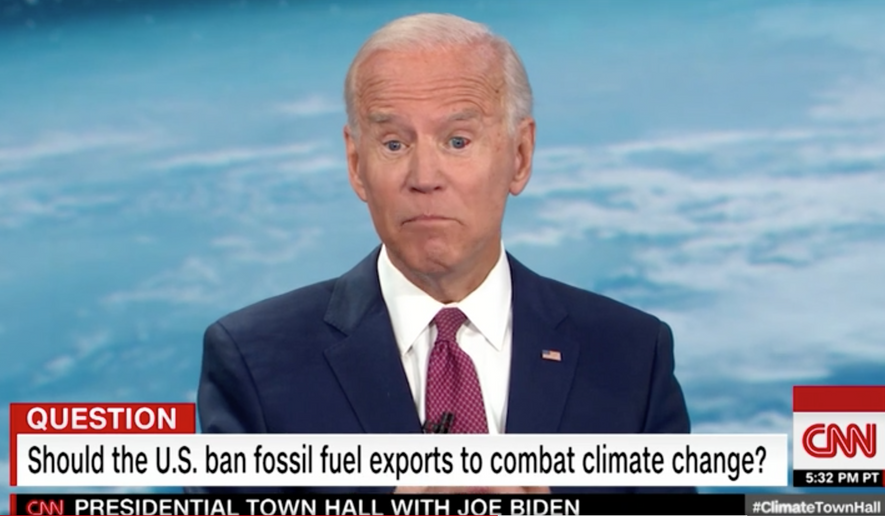
This past week, CNN held a seven-hour forum where the various Democratic candidates for president presented their solutions for the “climate crisis.” Each one had a different cost estimate for their solution, as well as a different number of years before the world comes to the end — again, as you recall it did in 2000. Both the cost numbers and the years to the “end” seem to have been untouched by reality.

Joe Biden wants to spend $1.7 trillion over 10 years. Elizabeth Warren wants to spend $3 trillion over the next decade, and Bernie Sanders wants to spend precisely $16.3 trillion over the next 10 years. (By way of comparison, the U.S. GDP is about $20 trillion.) All of the candidates are rather unclear as to what exactly we get for all of the taxpayer money to be spent. If each of the programs is designed to avoid a climate “catastrophe,” it seems most sensible to go with the cheapest — the Biden plan.

Mr. Sanders wants to ban drilling on public lands and fracking anywhere. He also wants to nationalize power companies and expand worker-owned grocery stores and food-processing plants. A similar plan was tried in the old Soviet Union — and, as you may recall, it resulted in Chernobyl, power and food shortages. Ah, but next time they will get it right.

Ms. Warren also wants to ban drilling and fracking on public land, and end the political influence of the fossil fuel companies. She would zero out emissions between 2028-35. The energy deficit would be made up from imprecisely specified green energy.

Unlike most of the others, Mr. Biden’s plan at least has some connection to reality. He is willing to consider small nuclear units, but he insists that we totally phase out fossil fuels by 2050.

Assume that the goal is to move toward zero net emissions of carbon dioxide by some realistic future date. It could be done in a non-economically destructive way, by expanding nuclear to take care of most of the base load. (Note the table — France uses nuclear for about 70 percent of its power. It has done this safely for a half-century, as has the U.S. Navy, which has been using nuclear power in its major ships for many decades.) Natural gas is almost perfect for dealing with power demand surges since it can be quickly turned on and off, unlike wind and solar. Recent studies have shown there is enough suitable land for growing more trees in the United States, Canada, Russia and China to almost totally offset the carbon emissions from burning natural gas (trees inhale CO2 and exhale oxygen — and they look nice and shield much manmade ugliness). In sum, it is very possible to have a more efficient electrical system that over time is carbon neutral.

The U.S. political and media class have managed to turn people who are heroes into villains. For years, the fact that the United States was dependent on less than savory foreign countries was viewed as costly and dangerous for the national well-being. The problem was solved by oil-men, many with advanced degrees in geology and physics who developed fracking, horizontal drilling and other techniques for producing much more oil and gas at much lower prices, and with lower emissions. Thank goodness for realistic private businessmen rather than government/socialist talking heads who would have left the world dependent on whale oil.

13 October, 2018

'Global Warming' - Disaster imminent this time (but ignore previous predictions)

Good news: we now have until 2030 to save the earth
Ross Clark

Phew! The dangers of global warming are receding. Admittedly that is not how most news sources are reporting the publication of the latest IPCC report this morning. But it is the logical conclusion of reading coverage of the issue over the past decade.

According to today’s IPCC report we now have 12 years to avert climate catastrophe. That might not sound long, but it means we are a good deal further away from doom that we were in 2007, when the WWF said we had five years to save the world. The doomsday clock hadn’t moved in 2011 when the International Energy Agency warned us that we had five years to start slashing carbon emissions or lose the chance forever. By last year it had shortened to three years, according to Christiana Figueres, the executive secretary of the UN Framework Convention on Climate Change. But now it’s right up at 12 years, presumably meaning that we can pretty twiddle our thumbs until 2030 – a whole 18 years after the WWF told us the world would come to an end if we didn’t slash carbon emissions.

And no, the world hasn’t made any progress in cutting emissions since the WWF sounded its warning siren. In 2007, according to the Oak Ridge National Laboratory in Tennessee, human activities emitted 8503 million tonnes of carbon. By 2012, when we were supposed to have slashed carbon emissions or face imminent doom, emissions were up to 9673 million tonnes. In 2014 – the latest year for which the laboratory has produced figures, it was up to 9855 million tonnes.

It isn’t hard to spot the problem with issuing frightening-sounding deadlines. If the deadlines come and go, without us managing to lower emissions and yet still life goes on, it makes the people setting the deadlines look rather foolish. It is also somewhat counter-productive. Given the failure of the world to come to an end, it is tempting to say, just as we do when religious cults and other fantasists make doom-laden predictions which fail to come to pass: well, the whole thing must be a hoax. What is the point of listening any further?

If the IPCC and others want us to reduce carbon emissions – and there is every reason why we should want to do this, for reasons of averting climate change as well as localised pollution – it would pay them to adopt rather less hyperbole. The over-close deadlines prevent a measured response which might actually achieve something – and without ruining the global economy. One country which has cut carbon emissions over the past two decades (and without doing as Britain has done over that period by offshoring much of its energy-intensive heavy industry) is the US. How? By replacing much of its coal-fired electricity generation with plants which burn gas from fracking wells.

How ironic that it is the US which is seen as the international pariah of the climate change lobby while Germany, which is seen as a goody-goody nation, always willing to put its name to the latest treaty, has failed to cut its emissions. Germany’s problem is that it is trying to leap to a low-carbon economy in one go, via solar and wind power – while coal plants are maintained in order to make up the huge gap between the energy that green energy manages to produce and energy the country consumes.

The story of the world’s attempts to slash carbon emissions is a story of hares and tortoises – with the hares’ little legs worn out by trying to react to demands that they run ever faster.

17 August, 2018

Is the Earth Warming?


How Do You Tell If The Earth's Climate System "Is Warming"?
August 09, 2018/
Francis Menton

The earth's climate system "is warming." True or false? The answer is that there is no definitive answer. And if someone tells you there is, then that person doesn't know what he or she is talking about.

A more precise answer to the question is that whether the earth's climate system "is warming" or "is cooling" entirely depends on who gets to pick the start date for the analysis. If you are the one who gets to pick the start date, then you can make it so that the system is either warming or cooling, whichever you would like for your purpose of the moment.

But of course, there are many people out there today with a lot invested in the proposition that the climate system "is warming." That proposition is a key tenet of global warming alarmism. To "prove" the point that the system "is warming," advocates use the simple trick of picking a start point to their liking, making for a presentation that appears to support their position. Have you been fooled by this simple trick? The advocates leave it up to you to figure out that if you picked a different start point, you could just as easily make an equally convincing presentation showing that the climate system "is cooling." A lot of seemingly intelligent people can't figure that out, and get taken in by the scam.

I raise this point today because it appears that, as part of the campaign to suppress disfavored political speech, Google has begun within the past few days adding a legend at the bottom of YouTube videos that express politically incorrect views in the field of climate science. For example, here is the legend that they have added to a video made for Prager University by eminent MIT atmospheric physicist and climate skeptic Richard Lindzen:


"Multiple lines of scientific evidence show that the climate system is warming."

The quote comes from the first two sentences of this Wikipedia entry with the title "Global warming." Well, Wikipedia says it, so I guess it must be true!

According to this post at BuzzFeed on August 7, others who have been subject to having the same legend affixed to their work include Tony Heller of the Deplorable Climate Science Blog, Mark Morano of Climate Depot, and the Heartland Institute. (So far, nothing comparable has happened to the Manhattan Contrarian; but then, I don't make YouTube videos.)

So let's investigate the question of whether the earth's "climate system" is or is not warming. You could, for example, look at the chart presented by Wikipedia in that entry. Here it is:


That looks rather dramatic. On the other hand, the whole vertical scale of the chart is only about 1.5 deg C; and they picked 1880 as their start date. (The slope here is also greatly accentuated by some very large and questionable "adjustments" that have made earlier years cooler and more recent years warmer. You can read my eighteen part series "The Greatest Scientific Fraud Of All Time" for much more detail. But those details are not critical for understanding the current issue.)

Does your skeptical mind possibly think, when they use that phrase "century scale," is that just a bias-free description of the issue at hand, or is it instead a hand-wave to provide a fake justification for picking a preferred start date? Why do we need to go back 138 years when we are considering a question phrased in the present tense -- whether the climate "is" warming? Wouldn't the present tense normally be used to cover a much shorter period, like a year or two or three at most? So you ask, what has the climate system been doing during that time? For the answer, how about looking for temperature data to the far more accurate UAH satellite-based series which provides monthly data points going back to 1979. Here is the latest chart from that source:


This time, you get to pick the start date. To cover the last few years, how about picking early 2016? After all, these last couple of years should be a much better indicator of whether the climate "is" warming or cooling than the entire last 138 years. Really, what do temperatures more than 100 years ago, or even 30 or 40 years ago, have to do with the question of whether the earth's climate "is" warming? So we look at the UAH chart, and we find our answer: since early 2016 temperatures have fallen by more than 0.5 deg C. Thus, once we get to pick our preferred start time, it is obvious that the climate system "is cooling."

Or, you can pick a different start date to your liking. How about 1998? That will give you an entire 20 year run. It's hard to say that the verb "is" should cover a period of more than 20 years. On the UAH series you can see that temperatures have also fallen about 0.4 deg C since early 1998. Again, even on this substantially longer scale, the earth "is cooling." (Note, however, that there is a significant difference between the Wikipedia chart and the UAH satellite series as to what has happened since 1998. On the Wikipedia chart the latest reading (2017?) is up about 0.3 deg C from 1998; while on the UAH series, the latest reading (July 2018) is down about 0.4 deg C from the then-records set in 1998. That's those "adjustments" in the surface temperature record that I was talking about. I would say that there is no credible position that the heavily adjusted surface temperature record that Wikipedia relies on should be used for this purpose over the far more accurate and un-tampered UAH satellite record.)

But how about if we decide that there is something to this "century-scale" thing? Let's agree that we're going to go back many, many decades to determine if the earth "is warming." But if we're going to do that, where do we stop? If you want, you can go back a hundred million years; or even a billion. And if you follow this subject a little, you probably know that the 1700s and 1800s are a very suspect era to start a series like this, because those centuries are a known cold period sometimes referred to as the "Little Ice Age." Picking a date in the "Little Ice Age" as the start point to prove warming is what's called "cheating." Let's pick something more fair. How about going back a nice round millennium? Was that time warmer or cooler than now?

OK, they didn't have networks of thermometers set up around the globe in the 11th century, let alone the highly accurate satellites that we have today. But scores of scientists have done hundreds of studies based on many sorts of "proxies" to determine at least whether it was warmer or cooler at that time than today. It turns out that the evidence is rather overwhelming that it was warmer. Actually, this is what is known as the "Medieval Warm Period." But picking a date in that period as your start date for deciding whether the earth "is warming" is no more fair or unfair than picking a date in the "Little Ice Age."

Here is a compilation of dozens of studies reaching the conclusion that the Medieval Warm Period was warmer than the present: "More than 700 scientists from 400 institutions in 40 countries have contributed peer-reviewed papers providing evidence that the Medieval Warm Period was real, global, & warmer than the present." Examples:
"Paper finds Medieval Warm Period in Arctic was much warmer than the present."
"Medieval Warming Exceeds Modern Warming, Per New Research Using 120 Proxies."
"Earth was warmer in Roman and Medieval Times say German researchers."

There are literally dozens more, if you follow the links. The conclusion is inescapable: on a centuries-scale basis, the earth's climate system "is cooling."

And by the way, if you want to keep going back farther and farther, you can keep finding time periods that were warmer than the present. Examples: the Roman Warm Period, from around 250 BC to 450 AD; and the Holocene Climate Optimum, about 5000 to 3000 BC.

So here's the real answer to the question of whether the earth's ciimate system "is warming":
If your start date is June 2018, it "is warming."
If your start date is January 2016, it "is cooling."
If your start date is January 1998, it "is cooling."
If your start date is 1880, it "is warming."
If your start date is the year 1000, it "is cooling."
If your start date is the Dark Ages, it "is warming."
If your start date is Roman times, it "is cooling."

In short, the question is completely meaningless.

It's hard to believe that the supposed geniuses at Google could be taken in by a scam so obvious and so transparent. But that's the world we live in.

25 September, 2017

Climate + Science Deniers


Global Warming: Who Are The Deniers Now?

Climate Change: Global warming is "settled science," we hear all the time. Those who reject that idea are "deniers." But as new evidence trickles out from peer-reviewed science studies, the legs beneath the climate change hypothesis — that the earth was doing just fine until carbon-dioxide spewing human beings came along — is increasingly wobbly.

A new study published in the journal Nature Geoscience purports to support action by global governments to reduce carbon dioxide output in order to lower potential global warming over the next 100 years or so. But what it really does is undercut virtually every modern argument for taking radical action against warming.

Why? The study admits that the 12 major university and government models that have been used to predict climate warming are faulty.

"We haven't seen that rapid acceleration in warming after 2000 that we see in the models," said Myles Allen, professor of geosystem science at Oxford and one of the authors of the study. "We haven't seen that in the observations."

And, of course, he's quite right. As we've noted here numerous times, the much-feared "global warming" trend seems to have halted somewhere around 1998. We know this is true because satellite temperature readings — the most accurate temperature gauge since it takes in the entire atmosphere, not just parts of it — show there's been virtually no change.

Based on the U.N.'s models, temperatures should have been shooting up sharply starting in about 1995. By this year, model temperatures show we should have had just under a 1.0 degree centigrade rise in temperature, a significant temperature spike in what is, in geological time, an extremely short period. It was those models that were used to sell the world on the idea that we needed a drastic reordering of our global economic priorities immedialy.

The reality: virtually no change in temperature. Put simply, the models are wrong.

And yet, advocates of the global warming dogma continue to ruin the careers of scientific apostates and hurl insults like calling skeptics "deniers" — which likens those who disagree about global warming science to those who "deny" the existence of the Holocaust — while denying painfully obvious facts about "climate change."

As we noted back in May, we noted that the Sunday Telegraph of Britain had reported that temperatures had dropped sharply early this year following the supposed "hottest year on record" in 2016. How could that be? 2016 was an El Niño year, which are always unusually hot.

"In recent months global temperatures have plummeted by more than 0.6 degrees: just as happened 17 years ago after a similarly strong El Niño." Not only that, but despite doom-and-gloom prognostications by global warming's biased, bought-and-paid for "scientist" forecasters, ice in the Arctic and Greenland both grew this year.

Recent revisions of climate data have all been in one direction: Older data have been revised to show cooler temperatures, more recent ones, warmer temperatures. Statistics would suggest that random errors would be not all in one direction.

So it looks suspiciously like scientist-statisticians who are getting big fat checks from governments that have every interest in selling the idea of inevitable and disastrous global warming are, if you will, cooking the books.

This might be merely an academic dispute if not for one thing: To remediate it, the United Nations and a legion of scientists around the world riding the global warming gravy train are seeking to have the world spend 2% of its GDP just to slow climate change.

That's about $1.5 trillion a year, at current levels of world GDP, an enormous amount. And most of it would come from the U.S. and a small handful of other rich nations. A huge tax on you to remedy a phantom threat, in short.

No one doubts the climate is changing. That's why it's called "climate," not "stasis." The scientific knowledge of climate is still in its infancy.

But now that we have further evidence in the form of another peer-reviewed study that shows the global warming models are flawed at best, fraudulent at worse, we do agree with global warming advocates on one thing: We need to take action.

So once again, we call on President Trump to pull out of the Paris Agreement on climate change. That bad deal won't change the climate one bit, but it will hurt the world economy and lower Americans' standard of living.

And we ask: Based on the growing evidence, who are the real deniers?