Showing posts with label free speech. Show all posts

27 May, 2016

Gawker + Thiel + Free Speech


The Liberal Case Against Peter Thiel Is The Worst Kind Of Hypocrisy
Hysteria over the Gawker suit is unconvincing— especially when you consider who’s leading the charge.
May 26, 2016 By David Harsanyi

We recently discovered that Peter Thiel, libertarian (?) billionaire co-founder of PayPal and early investor in Facebook, has been bankrolling lawsuits against the gossip site Gawker.

Now, as someone who considers himself a near-absolutist on free speech, I’m open to hearing arguments for why we need tort reform in these sorts of cases or why Hulk Hogan’s suit undermines free expression. But so far, the media’s hysteria about Thiel’s third-party legal funding has been unconvincing — especially when we consider who’s making the arguments.

And after wading through the thousands of angst-ridden words, I noticed that the case mostly boils down to two objections: Thiel’s motivations and Thiel’s money. And when I say Thiel, I mean Thiel. There is little anxiety over third-party funding when we’re talking about the giant apparatus the Left uses to implement their own will via the courts. Even more hypocritical is the fact that many of the same people so distressed about the future of sex tapes regularly advocate for policies that would allow the state to inhibit political speech.

Ezra Klein, for instance, writes that what’s “endangering Gawker is Thiel’s endless resources, and his apparently limitless appetite for revenge. Those tools can be used by anyone with enough money, against any media target they choose, for any slight they perceive.”

Josh Marshall says it’s a “Huge, Huge Deal,” and writes, “We don’t have to go any further than Donald Trump to know that the incredibly rich often use frivolous litigation to intimidate critics and bludgeon enemies.”

Thiel is “reinventing the concept of philanthropy so as to include weapons-grade attacks on America’s free press,” writes Felix Salmon, who goes onto say that Thiel’s success has essentially given other billionaires a blueprint on how to put critics out of business. Slate says Thiel is the bully here.

Which would all be very upsetting if true.

There’s a question that should not be lost in this debate: is it an invasion of privacy to make public a tape—not a news story about a sexual indiscretion or a snapped picture of a sexual indiscretion in some public place, but a movie of a person engaged in sex in private—without the consent of the person in it? In other words, was this lawsuit really “frivolous?” Not according to a judge. Not according to the jury that awarded Hogan more than $100 million. And not according to a circuit court judge that upheld that verdict.

There’s no doubt the judicial system has its share of ridiculous decisions, frivolous lawsuits and hyper-litigious troublemakers. So what precedent has Thiel really set? Well, we’ve probably seen the end of sites posting private sex tapes without permission. If you’re upset about the amount Gawker is on the hook for, let’s talk about capping awards. But the contention that Thiel is abusing the system because of a “limitless appetite” for revenge would be a lot stronger if he hadn’t actually won the case.

Now, whether Thiel was compelled to engage in this crusade because he was “slighted” by Gawker is immaterial. Some rich people are motivated to act because they are slighted, others because of ideology, or empathy or hate, or because there’s a media outlet that believes it’s okay to run sex tapes of people as long as they’re not under the age of four. So what?

Moreover, if Thiel’s motivation were a cause liberal pundits felt some moral or ideological affinity towards, they would be cheering him on. Vox asserts that Thiel “sees his lawsuit as a public-spirited attempt to enforce norms of decency and respect for personal privacy.” Or, in other words, he uses the judicial system the same way liberals have for decades when trying to enforce their own norms—including ones on abortion rights, gay marriage, and basically everything else they value.

Actually, every contemporary major lawsuit of any political consequence has probably been funded in some way by a third party. If Thiel is a problem, so is the pro bono legal work of wealthy lawyers who donate their time and resources to causes that move them. So is contingent litigation. So are class-action lawsuits. So is every advocacy legal group. Start with the ACLU, which is backed by hundreds of One Percenters and works to enforce its own norms of “decency and respect” when it comes boys’ and girls’ bathrooms and leads crusades to do away with the Free Exercise Clause.

By the way, Nick Denton is also a One Percenter. So are the owners of the New York Times and every other major media outlet you can think of. These One Percenters can just as easily destroy lives and abuse their powerful position and hire teams of lawyers. Sometimes the only way to fight back is to collectively fund an effort or find a third-party benefactor.

If press outlets feel that the sex tape case is worthy of a First Amendment fight, they could easily match Thiel’s $10 million investment. Otherwise, what do these critics propose? Should we pass a law capping the amount of funding people with the last names “Thiel” and “Koch” can provide for lawsuits? Ban billionaires from participating in the legal system?

But the most infuriating hypocrisy of the entire Thiel kerfuffle is that many of those wringing their hands have no problem with the overall deteriorating attitude regarding free expression on the Left. Some, in fact, actively argue for inhibiting free speech. I’m not only talking about the rampant illiberalism we see at institutions of higher learning or the abuse of government officials who are attempting to punish Americans who are skeptical of liberal doctrine. Some of them would be perfectly content handing over far broader and more consequential powers of censorship to the state, allowing government to literally ban movies and books with political messages. That includes the institutional position at almost every liberal publication lamenting the actions of Peter Thiel.

09 January, 2015

Time to stand up for free speech


The Future Should Belong To Those Who Can Slander The Prophet of Islam

By David Harsanyi
JANUARY 7, 2015

On September 9, 2012, Egyptian demonstrators in Cairo scaled the walls of the U.S. Embassy and pulled down the American flag, threatening the lives of those inside to protest a film they claimed was insulting to the prophet Mohammad. Reacting to this attack on our sovereignty and the lives of our citizens, the administration acted in the most un-American way imaginable, sending out this preposterous message:

The Embassy of the United States in Cairo condemns the continuing efforts by misguided individuals to hurt the religious feelings of Muslims — as we condemn efforts to offend believers of all religions.


The producer of this pointlessly inflammatory video was well within his rights to mock or slander any religion he chose however he pleased. So the statement irresponsibly perpetuated a false notion about how free speech works around here. Neither The Embassy of the United States in Cairo nor the president of United States has the power to apologize for your views on faith.

That’s, of course, only the most obvious problem. And the gratuitous groveling we do to allay the sensitivities of violence-prone Muslims (because who else are we attempting to placate?) has become a cringe-worthy aspect of American policy long before Barack Obama ever showed up. When the Bush administration, in the middle of the Danish carton controversy, claimed that “Anti-Muslim images are as unacceptable as anti-Semitic images, as anti-Christian images or any other religious belief,” it was equally wrong. As far as the state goes, they’re all “acceptable.” (Then again, you’ll only find yourself on an assassination list for one of the above.)


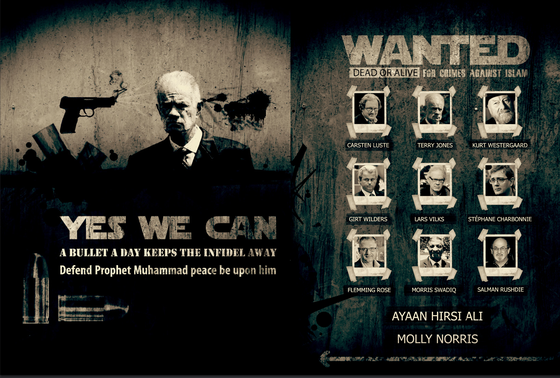
After the horrific and deadly terrorist attack on the Charlie Hebdo offices in Paris, France, it’s worth remembering again that there is no conciliatory rhetoric or kowtowing that will stop attacks on our liberal values. They won’t stop even if we give in, which is something we’ve done. It’s something we do quite often.

Surely you remember that the “Innocence of Muslim” fiasco didn’t end in Egypt. (Mollie talks about this more here.) U.S. taxpayers paid for television ads in Pakistan featuring footage of Barack Obama and Secretary of State Hillary Clinton during press a press conference – subtitled in Urdu – condemning the film. “We absolutely reject its content and message,” Clinton explained. Bro-ster Tommy Vietor, then spokesman for the National Security Council, told the Washington Post that the White House has “reached out to YouTube to call the video to their attention and ask them to review whether it violates their terms of use.” And due to this pressure – what amounts to no less than de facto censorship – YouTube pulled the video. The man ended up in prison and the extremists won.

When a pastor in Florida announced plans to burn a few copies of the Koran, the president didn’t head to TV and condemn those who were trying to inhibit free speech, but rather he pleaded with the pastor who was “proposing to do is completely contrary to our values … this country has been built on the notions of religious freedom and religious tolerance.” (Thanks for the reminder, @Popehat)

When the French government was going to temporarily shut down 20 embassies and schools in various theocracies to safeguard their citizens abroad from potential violence, the American administration offered this gibberish: “We are aware that a French magazine published cartoons featuring a figure resembling the prophet Muhammad, and obviously we have questions about the judgment of publishing something like this.” Was the United States government aware that Charlie Hebdo had been mocking all religious denominations, and that images mocking Jews and Catholics were likely just as offensive? The threat of violence is the only conceivable reason government has to become a critic of satire.

And even when the administration does try its hand at some perfunctory equivalence, they botch it. Most people remember Obama’s infamous pleading at United Nations, that “the future must not belong to those who slander the prophet of Islam.” But what he went on to say yo the world was probably even more dangerous:

But to be credible, those who condemn that slander must also condemn the hate we see in the images of Jesus Christ that are desecrated, or churches that are destroyed, or the Holocaust that is denied.

Why would the president conflate the destruction of a church – an act of violence – with a non-violent act of free speech? Why would he compare criticism of ideology with the irrational movement in the Muslim world of denying history?

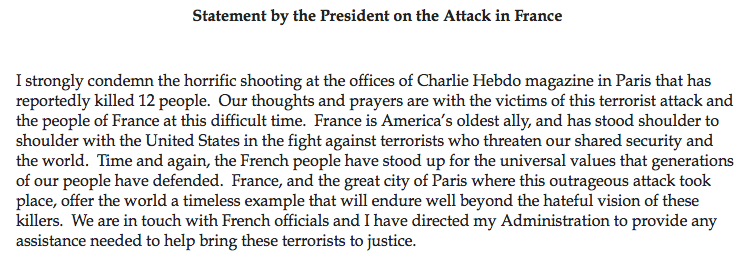
Why would the president, in condemning the Paris attacks, curiously leave out an important fact?


Perhaps he is only being diligent, rather than jumping to conclusions regarding Islamic terrorism. But then again, history says probably not.

Of course, it’s not this (or any other) administration’s fault that a major faction of one of the world’s major religions still believes that hurt feelings alone is justification enough to go out and massacre people. What the state’s squishy position does is fly in the face of the incontrovertible evidence that this one group has a near-monopoly on most of the world’s religious violence. Some people deserve more mockery than others. An uncomfortable fact that drives of us to type ludicrous things like:

People kill in the name of all religions—incl Islam, Christianity, Judaism. They don’t represent entire community. They are EXTREMISTS.

— Sally Kohn (@sallykohn) January 7, 2015

Funny how we don’t have to worry about our lives after mocking the Pope, though, isn’t it?

23 December, 2014

The right to pass through life without encountering any disagreeable thought


Texas takes aim at the First Amendment


By George F. Will 
December 17


The Battle of Palmito Ranch near Brownsville, Tex., on May 13, 1865, is called the last battle of the Civil War, but the Texas Division of the Sons of Confederate Veterans (SCV) might consider that judgment premature, given its conflict with the state’s Department of Transportation and Department of Motor Vehicles. This skirmish is of national interest because it implicates a burgeoning new entitlement: the right to pass through life without encountering any disagreeable thought.

Under Texas’s specialty license plate system, plates can be created by the legislature by specific enactments, or they can, for a fee, be designed by individuals, nonprofits or businesses. In the private instances, Texas is selling space for advertising. The specialty plates exhort (Be a Blood Donor), emote (I’d Rather Be Golfing), celebrate (NASCAR, many universities) and commemorate (Buffalo Soldiers, Korea Veteran).

The Texas SCV’s design caused a commotion because the organization’s logo includes the Confederate battle flag. The Texas committee that approves specialty plates approved the SCV plate before it disapproved it because an official considered the plate “controversial.” The Texas Transportation Code says that the state may refuse to create a plate “if the design might be offensive to any member of the public.” Yes, any .

A district court rejected the SCV’s contention that this decision was unconstitutional, but the U.S. Court of Appeals for the 5th Circuit held that specialty plates are private speech, so the state had violated the First Amendment by engaging in viewpoint discrimination against the SCV.

Texas is appealing to the U.S. Supreme Court, probably in vain. The SCV’s brief notes that “every circuit to address a specialty plate program enabling private parties to submit their own specialty plate designs has held that the plates constitute private speech, the First Amendment applies, and regulation has to be viewpoint neutral.”

But there is, believe it or not, a body of license plate law. In 1977, the Supreme Court upheld the right of a Jehovah’s Witness in New Hampshire to edit out, with tape or metal shears or otherwise, that state’s license plate slogan “Live Free or Die.” The plaintiff held that “life is more precious than freedom” and that the state could not compel him to “foster” religious or political “concepts” with which he disagreed.

Some language that is put on plates by legislative action — e.g., Idaho’s “Famous Potatoes” — is government speaking its mind and need not be neutral. In Illinois, where specialty plates require a specific legislative enactment, when a pro-life group sought a “Choose Life” plate, the state decided to exclude the subject of abortion, pro and con, so the denial was viewpoint-neutral.

Texas, however, denied the SCV plate explicitly because it, with its flag, was “offensive,” which is an impermissible reason for denying speech. The hearing that forbade the SCV plate approved a Buffalo Soldiers plate even though some Native Americans had said they were offended by this reference to the 19th-century African American military units that participated in battles against Native Americans. In 2011, however, the Supreme Court held:

“The Constitution does not permit the government to decide which types of otherwise protected speech are sufficiently offensive to require protection for the unwilling listener or viewer. Rather . . . the burden normally falls upon the viewer to avoid further bombardment of [his] sensibilities simply by averting [his] eyes.”

The new entitlement aims to spare the people this burden. At many American colleges and universities, where thinking goes to hibernate, freedom of expression is restricted for the purpose of sparing the delicate sensibilities of the most exquisitely sensitive people on the campuses. The First Amendment is construed to stipulate that there shall be no abridgement of free speech — unless the speech annoys, saddens, angers, dismays or otherwise discombobulates the emotional equilibrium or intellectual serenity of any listener.

Inevitably, this entitlement is expanded to include the right to assume a fetal position and be absolved of burdens if news of some event in the wider world distresses some students. So, Columbia University Law School recently allowed students to postpone final exams if these frail flowers felt that their performance would be “impaired” because they had been traumatized by the fact that grand juries in Ferguson, Mo., and New York did not indict police officers in cases involving Michael Brown and Eric Garner.

Columbia evidently is training lawyers for a United States so tranquil it will not need any lawyers. Tranquil because silent.