Showing posts with label Equal pay. Show all posts

14 July, 2019

Article here

Contracts and the lack of a free market contributes to the gap in pay of women's soccer beyond mere gender discrimination.  I agree with the author's point that the national organization should be providing equal accommodations (food, lodging) for men and woman.

The U.S. Soccer 'Pay Gap' Is About More Than Just Sexism

The U.S. women's soccer team deserves better, but mandating equal pay isn't the answer.
| 
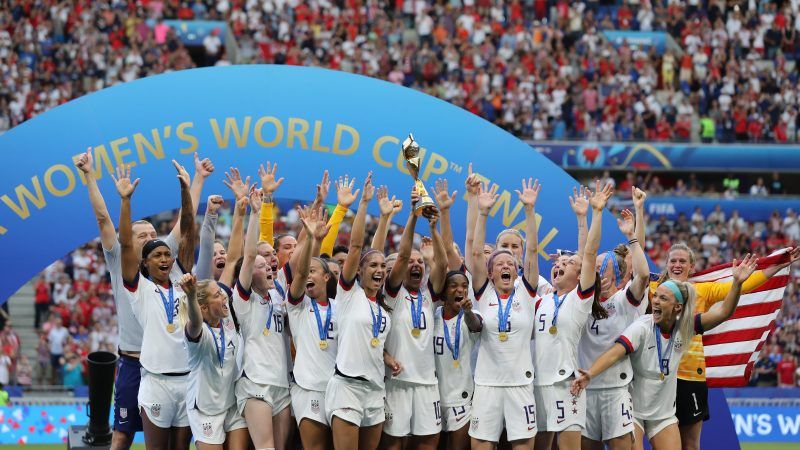
Members of the World Cup champion U.S. Women's National Soccer Team are agitating for better pay—equal to what the men on the U.S. team earn—after winning their second consecutive World Cup and their fourth overall. They were feted with a ticker-tape parade through Manhattan on Wednesday.
If pay exclusively reflected performance, there would be no doubt that Megan Rapinoe, Alex Morgan, Rose LaVelle, Julie Ertz, and the rest of the U.S. women's team deserve far more than what the men earn. The U.S. men's team, you may recall, failed to even qualify for last year's World Cup in Russia, and has not progressed beyond the tournament's quarterfinal round since the inaugural World Cup in 1930.
So it's easy to sympathize with the women's team when they demand better compensation—as they, and their fans, did during the trophy presentation on Sunday morning, shouting "equal pay, equal pay!" Presidential hopefuls have quickly judged which direction the wind is blowing and jumped aboard the cause. Sens. Elizabeth Warren (D–Mass.) and Kamala Harris (D–Calif.) have tweeted their support for equal pay on the soccer pitch, and New York Mayor Bill de Blasio on Wednesday said he would pay female athletes equally if elected president. Hillary Clinton has chimed in.
This debate is not happening only on the campaign trail, in New York's Canyon of Heroes, or on Twitter. The members of the U.S. women's team are suing their employer, the United States Soccer Federation, and the two sides have agreed to mediate the dispute out of court. That is important background for understanding why the women's team is trying to ramp up political and social pressure on the federation.
But, really, the debate over whether the U.S. women's team should be better compensated is about two related and overlapping issues. One is a matter of accounting and the other is about economics—specifically, about the importance of markets and about how workers are harmed when they do not exist.
Writing at Commentary, Christine Rosen dives deeply into the first argument. She notes that last year's American-less World Cup in Russia generated $6 billion in revenue, while the women's event in France this summer is expected to earn about $131 million. As a percentage of total revenue, FIFA (the body that governs international soccer and runs the World Cup) actually pays out larger prizes to the women's teams than to the men.
But what about the pay disparity between the American men's and women's teams, outside of prize money in major tournaments? The Wall Street Journal reports that the U.S. men's and women's teams have generated about the same amount of revenue from games played since 2015, although those totals account for only about half of U.S. Soccer's annual income. Yet, as Rosen again points out, the women's team continues to get shortchanged when it comes to the percentage of the federation's budget spent on "advertising and P.R., travel and training budgets, and…per diems for food."
U.S. Soccer has no good reason to feed the women's team less than the men's, or to make them sleep in subpar accommodations. Those inequalities should be addressed.
Beyond that, though, it's difficult to argue that the pay gap is unfair or sexist. It's largely the result of different pay structures that both teams have collectively bargained with the U.S. Soccer Federation.
Again, Rosen has the best explanation I've seen for the gap:
Because of the different pay structures, a straightforward comparison is difficult. The U.S. women earn a base salary of $100,000 annually, while the men are paid $5,000 per game, with bonuses for winning.
Why would the women agree to a different pay structure? In part, that probably has to do with how much players are earning elsewhere.
Professional soccer players are also paid by privately owned club teams. Megan Rapinoe, for example, plays for Seattle Reign FC, one of nine teams in the National Women's Soccer League (NWSL). Player's salaries in the NWSL range from about $16,000 to $46,000 annually, according to NPR. That's not a lot, and it's certainly less than even the lowest-paid players in Major League Soccer (MLS; the top North American men's pro soccer league), who earn a mandatory minimum salary of $60,000.
That pay gap isn't the result of sexism. It's what the market allows. Major League Soccer teams drew an average of 21,000 fans last year, while NWSL games drew about 6,000. The TV contract MLS has with ESPN and other broadcasters generates $90 million a year. While neither league discloses revenue figures, it's a safe bet MLS earns considerably more—and, thus, its players do too.
If that changes, women's salaries will increase—and, really, that's the best way to make sure your favorite World Cup players earn bigger bucks, as Rapinoe acknowledged during an appearance on Rachel Maddow's show this week.
"Fans can come to games," Rapinoe said. "Obviously, the national team games will be a hot ticket, but we have nine teams in the NWSL. You can go to your league games, you can support that way. You can buy players' jerseys, you can lend support in that way, you can tell your friends about it, you can become season ticket-holders."
She's absolutely right. For all the attention that the World Cup generates, club teams are always going to be where soccer players make their money. And those club teams are beholden to the same rules that govern private businesses everywhere: requiring the Seattle Reign to pay every player as much as the MLS' Seattle Sounders would bankrupt the women's team.
That brings us to the second part of the debate. Part of the problem facing the U.S. women is the fact that there are no markets in international soccer.
What I mean by that is that there is no ability for the U.S. women to demand better treatment by taking their talents elsewhere. Even if a player does qualify to play on multiple national teams (in the event they had parents from two different countries, for example), under FIFA rules she is locked in place once she makes a single appearance on the field for a national team.
Think about it like this: If Rapinoe is unhappy with her contract with Reign FC, she can field offers from the other eight teams in the NWSL. She could even take offers from women's teams in other countries—Sunday's World Cup finale was held in Lyon instead of Paris in part because the local club team, Olympique Lyonnais, has a reputation for paying high salaries to female players and, not surprisingly, attracting the world's top talent.
Even with markets, there would still be obvious financial constraints. The popularity of women's soccer and the revenue generated by individual clubs may not allow teams to offer Rapinoe or Morgan the amount of money those players feel they are worth.
When it comes to dealing with the national federation, though, the players have considerably less leverage. That's why even the most egregious inequalities between the treatment of the U.S. men's and women's teams are difficult to correct.
Above all, it's certainly not wrong for successful employees to demand better compensation, regardless of gender. But because international soccer lacks the market mechanisms that would otherwise help members of the U.S. Women's National Team achieve that goal, they are forced to resort to other, less efficient means. That's why they have to turn this into a public relations issue, and a legal matter.
Lacking any better economic incentive to get the federation to change its behavior, publicly shaming U.S. Soccer over the disparity between how the men's and women's teams are treated might be the best lever for fixing the supposed pay gap.

08 July, 2019

Women's Soccer and 'Equal' Pay

An interesting take on the 'equal pay for female soccer players' conversation.  Can pay be 'equal' if female players capture 20% of the revenue they generate while men receive only 9% of the revenue generated by their tournament?   


I'm not much of a soccer fan because I prefer watching sports, personally, but I was still happy to hear that the U.S. women's team won the World Cup over the weekend. I am far less enthused by the "gender pay gap" discussion that their victory inevitably generated, however.
The players on the women's team, along with the fans in the stadium, various presidential candidates, and a chorus of other feminists, have all insisted that female soccer players are the victims of a sexist wage gap. After all, they are paid less than male players, and misogyny is the only conceivable reason for this disparity. It is time, we are told, to rectify this injustice.
But is there any truth to these claims? Are women in soccer underpaid? If there is a gender pay gap, could there be a reasonable, non-bigoted explanation for it? Let's take a look at the facts.
First, we should clarify a crucial point. You've probably heard that the women should be paid more because they're better and they earn more revenue. Both of those claims are extremely misleading. It's true that the women's team is more successful against women than the men's team is against men. That does not mean that the women are actually better players. Keep in mind that the U.S. women's team lost to a bunch of 13- and 14-year-old boys a few years ago. If they couldn't beat adolescent boys, they can't beat grown men.
As for revenue, historically U.S. men's soccer has generated more revenue than U.S. women's soccer. That gap has closed in recent years, and now the women generate slightly more than the men — though this only takes into account ticket sales, not TV deals and merchandise. But the pay gap in U.S. soccer is not nearly as large as advertised. The highest-paid female soccer players in this country are paid almost the same as the highest-paid male soccer players. The pay gap in U.S. soccer only widens among the lower-tier players. The top stars are already on a very similar pay scale, as The New York Times notes:
According to figures provided by U.S. Soccer, since 2008 it has paid 12 players at least $1 million. Six of those players were men, and six were women. And the women hold their own near the top of the pay scale; the best-paid woman made about $1.2 million from 2008 to 2015, while the top man made $1.4 million in the same period. Some women in the top 10 even made more than their male counterparts over those years.
The really significant pay gap, and the one that gets most of the press, is in the World Cup payouts. FIFA, the international soccer organization, will give about $400 million to male players in the World Cup, while female players will make around $30 million. When you hear that male players make 10 times what female players make, this is the figure that justifies the claim. 
Megan Rapinoe has specifically condemned FIFA for this pay gap, and the FIFA president was booed over the issue after the World Cup in France. The fans in France weren't chanting "equal pay" because they want equal pay just in U.S. soccer, where the pay for top stars is already close to equal. They want it internationally, where the pay is definitely not close to equal. But that inequality, as Forbes explains, is entirely due to the astronomical disparity in revenue:
As Dwight Jaynes pointed out four years ago after the U.S. women beat Japan to capture the World Cup in Vancouver, there is a big difference in the revenue available to pay the teams. The Women's World Cup brought in almost $73 million, of which the players got 13%. The 2010 men's World Cup in South Africa made almost $4 billion, of which 9% went to the players.
The men still pull the World Cup money wagon. The men's World Cup in Russia generated over $6 billion in revenue, with the participating teams sharing $400 million, less than 7% of revenue. Meanwhile, the Women's World Cup is expected to earn $131 million for the full four-year cycle 2019-22 and dole out $30 million to the participating teams.
So that is $6 billion v. $131 million. The women aren't even in the same universe, in terms of revenue. If the women were paid the same total as the men — $400 million — they would be making nearly four times more than they generate. The men make 7% of their revenue. The women apparently want 400% of theirs. That's absurd, obviously, to say the least.
Megan Rapinoe, humble as always, will settle for just a meager quadrupling of their prize money. But $30 million quadrupled is $120 million. That would be close to 100 percent of their revenue. Again: The men only make 7%. Already, the women are earning around 20%. Indeed, if we want to be "fair" and "equal," we must conclude that the women are overpaid. Or else the men are underpaid. Either way, on an international scale, if there is a gender pay gap, women are the beneficiaries of it.

11 December, 2018

Gender Pay Gap? Not Exactly

Harvard Study: "Gender Wage Gap" Explained Entirely by Work Choices of Men and Women

Original Article

“Gender pay gap is worse than thought: Study shows women actually earn half the income of men,” NBC announced recently in reference to a report titled “Still a Man’s Labor Market” by the Washington-based Institute for Women’s Policy Research, which found that women's income was 51 percent less than men’s earnings.
What do you think of when you hear the phrase “gender pay gap”? Perhaps you think of a man and woman who work exactly the same job at exactly the same place, but he gets paid more than she does. This sort of discrimination has been illegal in the United States since the passage of the Equal Pay Act in 1963.

But that is not what is generally meant by the phrase “gender wage gap.” Instead, the commonly reported figure—that a woman earns 80 cents for every dollar earned by a man—is derived by taking the total annual earnings of men in the American economy in a given year and dividing that by the number of male workers. This gives you the average annual earnings of an American man. Then you do the same thing but for women. The average annual women’s earnings come in at about 80 percent of the average annual man’s earnings. Presto, you have a gender wage gap.

That’s it, honestly. It isn’t much above back-of-a-cigarette-box stuff. This methodology takes no account whatsoever of a whole host of factors that might explain this discrepancy. It ignores the fact that according to the Bureau of Labor Statistics (BLS), in 2017, men worked an average of 8.05 hours in an average day compared to 7.24 hours for women.

True, women are more likely to be raising children, taking care of elderly family members, or doing housework, leaving them with fewer hours in the day for paid employment. But this does not alter the essential fact: that people working fewer hours, on average, can be expected to earn lower incomes, on average.
And there are differences in the type of work men and women do, which bears on their earnings. BLS data shows that, in 2017, 94 percent of child day care services workers were female, the highest percentage of any category, and that the mean annual wage of childcare workers was $23,760. By contrast, just 2.9 percent of workers in logging were women, the lowest share of any category, and the mean annual wage here was $42,310.
 
They have simply assumed a cause and carried out a slightly grander version of the back-of-a-cigarette-box calculation to support it.

The Institute for Women’s Policy Research study fails to account for these differences. Indeed, its authors are airily dismissive of analysis that takes into account “occupational differences or so-called ‘women’s choices.’”

Its headline claim is that the 80 cents figure is wrong; in fact, women earn more like 49 cents for each dollar a man earns. The authors, Stephen J. Rose and Heidi I. Hartmann—listed in that order because that is how it is presented on the cover of their report, not because of sexism—arrive at this conclusion by taking a longitudinal dataset from 2001-2015 and measuring average annual earnings across the period for people who worked any amount during any of these years, and then comparing the overall averages for male and female workers, as well as for different subsets of men and women. Workers who were employed full-time for the entire 15-year period are lumped in with those who worked only part-time or occasionally.

Rather than starting with an observation (that 80-cent statistic) and examining possible causes, Hartmann and Rose have simply assumed a cause (rampant sexism) and carried out a slightly grander version of the back-of-a-cigarette-box calculation to support it. This isn’t how social science research should be done. It is exactly the wrong way round.
Remember, if we truly want to measure the impact of sexism on male and female relative earnings, we want to look at men and women doing exactly the same job at exactly the same place. Fortunately, a new study by Valentin Bolotnyy and Natalia Emanuel of Harvard University—again, listed in that order because that is how they are presented in their paper—does just this.

And yet, even here, Emanuel and Bolotnyy find that female train and bus operators earn less than their male counterparts.

They look at data from the Massachusetts Bay Transportation Authority (MBTA). This is a union shop with uniform hourly wages where men and women adhere to the same rules and receive the same benefits. Workers are promoted on the basis of seniority rather than performance, and male and female workers of the same seniority have the same choices for scheduling, routes, vacation, and overtime. There is almost no scope here for a sexist boss to favor men over women.
And yet, even here, Emanuel and Bolotnyy find that female train and bus operators earn less than their male counterparts. From this observation, they go looking for possible causes, examining time cards and scheduling from 2011 to 2017 and factoring in sex, age, date of hire, tenure, and whether an employee was married or had dependents.

They find that male train and bus drivers worked about 83 percent more overtime than their female colleagues and were twice as likely to accept an overtime shift—which pays time-and-a-half—on short notice and that around twice as many women as men never took overtime. The male workers took 48 percent fewer unpaid hours off under the Family Medical Leave Act each year. Female workers were more likely to take less desirable routes if it meant working fewer nights, weekends, and holidays. Parenthood turns out to be an important factor. Fathers were more likely than childless men to want the extra cash from overtime, and mothers were more likely to want time off than childless women.

“The gap can be explained entirely by the fact that, while having the same choice sets in the workplace, women and men make different choices.”

In other words, the difference in male and female earnings at the MBTA was explained by those “so-called ‘women’s choices,’” which Hartmann and Rose so easily dismissed.

“The gap of $0.89 in our setting,” the authors concluded, “can be explained entirely by the fact that, while having the same choice sets in the workplace, women and men make different choices.”
The “gender wage gap” is as real as unicorns and has been killed more times than Michael Myers. Yet politicians feel the need to genuflect before this phantom figure. President Obama’s White House was obsessed with that ridiculous 80-cent number. Let us substitute the quest for phantoms with serious research into the causes of relative incomes.

10 April, 2018

'Equal Pay' - The Myth that Just Won't Die

Equal Pay Day Celebrates a Tiresome Myth That Just Won't Die

By Andrew Biggs & Mark Perry
April 10, 2018

Equal Pay Day falls on April 10 this year, and supposedly represents how far into 2018 women must continue working to earn what their male counterparts earned last year. The National Center for Pay Equity promotes Equal Pay Day annually to bring attention to the so-called “gender pay gap,” which claims that women receive 20% lower pay on average for doing the same work as men. But the 20% gender wage gap is actually a tiresome statistical myth that persists in the face of overwhelming evidence to the contrary.

The reality is that men and women make very different career and work choices, and frequently play very different family roles, especially for families with children. While gender discrimination undoubtedly occurs, it is individuals’ choice – not discrimination – which accounts for the vast majority of gender differences in earnings.

Labor economists have conducted numerous studies over many decades to explain differences in earnings among all types of workers. Economists believe that two main factors influence the earnings received by a given worker.

The most important factor is the skills and productivity that an employee brings to the job. This can include both formal education, skills learned on the job through work experience and the sheer amount of time that a person works. Data show that male employees tend to have more years of work experience than females, and also work more hours per week on average than women.

Men also tend to gravitate toward college majors with greater market value than women. For instance, roughly 80% of engineering and computer science majors are male while two-thirds of liberal arts, drama, dance, education and fine arts majors are female. There is nothing wrong with these choices, but it’s also reasonable to expect these choices to translate into wide variations in earnings after graduation, since market forces in the labor market determine salaries for different educational specialties.

But there’s a second component of earnings, which labor economists call “compensating wage differentials” that also explains gender variation in salaries. Compensating wage differentials are differences in pay that are designed to attract employees to jobs that otherwise would be undesirable. As Adam Smith said in The Wealth of Nations, “The wages of labor vary with the ease and hardship … of the occupation.”

The undesirable aspects of certain jobs can range from the mundane to the gruesome. For instance, men have longer average commute times to their jobs than women. In the U.S., the average male spends 33 more hours commuting to work each year. How much extra pay would you demand to spend the equivalent of four additional eight-hour days sitting in traffic or on a bus riding to work?

While a long commute is an inconvenience, men are also much more likely to be injured or killed on the job. Economists have long found that, all else equal, more dangerous jobs pay higher average wages than safer jobs. And the 20 jobs with the highest occupational fatality rates are on average 94% male and 92.5% of workplace fatalities overall are men. Relatively safe occupations such as office and administrative support and education, training, and library occupations are roughly three-quarters female. If you think it’s reasonable for dangerous jobs to pay higher salaries, then you should also conclude that men on average should earn more than women.

But there are positive factors as well. For instance, employees might willingly accept a lower salary if their job is rewarding or focuses on issues the employees believe in, be it helping children, protecting the environment, or fighting cancer. This is the realm of non-profits, and 7-in-10 employees of non-profit organizations are female. The typical claim that women are underpaid relative to men accounts for none of these factors.

Proponents of the gender pay gap myth would have you believe that any difference in earnings between men and women is the result of gender pay discrimination. The reality is that men and women are different – they gravitate to different college majors, they have different levels of work experiences, they play different family roles, and they often work in very different types of jobs.

It is bizarre to imagine that men and women would earn precisely the same on average despite those differences. It would also be completely unrealistic to suggest that the 20% difference in annual earnings is exclusively or even largely the result of gender discrimination. But to celebrate Equal Pay Day, those are some of the statistical fairy tales that you have to accept.

15 April, 2016

Hypocrisy - Clinton Foundation Pays Female Executives 38 Percent Less Than Male Counterparts

Guy Benson


The "of course" piece of that headline is, needless to say, a reference to the many other "pay gap" violations of which Hillary Clinton has been guilty over the years. Under the Democrats' clumsy calculations, she has under-paid women in her Senate office and at her State Department. The Daily Caller documents the latest transgression. Why must the Clinton Foundation wage this brutal, mean-spirited war on women? Are they unsatisfied with their separate war on transparency and good government? Questions abound. Details:

Male executives at the Bill, Hillary and Chelsea Clinton Foundation earn 38 percent more than women executives, according to a Daily Caller News Foundation review of the foundation’s latest IRS tax filings. The foundation’s 2013 IRS form 990 reveals that nearly three times as many men as women occupy the executive suites at the Little Rock, Arkansas-based foundation. On average, top male executives at the foundation earn $109,000 more than the top female executives with positions in the C-suite.

The piece goes on to note that Mrs. Clinton was out beating the drums on this very "issue" earlier in the week, highlighting the fact that the presumptive Democratic nominee timed her campaign launch last year to coincide with the annual made-for-politics "equal pay day:"

Clinton has called for a multi-pronged effort to close the gap, starting by passing the Paycheck Fairness Act, which would add some teeth to the 50-year-old Equal Pay Act by preventing employers from retaliating against workers who share wage information. She’s also called for a higher federal minimum wage and new laws requiring employers to provide paid family and medical leave (she and her opponent Bernie Sanders agree on that front). “I feel like [equal pay] is something that’s long overdue but I know we’ve got to keep moving forward,” Clinton said. Equal Pay day this year falls on the one-year anniversary of the launch of Clinton’s presidential campaign. At the kickoff event held in New York City that day, Clinton promised to keep pay parity front and center in her bid for the Democratic nomination. “It is way past time to end the outrage of so many women still earning less than men on the job — and women of color often making even less,” she said. “This isn’t a women’s issue. It’s a family issue.”

As for Clinton's hypocrisy, Democrats will indignantly link to various fact-checkers who've "debunked" the numbers, explaining that the calculations involved are somewhat cherry-picked and fail to take important factors into account.  Which is exactly the point.  Lefties do precisely the same thing when they wield deeply misleading "X cents on the dollar" statistics as a cudgel to hammer Republicans who oppose their latest pointless, coercive government "solution" to a problem that they deliberately inflate with bogus numbers, derived from wildly simplistic math.  As we've documented in the past, the alleged 'pay gap' almost entirely vanishes when the data is analyzed in a thoughtful, nuanced way -- and that most of that gap is due to women's choices, as opposed to discrimination.  But because Democrats only apply nuance to themselves, Republicans can be forgiven for responding in kind and asking why the Clinton Foundation hates women, and not just as it relates to the mega-bucks it pulls in from undisclosed foreign donors and authoritarian regimes with terrible records on women's rights.  Should Hillary Clinton pay a political price for this two-faced nonsense?  Sure.  Will she?  In light of Donald Trump's extraordinarily horrendous ratings among female voters, it seems unlikely.  I'll leave you with this data point on married women, a demographic Republicans traditionally win.  Yeesh:

12 April, 2016

Equal Pay Day and the 23% gender pay gap myth

The American Association of University Women (AAUW), along with the National Committee on Pay Equity (NCPE), are major participants in the feminist propaganda machine that mobilizes its forces every April and engages in statistical misrepresentations to publicize the annual feminist holiday known as Equal Pay Day. Last April, AAUW executive director Linda D. Hallman sent a mass email that made this verifiably false statement (emphasis added):
Think about it: Women have to work almost four months longer than men do to earn the same amount of money for doing the same job. What’s more, we have to set aside a day each year just to call the nation’s attention to it.
Hallman’s statement is a statistical fairy tale because it’s based on the false assumption that women get paid 23% less than men for doing exactly the same work in the exact same occupations and careers, working side-by-side with men on the same job for the same organization, working the same number of hours per week, traveling the same amount of time for work obligations, with the same exact work experience and education, with exactly the same level of productivity, etc. In other words, the AAUW, NCPE, progressives, and gender activists falsely assume that employers all across America are using coupons like the one above to get a 23% wage discount for every woman they hire, and it’s that rampant, unjust and blatant gender discrimination that is the culprit behind the gender pay gap.

For example, Sen. Gary Peters (MI-D) said at this time last year that (emphasis mine): “Today, April 14th marks Equal Pay Day, the date by which women have made up for the wage discrimination they suffered during the previous year.” That’s complete statistical nonsense.
The reality is that you can only find a 23% gender pay gap by comparing raw, aggregate, unadjusted full-time median salaries, i.e. when you control for NOTHING that would help explain gender differences in salaries like:
  1. Hours Worked: The average man working full-time worked almost two more hours per week in 2014 compared to the average woman, see my analysis here.
  1. Type of Work: As I reported a few days ago, men represented 92.3% of workplace fatalities in 2014 (and the male share of job-related deaths has been consistently that high in every previous year) because men far outnumber women in the most dangerous, but higher-paying occupations like logging, mining and roofing that have the greatest probability of job-related injury or death. In contrast, women, more than men, show a demonstrated preference for lower risk occupations with greater workplace safety and comfort, and they are frequently willing to accept lower wages for the greater safety and reduced probability of work-related injury or death.
  1. Marriage and Motherhood: a) single women who have never married earned nearly 94% of male earnings in 2014 (but that does not control for anything else like hours worked, age, experience, education, occupation, etc.); b) more women than men leave the labor force temporarily for child birth, child care and elder care, and c) women, especially working mothers, tend to value “family friendly” workplace policies more than men, according this Department of Labor study.
Most economic studies that control for all of those variables conclude that gender discrimination accounts for only a very small fraction of gender pay differences, and may not even be a statistically significant factor at all. For example, as Andrew Biggs and I pointed out in a 2014 WSJ op-ed:
In a comprehensive study that controlled for most of the relevant labor market variables simultaneously—such as that from economists June and Dave O’Neill for the American Enterprise Institute in 2012—nearly all of the 23% raw gender pay gap cited by the UUAW can be attributed to factors other than discrimination. The O’Neills conclude that, “labor market discrimination is unlikely to account for more than 5% but may not be present at all.”
On Equal Pay Day, when groups like the AAUW and NCPE point to a 23% unadjusted gender pay gap and demand that the pay gap be completely closed, what they are really saying is that they want women to:
  • Work longer hours on average like men do;
  • Work in riskier, less safe occupations like logging and commercial fishing like men do where the chances of getting injured or killed are much greater;
  • Work in more physically demanding occupations like farming, construction, roofing, logging and working on oil rigs, where they’d be working alongside men outside in 100 degree weather in the summer and below zero weather in the winter;
  • Accept fewer jobs in family-friendly workplace environments like teaching elementary school that coincide with their children’s schedules (with summers off, etc.), and accept more jobs in less family-friendly workplace environments like being an over-the-road truck driver or being an oil field worker.
  • Take less time off, or no time off, for child birth and child care to minimize their time away from the labor force that might affect their earnings.
Bottom Line: Those who publicize Equal Pay Day and demand that the unadjusted 23% pay gap be reduced to zero are unknowingly really advocating that men and women play completely interchangeable roles in the labor market and identical roles in their family responsibilities; and that’s an outcome I don’t think most women (or men) really want. As the Department of Labor concluded in 2009, “The differences in raw wages may be almost entirely the result of the individual choices being made by both male and female workers.” They also concluded that “the raw wage gap should not be used as the basis to justify corrective action.”

As I concluded on my recent related post, once we adjust for all of the factors that contribute to the raw difference in pay by gender, Equal Pay Day actually probably fell close to December 31 of last year. Or maybe the first week of January…. but NOT the second week of April. Women should be embarrassed by the economic myth that is annually perpetuated on their behalf by Equal Pay Day, which suggests that gender discrimination in the labor market burdens them with 14 additional weeks of work to earn the same income as their male counterparts earned the previous year – when that’s not even remotely true.

14 October, 2014

The Mythical ‘Pay Equity’ Crisis


The Mythical ‘Pay Equity’ Crisis

Democrats won’t tell you, but equal pay for women is already the law.


By GERALD SKONING
Oct. 13, 2014 7:13 p.m. ET

As the 2014 midterm campaigns come down the home stretch, Democrats are pounding on the issue of “equal pay for women.” In his speech at Northwestern University on Oct. 2, for example, Mr. Obama said that we must “make sure a woman is paid equal to a man.” Democrats are “for equal pay for equal work,” Hillary Clinton said at a recent rally in Iowa, “and our opponents are not.” North Carolina Sen. Kay Hagan’s campaign has blasted Thom Tillis, her GOP opponent, for opposing “federal equal pay legislation.”

As a campaign issue, demands for pay equity are beside the point. Equal pay for women has been the law of the land for more than a half-century.

Democrats say we need another new federal statute to protect women because the existing panoply of federal and state laws prohibiting pay discrimination on the basis of gender are insufficient. Specifically, they have continued to press for passage of the Paycheck Fairness Act, which according to its congressional sponsors would “provide more effective remedies to victims of discrimination in the payment of wages on the basis of sex.” In reality, this bill would expand litigation opportunities for class-action lawyers seeking millions of dollars from companies without ever having to prove that the companies intentionally discriminated against women.

The Paycheck Fairness Act instead is meant to address the fact that “on average, full-time working women earn just 77 cents for every dollar a man earns,” as the Obama White House explains on its website. This is not a claim that any woman earns less than any man for the same work. Pay “disparities” between men and women generally reflect other factors such as interrupting a career to raise children, the types of jobs men and women on average choose, the type of education they have (sociology vs. engineering), etc.

Since 1963 it has been unlawful under the federal Equal Pay Act for an employer to pay a female employee less than a male employee for equal work. Sex discrimination in wages is also prohibited by Title VII of the Civil Rights Act of 1964. For employees of federal contractors and subcontractors, Executive Order 11,246 prohibits gender-based pay discrimination.

Finally, 46 states have antidiscrimination statutes mandating equal pay for equal work. While the enforcement schemes of these laws vary from state to state, the remedies those statutes provide are comparable to those available under federal laws.

Today, the Equal Pay Act and Title VII provide a woman who prevails on her wage discrimination claim a virtual smorgasbord of effective remedies. They include, but aren’t limited to, back pay, attorneys’ fees, injunctive relief, prejudgment interest, $300,000 in punitive and compensatory damages, an additional $10,000 in penalties, and a prison sentence of up to six months for an employer who willfully violates the law.

A government contractor or subcontractor—as some 270,000 American companies are—may face serious penalties for gender-based wage discrimination, including termination or suspension of any existing contract, and take remedial action including elimination of illegal pay practices, seniority relief, and monetary and equitable relief to identified class members.

Campaign rhetoric and simplistic election-year sound-bites can and do mislead voters into thinking that gender-based wage discrimination is a national crisis and that women have no recourse whatsoever in the face of invidious pay discrimination by their heartless employers. Nothing could be further from the truth. Several layers of tough federal and state laws protect women from pay discrimination.

Moreover, powerful federal and state agencies like the Equal Employment Opportunity Commission, the Labor Department and its Office of Federal Contract Compliance Programs, and 46 state agencies are charged with overall enforcement of the respective federal and state laws and their prohibitions of sex-based wage discrimination. In short, serious enforcement muscle is available to women who are discriminated against on payday.

So our lawmakers should ask themselves, do we really need another federal statute protecting women’s rights to equal pay? The laws already exist in spades. Those laws contain tough sanctions, generous remedies for violations, and establish powerful government enforcement agencies to pursue offenders.

Vigorous enforcement of the arsenal of tough federal and state laws prohibiting sex discrimination in wages will ensure continued progress toward the important national goal of true equal opportunity, as well as pay equity, for all. The Democrats’ populist campaign mantra about “pay equity” is empty rhetoric.

Mr. Skoning is a labor and employment lawyer in Chicago.