
Contracts and the lack of a free market contributes to the gap in pay of women's soccer beyond mere gender discrimination. I agree with the author's point that the national organization should be providing equal accommodations (food, lodging) for men and woman.
The U.S. Soccer 'Pay Gap' Is About More Than Just Sexism
The U.S. women's soccer team deserves better, but mandating equal pay isn't the answer.
(MAXPPP)
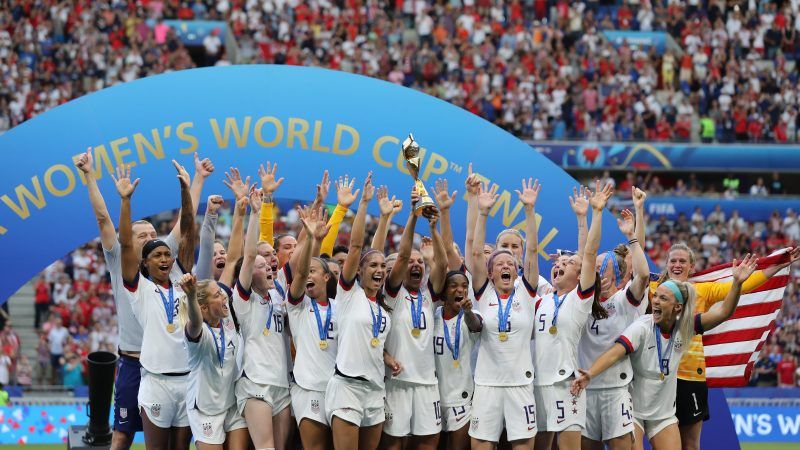
Members of the World Cup champion U.S. Women's National Soccer Team are agitating for better pay—equal to what the men on the U.S. team earn—after winning their second consecutive World Cup and their fourth overall. They were feted with a ticker-tape parade through Manhattan on Wednesday.
If pay exclusively reflected performance, there would be no doubt that Megan Rapinoe, Alex Morgan, Rose LaVelle, Julie Ertz, and the rest of the U.S. women's team deserve far more than what the men earn. The U.S. men's team, you may recall, failed to even qualify for last year's World Cup in Russia, and has not progressed beyond the tournament's quarterfinal round since the inaugural World Cup in 1930.
So it's easy to sympathize with the women's team when they demand better compensation—as they, and their fans, did during the trophy presentation on Sunday morning, shouting "equal pay, equal pay!" Presidential hopefuls have quickly judged which direction the wind is blowing and jumped aboard the cause. Sens. Elizabeth Warren (D–Mass.) and Kamala Harris (D–Calif.) have tweeted their support for equal pay on the soccer pitch, and New York Mayor Bill de Blasio on Wednesday said he would pay female athletes equally if elected president. Hillary Clinton has chimed in.
This debate is not happening only on the campaign trail, in New York's Canyon of Heroes, or on Twitter. The members of the U.S. women's team are suing their employer, the United States Soccer Federation, and the two sides have agreed to mediate the dispute out of court. That is important background for understanding why the women's team is trying to ramp up political and social pressure on the federation.
But, really, the debate over whether the U.S. women's team should be better compensated is about two related and overlapping issues. One is a matter of accounting and the other is about economics—specifically, about the importance of markets and about how workers are harmed when they do not exist.
Writing at Commentary, Christine Rosen dives deeply into the first argument. She notes that last year's American-less World Cup in Russia generated $6 billion in revenue, while the women's event in France this summer is expected to earn about $131 million. As a percentage of total revenue, FIFA (the body that governs international soccer and runs the World Cup) actually pays out larger prizes to the women's teams than to the men.
But what about the pay disparity between the American men's and women's teams, outside of prize money in major tournaments? The Wall Street Journal reports that the U.S. men's and women's teams have generated about the same amount of revenue from games played since 2015, although those totals account for only about half of U.S. Soccer's annual income. Yet, as Rosen again points out, the women's team continues to get shortchanged when it comes to the percentage of the federation's budget spent on "advertising and P.R., travel and training budgets, and…per diems for food."
U.S. Soccer has no good reason to feed the women's team less than the men's, or to make them sleep in subpar accommodations. Those inequalities should be addressed.
Beyond that, though, it's difficult to argue that the pay gap is unfair or sexist. It's largely the result of different pay structures that both teams have collectively bargained with the U.S. Soccer Federation.
Again, Rosen has the best explanation I've seen for the gap:
The women's team collectively bargained for and won a pay structure that guarantees them salaries, severance pay, medical benefits, and some performance-based bonuses. The women's team wanted the security of salary-based pay rather than purely performance-based pay, and they wanted to guarantee a salary even for players who were on the roster but didn't play.By contrast, the men are strictly pay-for-play. They do not receive a salary or additional benefits like health insurance or severance pay. Their pay structure is performance-based.
Because of the different pay structures, a straightforward comparison is difficult. The U.S. women earn a base salary of $100,000 annually, while the men are paid $5,000 per game, with bonuses for winning.
Why would the women agree to a different pay structure? In part, that probably has to do with how much players are earning elsewhere.
Professional soccer players are also paid by privately owned club teams. Megan Rapinoe, for example, plays for Seattle Reign FC, one of nine teams in the National Women's Soccer League (NWSL). Player's salaries in the NWSL range from about $16,000 to $46,000 annually, according to NPR. That's not a lot, and it's certainly less than even the lowest-paid players in Major League Soccer (MLS; the top North American men's pro soccer league), who earn a mandatory minimum salary of $60,000.
That pay gap isn't the result of sexism. It's what the market allows. Major League Soccer teams drew an average of 21,000 fans last year, while NWSL games drew about 6,000. The TV contract MLS has with ESPN and other broadcasters generates $90 million a year. While neither league discloses revenue figures, it's a safe bet MLS earns considerably more—and, thus, its players do too.
If that changes, women's salaries will increase—and, really, that's the best way to make sure your favorite World Cup players earn bigger bucks, as Rapinoe acknowledged during an appearance on Rachel Maddow's show this week.
"Fans can come to games," Rapinoe said. "Obviously, the national team games will be a hot ticket, but we have nine teams in the NWSL. You can go to your league games, you can support that way. You can buy players' jerseys, you can lend support in that way, you can tell your friends about it, you can become season ticket-holders."
She's absolutely right. For all the attention that the World Cup generates, club teams are always going to be where soccer players make their money. And those club teams are beholden to the same rules that govern private businesses everywhere: requiring the Seattle Reign to pay every player as much as the MLS' Seattle Sounders would bankrupt the women's team.
That brings us to the second part of the debate. Part of the problem facing the U.S. women is the fact that there are no markets in international soccer.
What I mean by that is that there is no ability for the U.S. women to demand better treatment by taking their talents elsewhere. Even if a player does qualify to play on multiple national teams (in the event they had parents from two different countries, for example), under FIFA rules she is locked in place once she makes a single appearance on the field for a national team.
Think about it like this: If Rapinoe is unhappy with her contract with Reign FC, she can field offers from the other eight teams in the NWSL. She could even take offers from women's teams in other countries—Sunday's World Cup finale was held in Lyon instead of Paris in part because the local club team, Olympique Lyonnais, has a reputation for paying high salaries to female players and, not surprisingly, attracting the world's top talent.
Even with markets, there would still be obvious financial constraints. The popularity of women's soccer and the revenue generated by individual clubs may not allow teams to offer Rapinoe or Morgan the amount of money those players feel they are worth.
When it comes to dealing with the national federation, though, the players have considerably less leverage. That's why even the most egregious inequalities between the treatment of the U.S. men's and women's teams are difficult to correct.
Above all, it's certainly not wrong for successful employees to demand better compensation, regardless of gender. But because international soccer lacks the market mechanisms that would otherwise help members of the U.S. Women's National Team achieve that goal, they are forced to resort to other, less efficient means. That's why they have to turn this into a public relations issue, and a legal matter.
Lacking any better economic incentive to get the federation to change its behavior, publicly shaming U.S. Soccer over the disparity between how the men's and women's teams are treated might be the best lever for fixing the supposed pay gap.


