09 August, 2021

COVID Stats

A recent CNN article contained some great data to ground discussions regarding public policy related to COVID:

 https://www.cnn.com/2021/07/31/health/fully-vaccinated-people-breakthrough-hospitalization-death/index.html

·         Among fully vaccinated individuals:

o   The likelihood of contracting COVID is less than 1%

o   The hospitalization rate for COVID is .004%

o   The death rate for COVID is .001%

25 July, 2021

Global Warming - Inconvenient Facts

 Another Global Warming Fact Alarmists Want Buried

pxhere.com

The entire climate change movement has been shady from its beginnings. Data have been hidden, truth has been sacrificed to politics, and hypocrisy and personal interests among its “leaders” have produced a giant credibility deficit. The more we learn, the worse the alarmists look.

Take, for instance, a new report that shows greenhouse gas emissions are not an American or Western problem. They are primarily a Chinese problem. A study from Sun Yat-sen University in China found that more than half of the world’s urban greenhouse gas emissions are generated in only 25 big cities, and 23 of them are located in China.

In other words, if the entire developed world cut its greenhouse gas emissions as activists, politicians, journalists, and celebrities have demanded, nothing would change regarding the climate. (This assumes human carbon dioxide emissions are responsible for warming the planet, which is a load of speculation that’s yet to be proved.)

The paper’s findings remind us of the great plastic scare that’s “inspired” lawmakers to outlaw single-use plastic bags, plastic straws, plastic utensils, and other modern products, in a mass pretense of doing something when in reality they’re doing nothing but inconveniencing people.

The data show ​​90% of ocean plastic pours into the sea from “the top 10 rivers with the highest loads” of plastic debris, according to the Helmholtz Centre for Environmental Research in Germany. None are in the U.S., which contributes only about 1% percent of all plastic debris found at sea. Eight of them though are in Asia, while two are in Africa.

While it provides useful information, the Sun Yat-sen study isn’t a shocking revelation. We’ve known for at least a decade that while agitators campaigned to force developed economies to eliminate fossil fuel use, China and India have been busy building hundreds of coal plants in an effort to spread the First World prosperity that the climate alarmists have enjoyed their entire lives. Late last year, the Canadian Energy Centre, affiliated with the Alberta government, reported that as of 2020, 350 coal-fired power plants were under construction worldwide. Seven were in South Korea, another 13 in Japan. But China and India were building 184 and 52 plants, respectively. 

China, which has not lived up to its emissions pledges even as the U.S. has decreased its GHG emissions, “is also building and financing hundreds of other coal-fired power plants in countries such as Turkey, Vietnam, Indonesia, Philippines, Egypt, and Bangladesh.”

A few months after the Canadian report, Yale Environment 360 noted that “despite pledges to cut emissions,” China, responsible for 28% of GHG emissions though it makes up less than 19% of the world’s population, has been “on a coal spree.”

Yet the U.S., and the developed nations of the West, which have zero cities listed among the top 25 greenhouse gas emitters – New York City is 26th – and only eight in the top 50, are the focus of climate activists.

Environmental zealots, more than a few of them elected and appointed officials, are constantly bullying Washington over international emissions agreements that will hurt the U.S. economy; telling Americans they have to live more primitively because they wreck the planet a little every time they consume conventional energy; and that they must make sacrifices for the health of Gaia. The hectoring never ends, the exaggerations never stop, the lies flow freely.

That China is rarely a target of the fanatics tells us a lot: The climate scare is more about pulling down capitalism, weakening the U.S. and other developed nations, cranking out international transfers of wealth, and advancing socialism than it is about saving the world. It’s no coincidence that the countries that are constantly mugged by the alarmists are those whose economic systems are the furthest removed from socialism on the political spectrum. There’s no reason for them to denounce China because it’s already laboring under the system they want to inflict on the world.

It’s a not-so-little secret among the environmental extremists that’s dirtier than Beijing’s polluted skies.

— Written by the I&I Editorial Board

20 June, 2021

Capital Gains Tax Policy

The highlighted portion below is a great example as to why it's appropriate the capital gains tax rate is less than the tax rate of other income. 

Seeing Through the ProPublica Misdirection


Peter P. Copses
Posted: Jun 16, 2021 12:01 AM


The recent ProPublica article claiming new insights into how the wealthy pay little or no income taxes has generated predictable, but uninformed, outrage among those who seek to make the rich pay their so-called “fair share.” But the ProPublica analysis contains logic errors and ignores important concepts built into the tax code.

ProPublica disingenuously compares current taxes paid to income that includes unrealized gains without considering the fact that eventually those gains will be taxed.

There is a difference between deferring taxes and eliminating taxes. A more honest analysis would factor in the present value of the taxes that will eventually be paid. If an individual has accumulated wealth, either he will sell the assets before he dies, in which case he will pay a capital gains tax, or he will die owning the assets in which case he will pay the estate tax, currently 40 percent of the asset’s value. The present value of these taxes has to be included in the numerator of the tax rate calculation if the increase in wealth is included in the denominator.

ProPublica would doubtless counter that these gains are never taxed because of “loopholes” available to the rich such as the arcane step-up in basis at death or charitable giving. Those arguments are specious.

To see this, consider an entrepreneur who founded a business that now has a value of $1 billion. His tax basis is likely close to zero, and if he dies not having sold a share, he will owe a $400 million estate tax (for simplicity, this ignores the $11.7 million exemption, since it is immaterial to the billionaires that ProPublica despises). His heirs should inherit assets with a cost basis of $1 billion because, by paying the estate tax, the entrepreneur has already paid the government its pound of flesh for the increase in value from $0 to $1 billion. Without the step-up in basis or by triggering unrealized gains at death, the $1 billion gain would be taxed at 23.8 percent (ignoring state income taxes, which tax-the-rich crusaders always do) and the gross value of the asset would be taxed at 40 percent resulting in a total tax burden of 63.8 percent. (If the tax on the gain is allowed to be credited in computing the estate tax, this burden would be 54.3 percent.) Most reasonable people would concede that 40 percent of gross assets is more than a “fair share” for anyone to have to pay at death, and that 63.8 percent is excessive. Taxing capital gains at death or eliminating the step-up in basis while continuing to impose the estate tax is double dipping.

It is true that an individual can avoid the estate tax by giving away his wealth to a charitable foundation. But this is hardly scandalous—after all, to avoid the tax the taxpayer actually has to give away billions! In doing so, he is not funding luxurious lifestyles for undeserving heirs, he is making a very rational choice that a private foundation will accomplish more with those assets than a wasteful federal government.

What about ProPublica’s complaint that it is unfair for capital gains to be taxed at a lower rate than the wages paid by normal people? This is a nice sound bite, but it is also disingenuous. The tax on capital gains is asymmetrical—it is based on a “heads the government wins, and tails you lose” proposition. If a taxpayer makes a successful capital investment, he pays tax on the gain, but if it is unsuccessful, he can only deduct the loss against other gains. Furthermore, the longer an asset is held, the larger the component of the gain that is just inflation rather than any real increase in value. For these two good reasons, the tax on capital gains is lower than on ordinary income. If the Progressives had their way, the tax rate on gains would be 43.8 percent (actually, over 50 percent if the average state income tax rate is included) and the tax benefit on losses would be 0 percent. Rational investors would risk less capital under such a regime. That would be a net negative for everyone.

ProPublica claims that the features of the tax code of which it disapproves are not available to ordinary people, but that is also not true. Jeff Bezos was born a very ordinary person as are most entrepreneurs who create tremendous value for others while accumulating enormous wealth for themselves. We should want to live in a society that encourages this. Could you imagine a world with no Amazon, no iPhone, and, yes, even no Twitter? Some will argue that entrepreneurs are motivated by passion not tax rates and these innovations would have been created anyway. That is wishful thinking. While entrepreneurs have a variety of motivations, the investors who finance them care only about after-tax return. ProPublica’s argument that these tax techniques are not available to normal people simply reflect jealousy that not everyone has the talent to create value like Bezos.

There is nothing stopping any American from founding the next Amazon, becoming a billionaire and deferring taxes on the value he creates until he makes a killing selling his company or he dies. I hope it always stays that way.

Peter P. Copses is a retired private equity executive.

23 February, 2021

Data re: White Supremecy

Interesting data compiled by Bill O'Reilly.  Although race-based groups certainly exist, the data does not support the current narrative that white supremacy is common and widespread.

Data from this article:

In 2020, the Department of Justice brought exactly 5 criminal cases against white supremacists.  14 individuals were charged.
 
In 2019, another five cases.  75 people charged. 
 
It’s a similar situation on the state level.  Last year in all 50 states there were only 3 prosecutions tied to “white supremacy.”  9 individuals were charged.  Nine.  In 50 states.
 
In 2019, the number of white racists charged: eight.

21 February, 2021

What's Wrong With The 1619 Project?


Thomas Sowell - Capitalism vs. Government

Great points here from Thomas Sowell.  As relevant now as it was a decade ago.  The private sector (capitalism) is what propels the standard of living forward, not government.  The best way to continue making progress is to allow individuals and businesses to innovate with the minimum regulatory burden possible.  This also extends to taxation - leaving more $$ in the hands of those who produce enables economic expansion and shared prosperity (not to mention avoiding the moral implications of taking from one group to give to another).  I hope you'll take a read...

The Real Public Service


By Dr. Thomas Sowell


May 31, 2010

Every year about this time, big-government liberals stand up in front of college commencement crowds across the country and urge the graduates to do the noblest thing possible— become big-government liberals.

That isn't how they phrase it, of course. Commencement speakers express great reverence for "public service," as distinguished from narrow private "greed." There is usually not the slightest sign of embarrassment at this self-serving celebration of the kinds of careers they have chosen— over and above the careers of others who merely provide us with the food we eat, the homes we live in, the clothes we wear and the medical care that saves our health and our lives.

What I would like to see is someone with the guts to tell those students: Do you want to be of some use and service to your fellow human beings? Then let your fellow human beings tell you what they want— not with words, but by putting their money where their mouth is.

You want to see more people have better housing? Build it! Become a builder or developer— if you can stand the sneers and disdain of your classmates and professors who regard the very words as repulsive.

Would you like to see more things become more affordable to more people? Then figure out more efficient ways of producing things or more efficient ways of getting those things from the producers to the consumers at a lower cost.

That's what a man named Sam Walton did when he created Wal-Mart, a boon to people with modest incomes and a bane to the elite intelligentsia. In the process, Sam Walton became rich. Was that the "greed" that you have heard your classmates and professors denounce so smugly? If so, it has been such "greed" that has repeatedly brought prices down and thereby brought the American standard of living up.

Back at the beginning of the 20th century, only 15 percent of American families had a flush toilet. Not quite one-fourth had running water. Only three percent had electricity and one percent had central heating. Only one American family in a hundred owned an automobile.

By 1970, the vast majority of those American families who were living in poverty had flush toilets, running water and electricity. By the end of the twentieth century, more Americans were connected to the Internet than were connected to a water pipe or a sewage line at the beginning of the century.

More families have air-conditioning today than had electricity then. Today, more than half of all families with incomes below the official poverty line own a car or truck and have a microwave.

This didn't come about because of the politicians, bureaucrats, activists or others in "public service" that you are supposed to admire. No nation ever protested its way from poverty to prosperity or got there through rhetoric or bureaucracies.

It was Thomas Edison who brought us electricity, not the Sierra Club. It was the Wright brothers who got us off the ground, not the Federal Aviation Administration. It was Henry Ford who ended the isolation of millions of Americans by making the automobile affordable, not Ralph Nader.

Those who have helped the poor the most have not been those who have gone around loudly expressing "compassion" for the poor, but those who found ways to make industry more productive and distribution more efficient, so that the poor of today can afford things that the affluent of yesterday could only dream about.

The wonderful places where you are supposed to go to do "public service" are as sheltered from the brutal test of reality as you have been on this campus for the last four— or is it six?— years. In these little cocoons, all that matters is how well you talk the talk. People who go into the marketplace have to walk the walk.

Colleges can teach many valuable skills, but they can also nourish many dangerous illusions. If you really want to be of service to others, then let them decide what is a service by whether they choose to spend their hard-earned money for it.

25 January, 2021

Wisdom from Silent Cal


Great quote here from Calvin Coolidge:

"The wisest and soundest method of solving our tax problem is through economy…The collection of any taxes which are not absolutely required, which do not beyond reasonable doubt contribute to the public welfare, is only a species of legalized larceny. Under this republic the rewards of industry belong to those who earn them. The only constitutional tax is the tax which ministers to public necessity. The property of the country belongs to the people of the country. Their title is absolute. They do not support any privileged class; they do not need to maintain great military forces; they ought not to be burdened with a great array of public employees….

I am opposed to extremely high rates, because they produce little or no revenue, because they are bad for the country, and, finally, because they are wrong." 


Calvin Coolidge’s Inaugural Address Warned of the Dangers of ‘Legalized Larceny’

Calvin Coolidge understood that if government can do something for you, it is only because it can do something to you.

In accordance with longstanding custom, Joe Biden’s first act upon being sworn in as the 46th US President will be to deliver an Inaugural Address. It will likely be longer than the shortest one (George Washington’s 135-word speech in 1793) but mercifully shorter than the longest one (William Henry Harrison’s two-hour, 8,450-word sleeper in 1841).

Most inaugural speeches are fully forgotten but every now and then, a new president coins a memorable term or utters an enduring phrase for the ages. FDR’s “We have nothing to fear but fear itself”; John Kennedy’s “Ask not what your country can do for you, ask what you can do for your country”; and Ronald Reagan’s “Government is not the solution to our problem, government is the problem” come to mind.

Biden is not known for such eloquence. We will find out if his speechwriters are.

In any event, he will deserve a pat on the back if his address is half as good as that of a previous president who wrote his own speeches. That would be our 30th, Calvin Coolidge, whose Inaugural Address on March 4, 1925 was both profound and substantive.

History teaches endless lessons whether people want to learn them or not. Its pages instruct us painfully that the two greatest dangers from government are mission creep and creeps on a mission. The last thing you would ever hear from the lips of Calvin Coolidge were arrogant pretensions to knowledge or grand plans to “fundamentally transform” America. He was smart enough to know what his job was—to “preserve, protect and defend the Constitution,” not to ignore it, shred it or rewrite it.

Coolidge’s appreciation of history and human nature tempered any illusions about government power he ever had. In a political leader, that’s a superlative quality, and a humbling one. It is often swept aside by lesser politicians (the creeps on a mission) who let the moment go to their heads. Our 30th president understood that if government can do something for you, it is only because it can do something to you, that it can get bigger only if you get smaller.

On that chilly March day in 1925, Coolidge noted America’s achievements at the same time he acknowledged they had sprung from a bedrock of principles:

We cannot continue these brilliant successes in the future, unless we continue to learn from the past. It is necessary to keep the former experiences of our country both at home and abroad continually before us, if we are to have any science of government. If we wish to erect new structures, we must have a definite knowledge of the old foundations. We must realize that human nature is about the most constant thing in the universe and that the essentials of human relationship do not change. We must frequently take our bearings from these fixed stars of our political firmament if we expect to hold a true course.

We know what Coolidge’s principles were because he repeated them throughout his public life: Respect for the Constitution; without it, we are at the mercy of whim and power lust. Respect for the highest authority, by which he meant the Creator, not a self-anointed elite or a congressional committee. Respect for the individual, especially his freedom to exercise his abilities and uniqueness in peaceful trade and service to fellow citizens. Long before the Austrian economist F. A. Hayek noted that “The more the State plans, the more difficult planning becomes for the individual,” Coolidge knew it in his gut. To be an American was to love free people, not the State. He cautioned us,

We believe that we can best serve our own country and most successfully discharge our obligations to humanity by continuing to be openly and candidly, intensely and scrupulously, American. If we have any heritage, it has been that. If we have any destiny, we have found it in that direction. But if we wish to continue to be distinctively American, we must continue to make that term comprehensive enough to embrace the legitimate desires of a civilized and enlightened people determined in all their relations to pursue a conscientious and religious life. We cannot permit ourselves to be narrowed and dwarfed by slogans and phrases.

In “progressive” nanny state fashion, Biden will probably tell us he cares for us, that he seeks to help us, that he has a laundry list of proposed spending to prove that he cares and wants to help. Calvin Coolidge also cared for people and wanted to help them, but to him that meant respecting their rights and property. Americans, he declared,

are opposed to waste. They know that extravagance lengthens the hours and diminishes the rewards of their labor. I favor the policy of economy, not because I wish to save money, but because I wish to save people. The men and women of this country who toil are the ones who bear the cost of the Government. Every dollar that we carelessly waste means that their life will be so much the more meager. Every dollar that we prudently save means that their life will be so much the more abundant. Economy is idealism in its most practical form.

Amid record budget deficits and unconscionable debt, perhaps Biden will muster the courage to tell us the till is empty and it’s time to get real about spending. Maybe he will value the lessons of the past as Coolidge did, and tell us that fiscal insanity is the path to bankruptcy and tyranny. What are the chances? The “progressives” in the audience would have a collective heart attack but I would cheer if Biden repeated these words from Coolidge’s Inaugural:

The wisest and soundest method of solving our tax problem is through economy…The collection of any taxes which are not absolutely required, which do not beyond reasonable doubt contribute to the public welfare, is only a species of legalized larceny. Under this republic the rewards of industry belong to those who earn them. The only constitutional tax is the tax which ministers to public necessity. The property of the country belongs to the people of the country. Their title is absolute. They do not support any privileged class; they do not need to maintain great military forces; they ought not to be burdened with a great array of public employees….

I am opposed to extremely high rates, because they produce little or no revenue, because they are bad for the country, and, finally, because they are wrong. We cannot finance the country, we cannot improve social conditions, through any system of injustice, even if we attempt to inflict it upon the rich. Those who suffer the most harm will be the poor. This country believes in prosperity. It is absurd to suppose that it is envious of those who are already prosperous. The wise and correct course to follow in taxation and all other economic legislation is not to destroy those who have already secured success but to create conditions under which everyone will have a better chance to be successful.

By early afternoon of January 20, 2021, we will all know what Joe Biden said in his Inaugural. Did it lift up “we the people” or “they, the government”? Did it empower free men and women or did it empower planners, bureaucrats and spenders to shackle those men and women? Did it do justice or violence to the Constitution? You be the judge, but I personally will be watching to see how Biden’s words measure up to these of Calvin Coolidge:

Those who want their rights respected under the Constitution and the law ought to set the example themselves of observing the Constitution and the law…Those who disregard the rules of society are not exhibiting a superior intelligence, are not promoting freedom and independence, are not following the path of civilization, but are displaying the traits of ignorance, or servitude, of savagery, and treading the way that leads back to the jungle.

17 January, 2021

Falling CO2, Rising Temperatures

It's hard to know the direct relationship between CO2 and the timing of climate warming, but the author makes some interesting points here regarding the fact CO2 has fallen significantly worldwide due to COVID lockdowns, yet temperatures seem unaffected. If we want to 'follow the science', we must also incorporate evidence that leads us in new directions.

Falling CO2 Emissions Expose 'Global Warming' Alarmism As Anti-Science

By David Simon
January 15, 2021

The “experts” that dominate government, big business, universities, and international institutions vitriolically insist that “science” purportedly establishes beyond doubt that carbon dioxide emissions are raising global temperatures and that the warmer earth will be catastrophic.

In 2020, the pandemic-induced shutdowns that inflicted so much economic harm, particularly on the Third World’s already poor, reduced CO2 emissions by a record-breaking 7 percent. Those demanding that Americans reduce emissions must be especially pleased: the U.S. led the world with a 12 percent reduction.

Prevailing scientific orthodoxy dictates that lowering CO2 emissions will restrain global warming. Yet NASA data show that the planet’s temperature increased by 0.03 degrees Celsius in 2020, more than double the average annual increase since 1920.

So much for the supposedly conclusive “scientific” link between CO2 emissions and global warming. Yet demands to reduce CO2 emissions continue unabated. Their insistence that we accept a theory contradicted by facts disregards basic scientific principles, fails to “follow the science,” and instead reflects religious views about the earth’s climate.

The assertion that reducing CO2 emissions will limit the planet’s warming isn’t the worst of the anti-scientific claims that dominate the climate change debate. That honor goes to the assertion that global warming is harmful and will be catastrophic. The scientific evidence contradicts this theory and shows the opposite: a warmer earth is beneficial.

A 2017 statement by some of the world’s most eminent scientists – such as Richard Lindzen of MIT, William Happer and the late Freeman Dyson of Princeton, the late Fred Singer of the University of Virginia, and Judith Curry of Georgia Tech – attests that “[o]bservations [over the last] 25 years … show that warming from increased atmospheric CO2 will be benign.”

Their statement notes that “carbon dioxide … is not a pollutant but a major benefit to agriculture and other life on Earth.” The dry ice used to keep the coronavirus vaccines cool, indeed, is solid frozen CO2.

Perhaps the strongest evidence that global warming is beneficial rather than harmful was published by the British medical journal The Lancet in 2015. This study by 22 scientists from around the world found that cold kills over 17 times more people than heat.

The scientists examined over 74 million deaths in Australia, Brazil, Canada, China, Italy, Japan, South Korea, Spain, Sweden, Taiwan, Thailand, the United Kingdom, and the United States in 1985-2012. They found that cold caused 7.29 percent of these deaths, while heat caused only 0.42 percent.

And small temperature changes are particularly significant. The study found that “moderately hot and cold temperatures” caused 88.85 percent of the temperature-related deaths, while “extreme” temperatures caused only 11.15 percent.

The data also show that global warming over the last one hundred years has neither increased harm from natural disasters nor prevented dramatic economic growth that has lifted billions out of poverty.

Natural disaster data compiled by EM-DAT (The International Disaster Database), indeed, show the opposite: since 1920, as the earth has warmed by 1.29 degrees – and as world population has quadrupled from less than two billion to over seven and half billion – the number of people killed by natural disasters has declined by over 80 percent, from almost 55,000 per year to less than 10,000 per year.

Air pollution data compiled by University of Oxford economist Max Roser and researcher Hannah Ritchie also are encouraging. Since 1990, while the planet’s temperature has risen by 0.57 degrees, the global air pollution death rate has declined by almost 50 percent, from 111.28 to 63.82 deaths per 100,000 people.

The economic data are even more positive. Oxford’s Roser also has reported that since 1920, as planet’s temperature has risen, the share of people living in extreme poverty fell from 67 percent in 1950 to less than 10 percent by 2015.

But what of the supposedly fast approaching catastrophic harm to the world economy? A 2019 National Bureau of Economic Research study suggests that it will be minimal.

Since 1960, as the earth has warmed by 1.05 degrees, global income per person has skyrocketed from $452 to $11,436 in 2019, according to World Bank data compiled by Macrotrends. That reflects a growth rate of over 5.6 percent per year.

If over the next 80 years, global income per person increases at just one fourth of that rate, i.e., at 1.4 percent per year, it will reach $34,778 in 2100.

The 2019 NBER study estimated that if the earth’s temperature rises by 0.01 degrees per year through 2100, world GDP in 2100 will be 1.07 percent lower in 2100 than it would otherwise be. This would reduce income per person from $34,778 to $34,406.

Even NBER’s extreme case projection that world GDP will be 7.22 percent lower in 2100 than it would otherwise be if the planet’s temperature rises by 0.04 degrees per year (over three times the actual rate of increase since 1920) similarly would leave income per person at $32,267.
In other words, regardless of any negative impact that global warming may have, world income per person in 2100 would be about three times today’s level.

The bottom line is that the case to limit CO2 emissions and global warming fails the most basic tests of sound science.

David M. Simon is a senior fellow at the Committee to Unleash Prosperity and a lawyer in Chicago. For more, please see www.dmswritings.com.

18 November, 2020

Tamny: Stable Currency is the Goal

Tamny's point is an obvious one - money is useful only to the degree it facilitates an exchange between two parties. To that end, money should consistency measure and communicate value (like any other unit of measure). You don't want a unit of monetary measure that's constantly changing, and anchoring it to gold is only one of many ways to ensure a stable currency.  

It's Truly Scandalous That Some View Judy Shelton As Controversial

By John Tamny

The rial is no longer Iran’s currency. It was recently replaced by the toman. Why was it replaced? The answer is really simple. Since 1971 the rial has been devalued over 3,500 times. Translated for those who need translation, the rial long ago ceased to function as a currency.

In order for currencies to be broadly circulated, they must be trusted. That’s the case because no one exchanges money when they transact. In truth, they exchange products for other products. Money is just an agreement about value that facilitates the transaction.

The rial ceased to function as a currency precisely because no reasonably sensible provider of goods and services would accept that which was constantly being devalued. In other words, no sane person will hand over real goods and services for money that is exchanging for fewer and fewer goods and services by the day, week, and year.

All of the above is a reminder that when monetary authorities devalue what we call “money,” they’re robbing workers of the fruits of their work. It’s as simple as that. If money is consistently shrinking as a measure exchangeable for goods and services, so is the value of our work. It’s being taken from us. Politicians can shrink our buying power through direct taxation, or they can do so through the tax that is devaluation. Both are cruel levies placed on our work.

That currency devaluation is as old as money is explains better than anything else why Judy Shelton - whose nomination to the Federal Reserve Board was stalled Tuesday by a Senate committee vote - has been such an insightful and muscular voice in favor of credible money for decades. To know Shelton is to know how thoroughly decent she is, and how gracious she is. To know her is to want to be like her. She’s also a very compassionate person. One of the most animating factors of her work over the decades is that she rightly sees currency devaluation as incredibly unjust.

Shelton has long focused on monetary policy because she’s long been horrified by the despicable act of devaluation. In its extreme form, it’s what’s happened in Iran. The Iranians who were paid for their toil in rial saw their life’s work taken from them. Shelton views this as tragic.

Looked at through a dollar lens, U.S. monetary authorities haven’t wrecked the dollar in the way that Iranian authorities have. Evidence supporting the previous assertion is that the dollar is still accepted as “money” around the world. Its global acceptance is a consequence of it having for the most part held its value over the decades.

In Shelton’s case, the “for the most part” when it comes to the dollar’s constancy as a measure of value is what concerns her. Per Adam Smith, the “sole use of money is to circulate consumable goods.” Money should be a stable and forever measure of value. Historically it was. Gold was the market commodity used to anchor money not with the view of limiting the supply of money, but because gold has long been the commodity least affected in price by surges in its supply or demand. Gold has long been the constant, which explains why it’s defined currencies around the world for hundreds, and realistically thousands of years.

Gold-defined money existed as assurance for workers that their immense effort on the job would not be taken from them by stealth. Simple as that.

So while the dollar’s exchange value has never been a Fed function to begin with, and wouldn’t be even if Shelton were Fed Chairman, Shelton has a positive view of gold-defined money precisely because she wants to end the currency devaluations that so cruelly rob innocent workers of the fruits of their work. Translated for those who need it, Shelton’s allegiance isn’t to gold as much as it’s to workers whom she hates to see being shortchanged.

That’s why, assuming a commodity or dollar-issuing method comes along that reveals itself as more price stable than gold, Shelton would logically support that which imbued the dollar with even greater stability. Shelton respects hard work, and stable money as a measure of value is what ensures that effort in the workplace won’t happen in vain.

What’s sad is that Shelton’s views are seen by some as “controversial.” Somehow her tireless support of money that holds its value so that workers get to retain the value of their work has economists in particular up in arms. Notable here is that the Fed is the largest employer of economists in the world. Many inside the central bank view the notion of stable money as improper, or yes, “controversial.” That they don’t share Shelton’s vision of money, one that has been around for millennia, is a happy reminder of what a great addition Shelton will be at the Fed. Her presence will force the economists in its employ out of their comfort zones, and perhaps cause them to reconsider why they reflexively disagree with Shelton about money.

In the process, they might pause to consider what Shelton already knows intimately: there are no companies and no jobs without investment first. And when investors put money to work, they are buying future dollar income streams and future returns in dollars. It’s a reminder that devaluation doesn’t just eviscerate the value of our toil. Indeed, it’s also a tax on the very investment without which work opportunities would be rather limited.

Judy Shelton is pro-worker and also pro-work opportunity. Yet her decades-long support for workers and work opportunities is viewed by some as controversial. That’s truly scandalous. Though yesterday's vote revealed an uphill battle for the nominee, there’s still a chance for Shelton to be confirmed. Republicans need to make it happen.

05 October, 2020

Census Bureau - Median Income by Race

Saw this data recently regarding US median income by race (adjusted for inflation).

Observations:

  • Real median income pre-COVID was highest ever for Asian, Whites, Hispanics, and Black Americans
  • Median incomes for all races changed trajectory (positive) in 2019. Interesting coincidence given passage of the tax-cut in 2018. 


17 September, 2020

Stossel - Expertise has its limits

Great historical context here regarding the gap between what expert models predicted and what actually happened.  Also interesting background regarding the massive failure of models predicting mad cow, swine flu, and avian flu.


02 June, 2020

Protests Turn to Riots

It's been too long since my last post, and it is sad the returning topic must be this one.

Four observations prior to the video below:

  1. The violence portrayed in the video below is shocking and clearly widespread. Why isn't it on every major news source in the country? Avoiding telling the truth about this violence is far beyond 'Fake News' and bias and into something far worse.
  2. Outside of direct and immediate threat of bodily harm and in self-defense, when are any of these violent acts acceptable?  If they are not acceptable, what will it take for societal by-standers to say so?  I don't see much of that on social media these days as everyone falls over themselves to renounce Systemic Oppression. Whether you believe the USA has systemic oppression or not is irrelevant to your stance against mob violence, I would hope. 
  3. Irony alert - we just finished a period where government used its power to forcibly close businesses and suspend rights of assembly and worship in the name of public safety.  Where's that concern for public safety now?  We heard nothing except the need to social distance for months, at the very least shouldn't we be condemning the rioters for putting themselves and others at risk of the COVID-19? Of course that sounds ridiculous, because everything about this is ridiculous. Rioting and violence are not on the same level as failing to maintain #socialdistance, yet so far government seems more motivated to use its powers to limit freedom (even if well intended) than to protect citizens from mobs. 
  4. Is the skin color of criminals relevant to how we prosecute them for the crimes they commit?  I don't care what color you are, I judge you by the ideas you have and the actions you take. 


30 January, 2020

Undoing the Dis-Education of Millennials


Undoing the Dis-Education of Millennials
By Adam J. MacLeod | November 9, 2017, 9:06 EST

I teach in a law school. For several years now my students have been mostly Millennials. Contrary to stereotype, I have found that the vast majority of them want to learn. But true to stereotype, I increasingly find that most of them cannot think, don’t know very much, and are enslaved to their appetites and feelings. Their minds are held hostage in a prison fashioned by elite culture and their undergraduate professors.

They cannot learn until their minds are freed from that prison. This year in my Foundations of Law course for first-year law students, I found my students especially impervious to the ancient wisdom of foundational texts, such as Plato’s Crito and the Code of Hammurabi. Many of them were quick to dismiss unfamiliar ideas as “classist” and “racist,” and thus unable to engage with those ideas on the merits. So, a couple of weeks into the semester, I decided to lay down some ground rules. I gave them these rules just before beginning our annual unit on legal reasoning.

Here is the speech I gave them.

********************************

Before I can teach you how to reason, I must first teach you how to rid yourself of unreason. For many of you have not yet been educated. You have been dis-educated. To put it bluntly, you have been indoctrinated. Before you learn how to think you must first learn how to stop unthinking.

Reasoning requires you to understand truth claims, even truth claims that you think are false or bad or just icky. Most of you have been taught to label things with various “isms” which prevent you from understanding claims you find uncomfortable or difficult.

Reasoning requires correct judgment. Judgment involves making distinctions, discriminating. Most of you have been taught how to avoid critical, evaluative judgments by appealing to simplistic terms such as “diversity” and “equality.”

Reasoning requires you to understand the difference between true and false. And reasoning requires coherence and logic. Most of you have been taught to embrace incoherence and illogic. You have learned to associate truth with your subjective feelings, which are neither true nor false but only yours, and which are constantly changeful.

We will have to pull out all of the weeds in your mind as we come across them. Unfortunately, your mind is full of weeds, and this will be a very painful experience. But it is strictly necessary if anything useful, good, and fruitful is to be planted in your head.

There is no formula for this. Each of you has different weeds, and so we will need to take this on the case-by-case basis. But there are a few weeds that infect nearly all of your brains. So I am going to pull them out now.

First, except when describing an ideology, you are not to use a word that ends in “ism.” Communism, socialism, Nazism, and capitalism are established concepts in history and the social sciences, and those terms can often be used fruitfully to gain knowledge and promote understanding. “Classism,” “sexism,” “materialism,” “cisgenderism,” and (yes) even racism are generally not used as meaningful or productive terms, at least as you have been taught to use them. Most of the time, they do not promote understanding.

In fact, “isms” prevent you from learning. You have been taught to slap an “ism” on things that you do not understand, or that make you feel uncomfortable, or that make you uncomfortable because you do not understand them. But slapping a label on the box without first opening the box and examining its contents is a form of cheating. Worse, it prevents you from discovering the treasures hidden inside the box. For example, when we discussed the Code of Hammurabi, some of you wanted to slap labels on what you read which enabled you to convince yourself that you had nothing to learn from ancient Babylonians. But when we peeled off the labels and looked carefully inside the box, we discovered several surprising truths. In fact, we discovered that Hammurabi still has a lot to teach us today.

One of the falsehoods that has been stuffed into your brain and pounded into place is that moral knowledge progresses inevitably, such that later generations are morally and intellectually superior to earlier generations, and that the older the source the more morally suspect that source is. There is a term for that. It is called chronological snobbery. Or, to use a term that you might understand more easily, “ageism.”

Second, you have been taught to resort to two moral values above all others, diversity and equality. These are important values if properly understood. But the way most of you have been taught to understand them makes you irrational, unreasoning. For you have been taught that we must have as much diversity as possible and that equality means that everyone must be made equal. But equal simply means the same. To say that 2+2 equals 4 is to say that 2+2 is numerically the same as four. And diversity simply means difference. So when you say that we should have diversity and equality you are saying we should have difference and sameness. That is incoherent, by itself. Two things cannot be different and the same at the same time in the same way.

Furthermore, diversity and equality are not the most important values. In fact, neither diversity nor equality is valuable at all in its own right. Some diversity is bad. For example, if slavery is inherently wrong, as I suspect we all think it is, then a diversity of views about the morality of slavery is worse than complete agreement that slavery is wrong.

Similarly, equality is not to be desired for its own sake. Nobody is equal in all respects. We are all different, which is to say that we are all not the same, which is to say that we are unequal in many ways. And that is generally a good thing. But it is not always a good thing (see the previous remarks about diversity).

Related to this: You do you not know what the word “fair” means. It does not just mean equality. Nor does it mean something you do not like. For now, you will have to take my word for this. But we will examine fairness from time to time throughout this semester.

Third, you should not bother to tell us how you feel about a topic. Tell us what you think about it. If you can’t think yet, that’s O.K.. Tell us what Aristotle thinks, or Hammurabi thinks, or H.L.A. Hart thinks. Borrow opinions from those whose opinions are worth considering. As Aristotle teaches us in the reading for today, men and women who are enslaved to the passions, who never rise above their animal natures by practicing the virtues, do not have worthwhile opinions. Only the person who exercises practical reason and attains practical wisdom knows how first to live his life, then to order his household, and finally, when he is sufficiently wise and mature, to venture opinions on how to bring order to the political community.

One of my goals for you this semester is that each of you will encounter at least one idea that you find disagreeable and that you will achieve genuine disagreement with that idea. I need to explain what I mean by that because many of you have never been taught how to disagree.

Disagreement is not expressing one’s disapproval of something or expressing that something makes you feel bad or icky. To really disagree with someone’s idea or opinion, you must first understand that idea or opinion. When Socrates tells you that a good life is better than a life in exile you can neither agree nor disagree with that claim without first understanding what he means by “good life” and why he thinks running away from Athens would be unjust. Similarly, if someone expresses a view about abortion, and you do not first take the time to understand what the view is and why the person thinks the view is true, then you cannot disagree with the view, much less reason with that person. You might take offense. You might feel bad that someone holds that view. But you are not reasoning unless you are engaging the merits of the argument, just as Socrates engaged with Crito’s argument that he should flee from Athens.

So, here are three ground rules for the rest of the semester.

1. The only “ism” I ever want to come out your mouth is a syllogism. If I catch you using an “ism” or its analogous “ist” — racist, classist, etc. — then you will not be permitted to continue speaking until you have first identified which “ism” you are guilty of at that very moment. You are not allowed to fault others for being biased or privileged until you have first identified and examined your own biases and privileges.

2. If I catch you this semester using the words “fair,” “diversity,” or “equality,” or a variation on those terms, and you do not stop immediately to explain what you mean, you will lose your privilege to express any further opinions in class until you first demonstrate that you understand three things about the view that you are criticizing.

3. If you ever begin a statement with the words “I feel,” before continuing you must cluck like a chicken or make some other suitable animal sound.

********************************

To their credit, the students received the speech well. And so far this semester, only two students have been required to cluck like chickens.


Adam J. MacLeod is an associate professor of law at Jones School of Law at Faulkner University in Montgomery, Alabama.

26 November, 2019

Twenty Crazy Beliefs on Economics and Politics


Excellent questions posed here...

Twenty Crazy Beliefs on Economics and Politics

Donald J. Boudreaux – November 25, 2019
 
1. Why do so many American Progressives, fearing that rich people abuse state power, aim to reduce the riches of rich people, instead of the state power that Progressives admit is subject to being abused?

2. Why do so many American Progressives wish to put even larger swathes of our lives under political control given their belief that politics is so very easily corrupted by oligarchs and big-money donors?

3. Why do so many American Progressives – fearful of corporate power and understandably dismayed by cronyism – support tariffs and export subsidies (such as those dispensed by the U.S. Export-Import Bank)? After all, each tariff and every cent of subsidy is an unearned privilege granted by government to corporations at the expense of consumers, workers, and households – a privilege that creates corporate power and fuels abuse by corporations that would otherwise not arise.

4. Why do so many American Progressives, with one breath, criticize free-market economists for allegedly failing to take account of the immense importance that we humans attach to community, cultural identity, and other non-monetary values and features of our existence, and yet with the next breath talk as if the only inequality that matters is inequality of monetary incomes or wealth? (That this “Progressives” criticism of free-market economists is baseless is a subject for another day.)

5. And why do so many American Progressives, given their correct understanding that monetary values are not all that matter, treat differences in monetary incomes and wealth as sure evidence of economic malfunction?

6. Why do so many American Progressives believe that ordinary Americans are far too incompetent to choose for themselves, each individually, the appropriate levels of safety for their automobiles, workplaces, and pharmaceutical products, but supremely competent to choose which political ‘leaders’ are best for the entire country?

7. Why do so many American Progressives revile business people who seek greater wealth by succeeding in commerce, yet revere politicians who seek greater power by succeeding in politics?

8. Why do so many Americans Progressives hurl accusations of “greed” at private citizens who wish only to keep for themselves more of the money that they’ve earned, yet celebrate as selfless and noble politicians who wish to take from private citizens money that these politicians did not earn?

9. Why do so many American Progressives tout the alleged virtues of locally “sourced” foods and of locally produced goods while incessantly pushing for more and more power over individuals and locales to be exercised in far-away state capitals and in even farther away Washington, DC.?

10. Why do large numbers of American conservatives believe that U.S. government tax hikes and other interventions into the American economy are ham-fisted and, hence, harmful to the American economy, yet believe that similar interventions by foreign governments into foreign economies are genius surgical operations that inevitably strengthen those foreign economies?

11. Why do these very same conservatives also believe that the U.S. government somehow becomes capable of intervening successfully into the American economy if such intervention is advertised as being a response to foreign-government interventions into foreign economies?

12. Why do large numbers of American conservatives oppose taxes but support tariffs? Are these conservatives unaware that the latter is simply one of many different species of taxes?

13. Why do so many American conservatives boast about the strength of America and the resilience and greatness of her people but insist also that to allow these same American people to freely purchase goods and services supplied by low-productivity (and, thus, low-wage) foreign workers paves a sure path to America’s impoverishment and demise?

14. Why do so many Americans across most of the ideological space think they are offering sound and operational advice when they tell someone who is unhappy with existing government policies to “change” these policies by going to the polls to vote?

15. Why do so many Americans across most of the ideological space equate freedom with democracy? Do these Americans not see that oppression by a majority of one’s fellow citizens is oppression no less than is oppression by a minority of one’s fellow citizens?

16. Why do so many Americans, across most of the ideological space, who have ever waited in a line at the Department of Motor Vehicles to renew a driver’s license or to register a vehicle, or who have suffered long delays in a cavernous passport-control room to reenter the country after traveling abroad, want to turn over to the same institution that is responsible for the inefficiencies regularly on display in those government offices more control over our lives?

17. Why does not every American who has ever listened to a speech by a successful 21st century politician, or who has ever attended or tuned in to a “debate” among these office-seekers, come away from such an experience filled with terrible fear at the thought of any of these office-seekers exercising even the tiniest bit of say in the lives of ordinary Americans?

18 Why do so few American conservatives who were rightly appalled by Barack Obama’s performance in the Oval Office – and who rightly fear how that office would be abused by a President Elizabeth Warren or Joe Biden – wish to reduce the power of the presidency?

19 And why do so few American Progressives who are rightly appalled by Donald Trump’s performance in the Oval Office – and who rightly fear an additional four years of Trump’s abuse of that office – wish to reduce the power of the presidency?

20. Why does the goal of restraining the power of government in all areas of life have so little political clout given that confidence in government is at historic lows?

13 November, 2019

A ‘Wealth Tax’ is a Morally Evil Policy Proposition


A ‘Wealth Tax’ is a Morally Evil Policy Proposition
By William Sullivan

The late Dr. Charles Krauthammer wrote in 2002 that to “understand the workings of American politics, you have to understand this fundamental law: Conservatives think liberals are stupid. Liberals think conservatives are evil.” But many of today’s leftist policy propositions are not only practically stupid, but morally evil.

Consider that Bill Gates has come under fire for appearing skeptical of Senator Elizabeth Warren’s new “wealth tax.” For example, Anand Giridharadas, editor at large of TIME magazine, recently tweeted:

Astonishing.

@BillGates, the great philanthropist of our age, is so attached to his own wealth that he refuses to rule out voting to re-elect a white nationalist demagogue over Elizabeth Warren. 


It should be noted that Giridharadas is making a moral argument here, not a practical one. By not supporting Elizabeth Warren’s policy proposal to confiscate an arbitrary percentage of his wealth for the workings of government, Gates is not only advancing “white nationalism,” but he’s somehow morally suspect as an actual “philanthropist.”

Contrary to Anand Giridharadas’ claim, however, what is truly “astonishing” is how anyone can make an argument suggesting that Bill Gates is not philanthropic with a straight face. “Gates is among a group of billionaire philanthropists who have said that they would give away at least half of their wealth to charities under terms of the Giving Pledge,” writes Mark Decambre of Market Watch.

Note the words employed in that sentence. “Philanthropists.” “Give.” “Charities.” “Pledge.” Each and every one of them requires an individual action which is voluntary. Bill Gates is willing to give half his wealth to vetted charities of his choosing, and I don’t think that anyone could argue that such a pledge is not morally admirable. What he seems less willing to do is give the government license to forcibly confiscate his property at arbitrary and ever-changing levels, as it deems appropriate ongoing, to serve the purposes of government.

Gates made a statement that he didn’t think that Elizabeth Warren would like to speak with people like him on the matter, prompting Warren to say that she’d love to sit down with him about her “wealth tax” proposal. “I promise, it won’t be $100 billion,” of his estimated $107 billion net worth, she tweeted.

Bernie Sanders, the millionaire politician from Vermont who once honeymooned in the Soviet Union and espoused the economic virtues of governmental “bread lines,” apparently felt that Warren isn’t going far enough. “Say Bill Gates was taxed $100 billion,” Sanders tweeted. “We could end homelessness and provide safe drinking water to everyone in this country.”

So why shouldn’t the government steal $100 billion of his wealth? That seems to be the argument.

It’s easy to point out the practical failings in such arguments as Bernie’s.

Bill Gates claims he’s paid over $10 billion in taxes, and I have no reason to believe that’s untrue. If the government seizes $100 billion of his wealth and spends it today, then that’s it. He’d be a turnip with little else to bleed for such grand political schemes. But Bill Gates has earned his wealth through decades of unprecedentedly successful entrepreneurship and investment, and he’s proven that he’s far better with his own money than the government has been with ours.

If you need proof of the silliness in Bernie’s claim, consider that, this year alone, the federal government will confiscate from its citizens roughly 37 times the amount that Bernie Sanders argues could cure homelessness forever. And lack of sufficient revenue isn’t stopping additional spending beyond receipts, mind you. That same government will spend roughly 47 times that amount this year. So, we’re incurring debt of $1 trillion in an annual budget deficit, or ten times what Sanders says we need to cure homelessness and provide safe water to everyone. Why wasn’t America’s problem with homelessness and unclean water cured long ago, if simply having the government throw a hundred billion of other people’s dollars at any given problem is some kind of social and fiscal cure-all that no one’s thought of before?

Of course, any sane person knows that what Sanders is arguing is nonsense, in a practical sense. Any sane person knows that the federal government doesn’t have an income problem, but a resource allocation and a spending problem. But it’s compelling for many that he’s speaking to, nonetheless, because the practicality of his “solution” isn’t the point.

He’s making a moral argument that Bill Gates shouldn’t have as much money as he does. That’s the real problem that he’s looking to “solve,” and he’s proven that. The stated goal of his aggressive plan, called “The Tax on Extreme Wealth,” is literally to “cut the wealth of billionaires in half over fifteen years.” “I don’t think billionaires should exist,” Bernie says.

That is the true ideological impulse driving socialism, and it should be the most glaring problem with it. The obvious goal is to tear down successful individuals, not to empower the less-successful masses.

It’s not that socialist leaders like Bernie Sanders, a lifelong rabble-rouser who has never created any jobs or wealth without taxpayer funding, don’t have a clue what they’re talking about when it comes to the broad economics or practical outcomes of these Marxist policy propositions like the “wealth tax.” It’s that, in their immoral pride and lust for power, they stoke envy among the populace, nurturing and courting a growing gaggle of envious grumblers who, in turn, seek only to outsource their chosen moral depravity to government enforcers who may “equalize” economic outcomes by robbing others of their property.

Unmistakably, there is an eternal moral difference between Bill Gates pledging his own wealth to provide for the public good via charitable institutions, and Elizabeth Warren and Bernie Sanders telling you that they will confiscate his wealth in order to provide “charity” for others via government redistribution. The moral argument as to why one is morally righteous and the other is morally evil really couldn’t be simpler, and we never have to look at a single number to understand why.

Consider, for example, a circumstance where I donate my car to a fellow less fortunate than me. I am charitably pledging my property to benefit someone else. That is a culturally understood to be a positive moral decision that I was free to make. It is that freedom to choose which makes such a decision morally “good.”

If, on the other hand, someone takes my car against my will so that he might use it as he sees fit, it is equally well-understood to be a criminal act. It doesn’t matter if that someone steals my car so that someone else might use it, because it would not change the fact that my property was stolen from me. It’s still theft. And if every single one of my neighbors decides that the neighborhood association should confiscate my car so that it can be used by others in the neighborhood, I would thankfully enjoy the legal protection of my property. However, even if that association were able to exercise its power by stealing my car so that others might use it, the moral dynamic of the circumstance remains unchanged, because the element of my freedom to choose what to do with my property is never considered.

Okay. Save a few outliers who may harbor some peculiar notions about morality, we should all be able to agree that all of that is true. So, here’s the question. What if that car is one of fifty, a hundred, or a thousand cars that I own? In what way does that change the fundamental moral dynamic involved? And if it does, in your estimation, then why? Should I not be afforded the same rights to property that another might have who owns less property than I?

I should be so protected, in a culture where genuine morality is intact and individual rights are equally applied. So should Bill Gates, and any other American citizen. However popular the unconstitutional notion of a “wealth tax” may become, it will never be anything more or less than a morally depraved and evil proposition which can only serve to erode Americans’ property rights.

08 October, 2019

Median Incomes Surge under Trump

But wait, I thought tax cuts and Trump's handling of the economy were harmful to everyone but the very wealthy.

Might have to re-think that...

Democrats are wrong. Middle-class incomes surging – thanks to Trump policies
By Steve Moore | Fox News

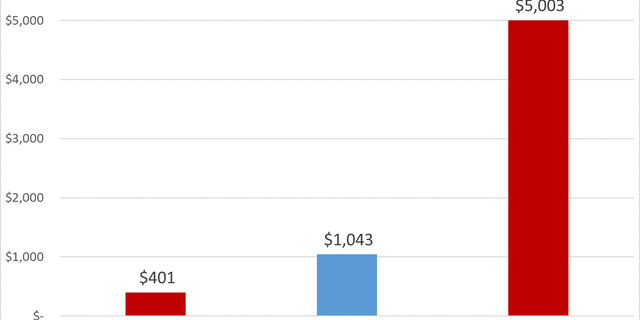
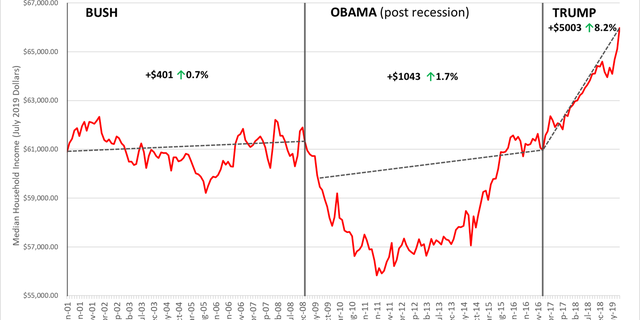
The latest Census Bureau Current Population Survey data now show that middle-class incomes, after adjusting for inflation, have surged by $5,003 since Donald Trump became president in January 2017. Median household income has now reached $65,976 – an all-time high and up more than 8 percent in 2019 dollars under the Trump presidency.

This data was compiled by the statisticians at Sentier Research, an economic research group whose founders have more than 30 years of experience at the Census Bureau in analyzing the monthly income numbers.


I reported last week in the Wall Street Journal that real median family income had soared by $4,146 under Trump through July 2019. The just-released August numbers from Sentier show a huge monthly gain of $857 in income per household.

These numbers contrast sharply with the 16 years prior to Trump’s presidency. In the eight years that George W. Bush was president, median income barely showed any gain, up just $401 thanks to the deep recession of 2008.

In the seven and a half years that Barack Obama was president, and not including the end of the recession, which Obama inherited, incomes inched up by $1,043 (June 2009 – January 2019). This means that in the 16 years before the Trump presidency, incomes rose by about $1,500 while in less than three years middle incomes have risen three times faster.


The contrast is even sharper when measured on a monthy basis. The monthly rise in incomes under Bush was $4. That number was $11 under Obama and $161 under Trump.

These income numbers are PRE-TAX, so they do NOT include the impact of the Trump tax cut. The Heritage Foundation estimates that the average household has saved $1,400 a year on their federal taxes from the 2017 Trump tax cut. This means many working-class families now have a $6,000 higher after-tax, and after-inflation paycheck today.

These surges in income, especially in the last several months, have occurred at exactly the time when many liberal economists and media talking heads were shouting “recession.” In reality middle-class families were enjoying a near-unprecedented income windfall and “the gains in income levels in recent months,” Sentier reports, “have been accelerating.“


These surges in income, especially in the last several months, have occurred at exactly the time when many liberal economists and media talking heads were shouting “recession.”

These higher wage and salary incomes are no doubt related to the very tight labor market, which has given workers new bargaining power to ask for higher pay. Today there are more than seven million unfilled jobs in America – the highest number of surplus jobs in American history.

These latest income numbers also squarely contradict the claims by Democratic presidential candidates, such as former Vice President Joe Biden and Sens. Elizabeth Warren and Bernie Sanders, who claim that all the gains from the Trump economy have gone to the rich and large corporations. Warren claimed earlier this year that workers had to work "two or three or four jobs" just to keep their incomes from falling.

No, this has been one of the biggest middle-class success stories in modern times, and it is a testament to the success of the Trump tax, regulatory and energy policies.